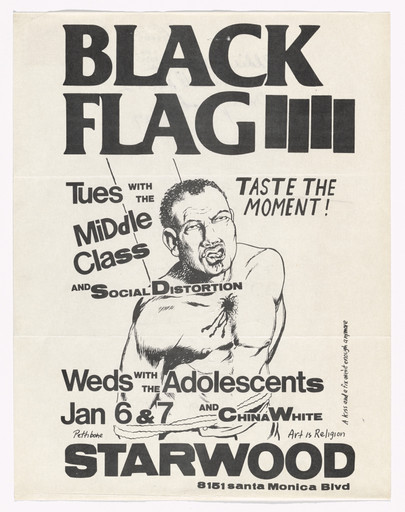
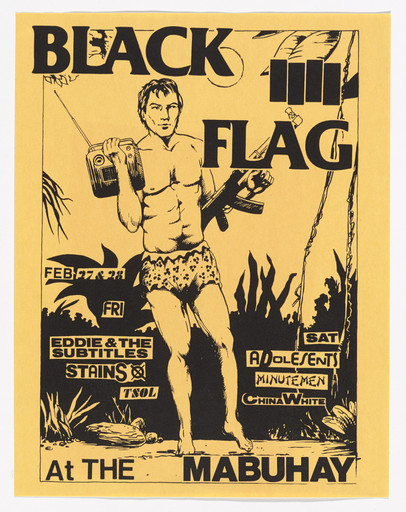
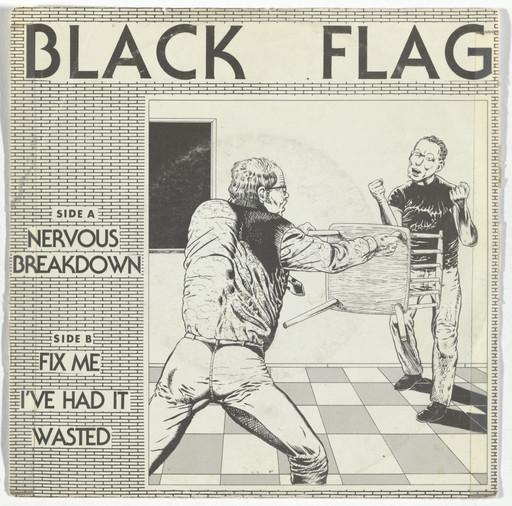
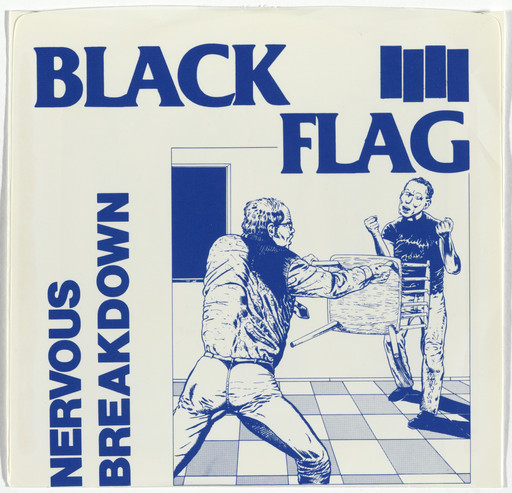
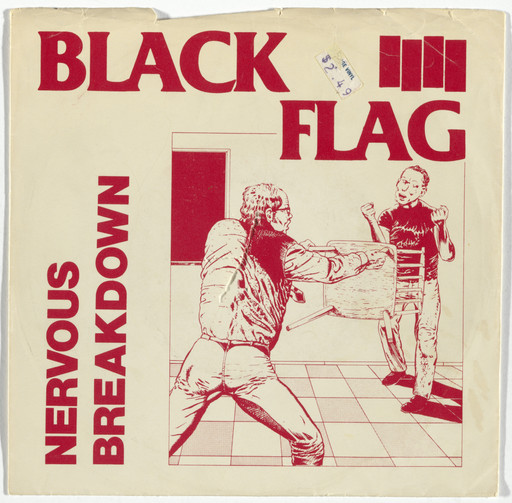
Raymond Pettibon's darkly poetic work takes the form of pen-and-ink drawings incorporating brief handwritten texts. He started as an artist by designing album covers for his brother's punk rock band Black Flag in the late 1970s. In 1978 he began making photocopied compilations of his drawings as books, with more than one hundred titles issued to date. An underground figure for many years before he received art-world attention in the early 1990s, Pettibon originally sold these books in comic-book and record stores in his hometown of Los Angeles.
Pettibon's style developed initially from cartoons, although he has also named Francisco Goya and William Blake as influences. His imagery refers to various American cultural archetypes such as surfers, G.I.s in Vietnam, and baseball players, as well as specific figures such as Charles Manson, John F. Kennedy, and Batman. Pettibon's texts are often fragments from his favorite authors, including Henry James, Marcel Proust, and William Faulkner, among many others, taken out of context and sometimes altered. Unconnected in any straightforward way, the texts resonate with the images to suggest complex, ambiguous, and often amusing readings and a sensibility that moves from the lyrical to the sardonic. Pettibon's voice rises from the dark side of American culture, reflecting sources in detective fiction, the tabloid press, and film noir.
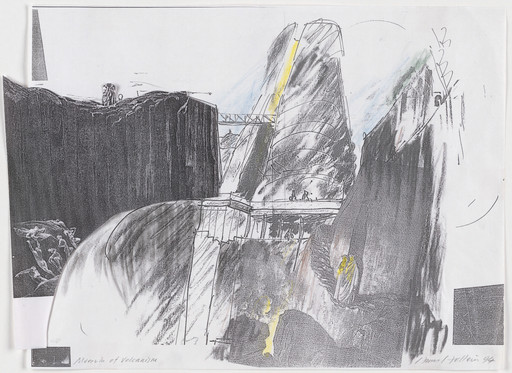
Lithography has become a natural extension of Pettibon's drawing practice. Since the late 1990s, he has collaborated extensively with Hamilton Press in Venice, California, and has also made prints in conjunction with exhibitions of his drawings at the Kunsthalle in Kiel, Germany (1998), and the Philadelphia Museum of Art (1999). Pettibon worked on the lithographs for the book Plots on Loan, for over seven years. Its large format on thick archival paper monumentalizes the ephemeral nature of the earlier Xerox booklets.
an essay by Starr Figura, in Deborah Wye, Artists and Prints: Masterworks from The Museum of Modern Art, New York: The Museum of Modern Art, 2004, p. 249.
Explore more
From MoMA Design Store


Installation views
We have identified this work in the following photos from our exhibition history.
Licensing
Artwork or archival images
If you would like to reproduce an image of a work of art in MoMA's collection, or an image of a MoMA publication or archival material (including installation views, checklists, and press releases), please contact Art Resource (publication in North America) or Scala Archives (publication in all other geographic locations).
Audio and film clips
MoMA licenses archival audio and select out of copyright film clips from our film collection. At this time, MoMA produced video cannot be licensed by MoMA/Scala. All requests to license archival audio or out of copyright film clips should be addressed to Scala Archives at [email protected]. Motion picture film stills cannot be licensed by MoMA/Scala. For access to motion picture film stills for research purposes, please contact the Film Study Center at [email protected]. For more information about film loans and our Circulating Film and Video Library, please visit Circulating Film and Video Library.
Text from a publication or the archives
If you would like to reproduce text from a MoMA publication, please email [email protected]. If you would like to publish text from MoMA's archival materials, please fill out this permission form and send to [email protected].
Feedback
This record is a work in progress. If you have additional information or spotted an error, please fill out this feedback form.