Painted papier-mâché demisphere fitted on velvet-covered disk, copper collar with plexiglass dome, motor, pulley, and metal stand
Not on view
Duchamp fabricated Rotary Demisphere as a commission for the collector Jacques Doucet and with the assistance of a mechanic. The device’s papier-mâché half-sphere is housed under a plexiglass dome fitted to a disk covered in dark velvet, and the entirety is mounted on a motorized stand. When the machine is set in motion, the dome appears to pulsate hypnotically, projecting and receding in illusory space. Engraved on a copper ring around the dome’s circumference is a tongue-twisting sentence that, as Duchamp noted, “will make the object look curious even when still.”
Marcel Duchamp, April 12–August 22, 2026
Gallery label from 2024
Rotary Demisphere is one of several works in which Duchamp experimented with mechanisms that produce optical effects. When set in motion, the circles appear to pulsate. The copper ring around the dome’s circumference is engraved with French words whose sounds echo one another: Rrose Sélavy et moi esquivons les ecchymoses des esquimaux aux mots exquis, in English, “Rrose Sélavy and I dodge the Eskimos’ bruises with exquisite words” (Eskimo is a now outdated term referring to Indigenous peoples from the Arctic). Rrose Sélavy is a persona that Duchamp debuted in 1920 as part of his broader investigation of identity, authorship, and the boundaries of conventional art.
2024
Explore more
Marcel Duchamp
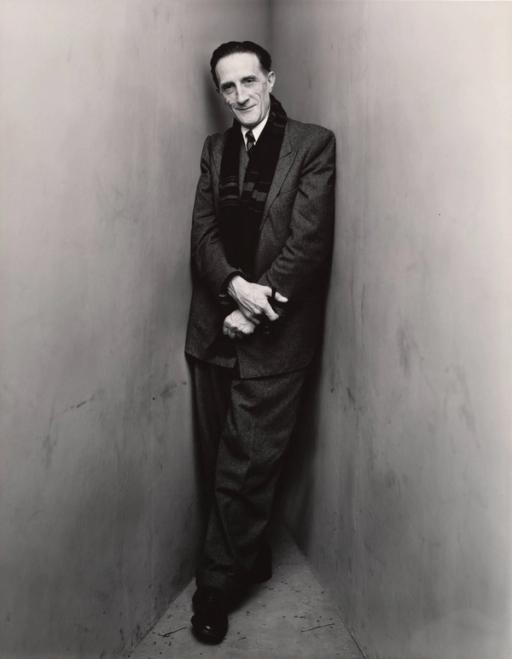
American, born France. 1887–1968 190 works onlineWhen Marcel Duchamp created his most famous work—the industrially produced urinal Fountain —it was largely ignored. Fountain was the high point of Duchamp’s campaign to dismantle and expand the boundaries of what constitutes a work of art; it had begun four years earlier, when he asked, “Can one make works that are not ‘of art’?
Learn more →

Audio
Audio from the playlist Inventing Abstraction, 1910–1925
From MoMA Design Store


Installation views
We have identified this work in the following photos from our exhibition history.
Provenance Research Project
This work is included in the Provenance Research Project, which investigates the ownership history of works in MoMA's collection.
Jacques Doucet (1853-1929), Paris/Neuilly [1]; by inheritance to Jeanne Roger-Doucet (Jacques Doucet's widow), Neuilly, 1929; given to Henri-Pierre Roché (1879-1959), Paris, 1930 [2]; by inheritance to Denise Roché (Henri-Pierre Roché's widow), Paris, 1959-c. 1961 [3]; Cordier & Ekstrom, New York; sold to Mary Sisler, New York, 1963 [4]; The Museum of Modern Art, New York (Gift of Mrs. William Sisler and Edward James Fund), 1970.
[1] Commissioned in 1924. See Schwarz 1997, no. 409.
[2] Scarlett et Philippe Reliquet, Henri-Pierre Roché: l'enchanteur collectionneur, Paris: Ramsay, 1999, pp. 201-02. Calvin Tomkins, Duchamp: A Biography, New York: Henry Holt, 1997, p. 295.
[3] Francis Naumann, Marcel Duchamp: The Art of Making Art in the Age of Mechanical Reproduction, Ghent and Amsterdam: Ludion Press, 1999, p. 214.
[4] Mary and William Sisler Papers, II.4. The Museum of Modern Art Archives, New York. Included in the exhibition Not Seen and/or Less Seen of/by Marcel Duchamp/Rrose Sélavy, 1904-1964. Mary Sisler Collection, Cordier & Ekstrom, New York, January 14-February 13, 1965 (no. 75).
Provenance research is a work in progress, and is frequently updated with new information. If you have any questions or information to provide about the listed works, please email [email protected] or write to:
Provenance Research Project
The Museum of Modern Art
11 West 53 Street
New York, NY 10019
Licensing
Artwork or archival images
If you would like to reproduce an image of a work of art in MoMA's collection, or an image of a MoMA publication or archival material (including installation views, checklists, and press releases), please contact Art Resource (publication in North America) or Scala Archives (publication in all other geographic locations).
Audio and film clips
MoMA licenses archival audio and select out of copyright film clips from our film collection. At this time, MoMA produced video cannot be licensed by MoMA/Scala. All requests to license archival audio or out of copyright film clips should be addressed to Scala Archives at [email protected]. Motion picture film stills cannot be licensed by MoMA/Scala. For access to motion picture film stills for research purposes, please contact the Film Study Center at [email protected]. For more information about film loans and our Circulating Film and Video Library, please visit Circulating Film and Video Library.
Text from a publication or the archives
If you would like to reproduce text from a MoMA publication, please email [email protected]. If you would like to publish text from MoMA's archival materials, please fill out this permission form and send to [email protected].
Feedback
This record is a work in progress. If you have additional information or spotted an error, please fill out this feedback form.