Miniature French window with panes of glass covered with black leather, painted wood frame, and plastic push pins
Not on view
Constructed by a carpenter in accordance with Marcel Duchamp’s instructions, Fresh Widow is a small version of the double doors commonly called a French window. Duchamp was fascinated by themes of sight and perception; here, the expectation of a view through windowpanes is thwarted by opaque black leather, which Duchamp insisted “be shined everyday like shoes.” Windows had an important place in the artist’s work. He stated, “I used the idea of the window to take a point of departure, as…I used a brush, or I used a form, a specific form of expression…. I could have made 20 windows with a different idea in each one….”
Puns and wordplay were also central to Duchamp’s work. By changing a few letters, Duchamp transforms “French window”—which the work resembles in form—into “Fresh Widow,” a reference to the recent abundance of widows of World War I fighters.
Gallery label from 2006.
This is a small replica of a traditional French window. The glass panes are covered with black leather that Duchamp insisted "should be shined every day like shoes." With the inscription along the base, Duchamp turned an inanimate French window into an anthropomorphic "Fresh Widow," which was, he felt, "an obvious enough pun."
2006.
Gallery label from Dada , June 18–September 11, 2006.
Constructed by a carpenter in accordance with Duchamp's instructions, Fresh Widow is a reduced scale version of the traditional floor-length French window. Duchamp covered the glass panes with panels of black leather, obstructing the metaphorical view through the window that is associated with illusionistic painting. With the change of three letters, Duchamp transforms "French window" into the title "Fresh Widow," a pun that points to the recent war and the bawdy tradition of amorous (or "fresh") widows of soldiers. The inscription at the base, "COPYRIGHT ROSE SELAVY 1920," is the first time the name of Duchamp's female alter ego appears on one of his works.
Dada, June 18–September 11, 2006.
Explore more
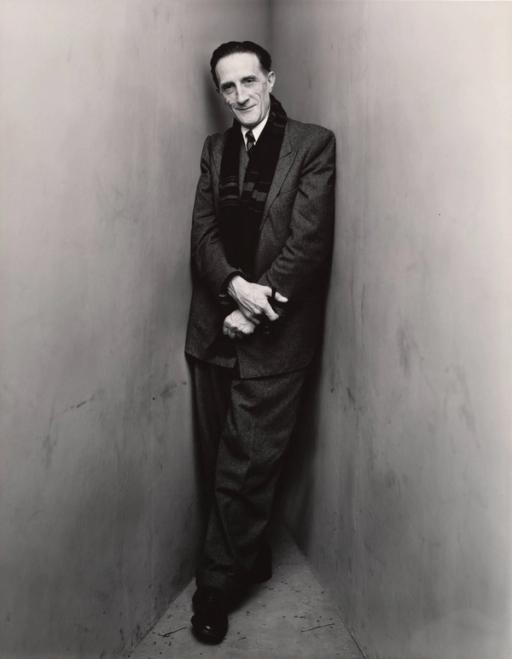
Marcel Duchamp
American, born France. 1887–1968 190 works onlineWhen Marcel Duchamp created his most famous work—the industrially produced urinal Fountain —it was largely ignored. Fountain was the high point of Duchamp’s campaign to dismantle and expand the boundaries of what constitutes a work of art; it had begun four years earlier, when he asked, “Can one make works that are not ‘of art’?
Learn more →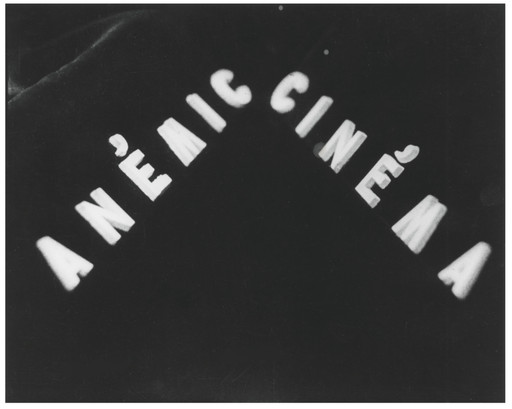
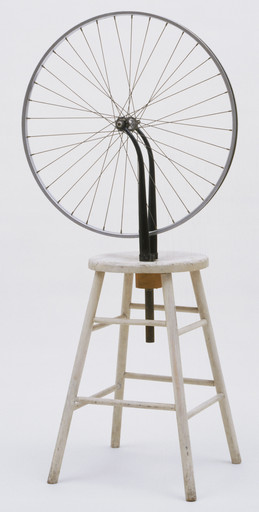
Readymade
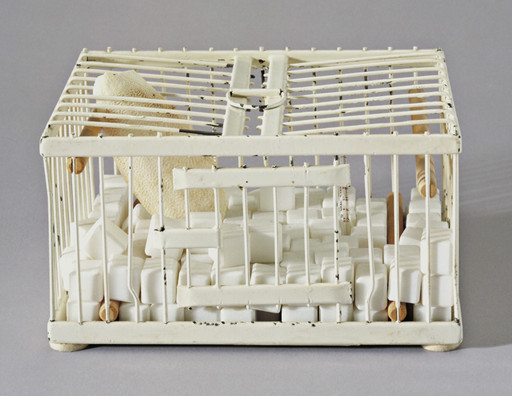
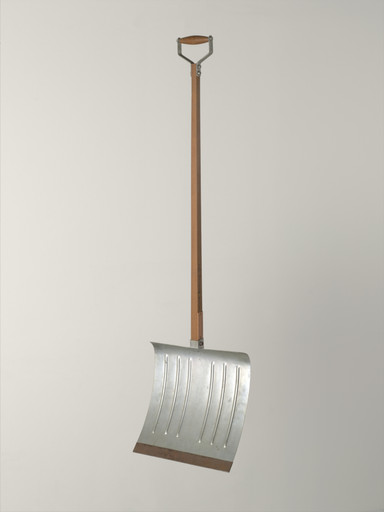
A term coined by Marcel Duchamp in 1916 to describe prefabricated, often mass-produced objects isolated from their intended use and elevated to the status of art by the artist choosing and designating them as such.
Learn more →

Audio
Audio from the playlist Marcel Duchamp
From MoMA Design Store


Installation views
We have identified this work in the following photos from our exhibition history.
Provenance Research Project
This work is included in the Provenance Research Project, which investigates the ownership history of works in MoMA's collection.
Katherine S. Dreier (1877-1952), West Redding and Milford, Connecticut
The Museum of Modern Art, New York. Katherine S. Dreier Bequest, 1953
Provenance research is a work in progress, and is frequently updated with new information. If you have any questions or information to provide about the listed works, please email [email protected] or write to:
Provenance Research Project
The Museum of Modern Art
11 West 53 Street
New York, NY 10019
Licensing
Artwork or archival images
If you would like to reproduce an image of a work of art in MoMA's collection, or an image of a MoMA publication or archival material (including installation views, checklists, and press releases), please contact Art Resource (publication in North America) or Scala Archives (publication in all other geographic locations).
Audio and film clips
MoMA licenses archival audio and select out of copyright film clips from our film collection. At this time, MoMA produced video cannot be licensed by MoMA/Scala. All requests to license archival audio or out of copyright film clips should be addressed to Scala Archives at [email protected]. Motion picture film stills cannot be licensed by MoMA/Scala. For access to motion picture film stills for research purposes, please contact the Film Study Center at [email protected]. For more information about film loans and our Circulating Film and Video Library, please visit Circulating Film and Video Library.
Text from a publication or the archives
If you would like to reproduce text from a MoMA publication, please email [email protected]. If you would like to publish text from MoMA's archival materials, please fill out this permission form and send to [email protected].
Feedback
This record is a work in progress. If you have additional information or spotted an error, please fill out this feedback form.