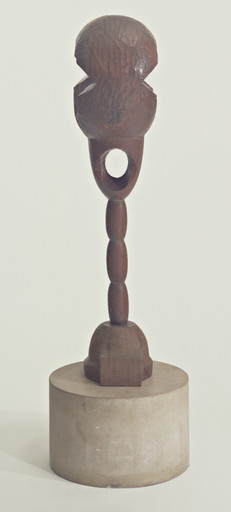
Bronze 15 3/4" (40 cm) high, on four-part pedestal of marble 3 5/8" (9.1 cm) x 3 3/4" (9.4 cm) in diameter, limestone 9 7/8 x 14 5/8 x 14 1/8" (25 x 37.1 x 36.2 cm), and two oak sections (carved by the artist) 7 3/8 x 14 3/8 x 14 1/4" (18.6 x 36.3 x 36.2) and 35 1/2 x 11 x 11" (90.2 x 28 x 28 cm), overall 71 1/4 x 14 1/4 x 14 1/2" (181 x 36.2 x 36.8 cm)
Not on view
In addition to drawing on the folk art of his native Romania, Brancusi was one of many artists working in Paris during the 1920s who appropriated elements of African sculpture, which he saw in private collections and at Paris’s Musée d’Ethnographie. According to the artist, the series to which this work belongs was inspired by a woman he saw at the 1922 Colonial Exposition in Marseilles—one of the era’s many international fairs promoting European colonial dominance—whom he assumed to be of African descent. Brancusi’s choice to isolate the figure’s hair and lips reflects Western stereotypes about the appearance of people from Africa. The work’s original French title, La Négresse blonde II, includes a dehumanizing term—“négresse”—which was historically used to exoticize and eroticize Black women.
2023
Explore more
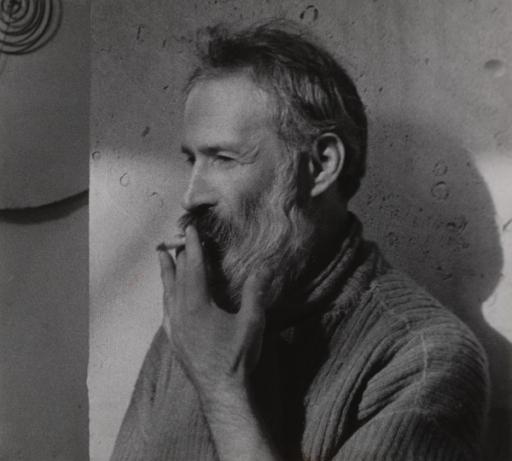
Constantin Brancusi
French, born Romania. 1876–1957 36 works onlineConstantin Brancusi sought to expand the bounds of sculptural language. At the core of this pursuit was an abiding interest in materiality, which he probed tirelessly across wood, bronze, and stone.
Learn more →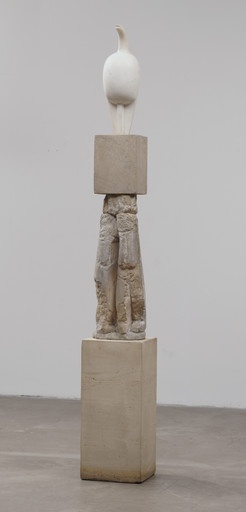
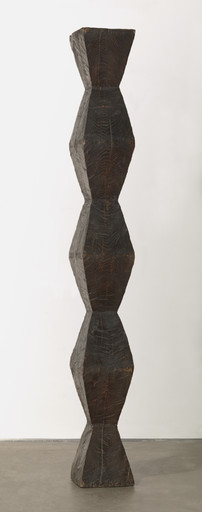
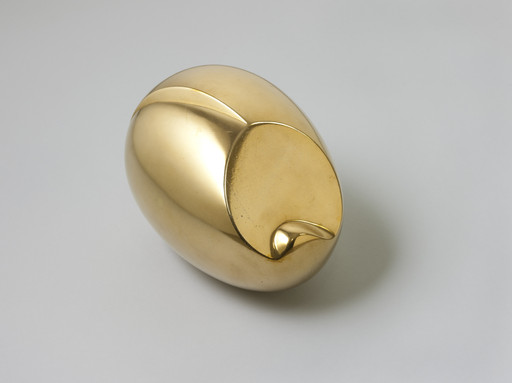

From MoMA Design Store


Installation views
We have identified this work in the following photos from our exhibition history.
Provenance Research Project
This work is included in the Provenance Research Project, which investigates the ownership history of works in MoMA's collection.
1934 Philipp L. Goodwin (acquired from Brummer Gallery)
1958 The Museum of Modern Art, New York (acquired from the above)
Provenance research is a work in progress, and is frequently updated with new information. If you have any questions or information to provide about the listed works, please email [email protected] or write to:
Provenance Research Project
The Museum of Modern Art
11 West 53 Street
New York, NY 10019
Licensing
Artwork or archival images
If you would like to reproduce an image of a work of art in MoMA's collection, or an image of a MoMA publication or archival material (including installation views, checklists, and press releases), please contact Art Resource (publication in North America) or Scala Archives (publication in all other geographic locations).
Audio and film clips
MoMA licenses archival audio and select out of copyright film clips from our film collection. At this time, MoMA produced video cannot be licensed by MoMA/Scala. All requests to license archival audio or out of copyright film clips should be addressed to Scala Archives at [email protected]. Motion picture film stills cannot be licensed by MoMA/Scala. For access to motion picture film stills for research purposes, please contact the Film Study Center at [email protected]. For more information about film loans and our Circulating Film and Video Library, please visit Circulating Film and Video Library.
Text from a publication or the archives
If you would like to reproduce text from a MoMA publication, please email [email protected]. If you would like to publish text from MoMA's archival materials, please fill out this permission form and send to [email protected].
Feedback
This record is a work in progress. If you have additional information or spotted an error, please fill out this feedback form.