This Endless Column is the earliest extant version of a motif to which Brancusi would return over the course of his career. In previous years Brancusi had used a doubled pyramid as a base for his sculptures, but he eventually realized that this abstract block could be multiplied into a pillar form, a fully realized work in its own right. Carved from oak, this succession of pyramids has a rhythmic, undulating geometry that suggests the possibility of infinite expansion.
2019
Gallery label from Inventing Abstraction, 1910–1925 , December 23, 2012–April 15, 2013
Brancusi made several versions of his Endless Column, this one being the first he fully developed. It consists of a single symmetrical element, a pair of truncated pyramids stuck together at their base, then repeated to produce a continuous rhythmic line. In replicating the same abstract shape, Brâncuși emphasized its potential for vertical expansion—it was, he later said, a “column for infinity.” In Brancusi's work generally the pedestal that traditionally supported sculpture, usually a secondary element, took on a new prominence, often equal to that of the artwork itself: he first used the geometric motif seen here in bases for his sculptures, but gradually realized its value as an independent form. He later repeated the Endless Column on larger scales and in different materials, making it serve as an architectural element and a monument. This version is carved directly in oak, with gouges and cuts in the wood readily apparent, so that it straightforwardly declares its own materials and process of making. Its simplicity, directness, and modularity helped to define the foundational principles of modern abstract sculpture.
Inventing Abstraction, 1910–1925, December 23, 2012–April 15, 2013
Explore more
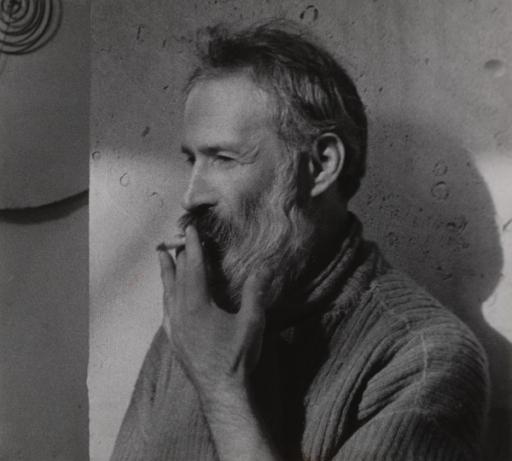
Constantin Brancusi
French, born Romania. 1876–1957 36 works onlineConstantin Brancusi sought to expand the bounds of sculptural language. At the core of this pursuit was an abiding interest in materiality, which he probed tirelessly across wood, bronze, and stone.
Learn more →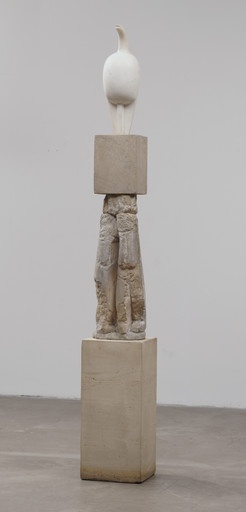



From MoMA Design Store


Installation views
We have identified this work in the following photos from our exhibition history.
Provenance Research Project
This work is included in the Provenance Research Project, which investigates the ownership history of works in MoMA's collection.
The artist, Paris; sold (through Henri-Pierre Roché) to John Quinn (1870-1924), New York, 1922 [1]; Estate of John Quinn, 1924 [2]; sold to Marcel Duchamp (1887-1968) and Henri-Pierre Roché (1879-1959), Paris, 1926 [3]; sold from the Roché Collection to Jon N. Streep, Amsterdam, 1957 [4]; sold to Mary Sisler, Palm Beach, FL [5]; acquired by The Museum of Modern Art, New York (Gift of Mary Sisler), 1983.
[1]Letter Quinn to Brancusi, March 10, 1922, Quinn Memorial Collection, Manuscripts Division, New York Public Library, qtd. in Francis M. Naumann, ed., The Mary and William Sisler Collection, New York: The Museum of Modern Art, 1984, pp. 50-60. See also Margit Rowell and Ann Temkin, eds., Constantin Brancusi, 1876-1957, exh. cat. Paris: Centre Georges Pompidou, 1995, p. 162.
[2] Included in the exhibition Brancusi, Brummer Gallery, New York, 1926, no. 31 (Column Without End).
[3] Scarlett et Philippe Reliquet, Henri-Pierre Roché: l'enchanteur collectionneur, Paris: Ramsay, 1999, p. 313. On loan to Katherine Dreier, West Redding, CT, 1935-1945; and on loan to The Museum of Modern Art, New York, 1945-1956 (Margit Rowell and Ann Temkin, eds., Constantin Brancusi, 1876-1957, p. 162).
[4] Ibid., p. 280, fn. 2. Margit Rowell and Ann Temkin, eds., Constantin Brancusi, 1876-1957, p. 162.
[5] Francis M. Naumann, ed., The Mary and William Sisler Collection, New York: The Museum of Modern Art, 1984, pp. 50-60.
Provenance research is a work in progress, and is frequently updated with new information. If you have any questions or information to provide about the listed works, please email [email protected] or write to:
Provenance Research Project
The Museum of Modern Art
11 West 53 Street
New York, NY 10019
Licensing
Artwork or archival images
If you would like to reproduce an image of a work of art in MoMA's collection, or an image of a MoMA publication or archival material (including installation views, checklists, and press releases), please contact Art Resource (publication in North America) or Scala Archives (publication in all other geographic locations).
Audio and film clips
MoMA licenses archival audio and select out of copyright film clips from our film collection. At this time, MoMA produced video cannot be licensed by MoMA/Scala. All requests to license archival audio or out of copyright film clips should be addressed to Scala Archives at [email protected]. Motion picture film stills cannot be licensed by MoMA/Scala. For access to motion picture film stills for research purposes, please contact the Film Study Center at [email protected]. For more information about film loans and our Circulating Film and Video Library, please visit Circulating Film and Video Library.
Text from a publication or the archives
If you would like to reproduce text from a MoMA publication, please email [email protected]. If you would like to publish text from MoMA's archival materials, please fill out this permission form and send to [email protected].
Feedback
This record is a work in progress. If you have additional information or spotted an error, please fill out this feedback form.