“What is it? Does it rest on a pedestal? Does it hang on a wall? What is it, painting or sculpture?” These are the questions Picasso’s sheet metal Guitar prompted from bewildered visitors to his studio, according to French poet and art critic André Salmon. To these queries the artist is said to have replied, simply, “It’s nothing, it’s el guitare!” Like its cardboard predecessor, Picasso’s Guitar broke with the traditions of carved and cast sculpture. Its projecting planes, including the lower extension, create a sense of volume, generating real shadows rather than the rendered shading historically used to simulate depth in painted and graphic art.
British artist and writer Wyndham Lewis memorably remarked that many of Picasso’s early constructions, the cardboard Guitar among them, did “not seem to possess the physical stamina to survive.” His words suggest one reason why Picasso may have chosen to memorialize the revolution announced by his fragile cardboard instrument in the more
permanent material of sheet metal, in planes connected with wire in just a few ingeniously selected spots.
Focus: Picasso Sculpture, July 3–November 3, 2008.
Gallery label from Focus: Picasso Sculpture , July 3–November 3, 2008.
To create Guitar Picasso made a radical leap from the sculptural tradition of modeling (carving or molding) to a new technique of assemblage. He created a first version of Guitar from cardboard in 1912, then later remade the work in sheet metal; the modern ordinariness of both of these materials is very different from traditional sculptural materials such as bronze, wood, and marble. The planes of the sheet–metal construction engage in a play of substance and void in which volume is suggested, not depicted. In a dramatic demonstration of the flexible way visual forms can be read in context, the guitar's sound hole, which normally recedes from the instrument's smooth surface, here projects outward into space.
Focus: Picasso Sculpture, July 3–November 3, 2008.
Publication excerpt from The Museum of Modern Art, MoMA Highlights , New York: The Museum of Modern Art, revised 2004, originally published 1999, p. 68.
Before the twentieth century, sculpture often described the human form, and was principally an art of carving and modeling solids. In Guitar Picasso broke with these age-old traditions, examining an everyday object and initiating a new type of sculptural construction: built up from sheet metal, Guitar has no solid center but is open to space. A shallow arrangement of planes to be viewed from the front, it seems pictorial as well as sculptural, and relates to Picasso's Cubist collages of newspaper clippings and the like. This points to another departure from tradition: whereas ambitious sculptors of the period might work in bronze or marble, Picasso used sheet metal and wire—common, everyday materials, like the newspapers of the collages.
Picasso's guitar sculpture is the same size and shape as the real thing, but he shatters its form. If the front of a guitar is a plane concealing a volume, he cuts that plane away, opening up the interior as an empty box. If the sound hole is ordinarily a void, he gives it substance, turning it into a projecting cylinder (a device, Picasso said, inspired by the tubular eyes in an African Grebo mask). Viewed frontally, the cylinder's open rim becomes a line drawing of the sound hole. Here, Picasso has opened up the central core of sculpture, allowing us to see into and through it.
The Museum of Modern Art, MoMA Highlights, New York: The Museum of Modern Art, revised 2004, originally published 1999, p. 68.
Explore more
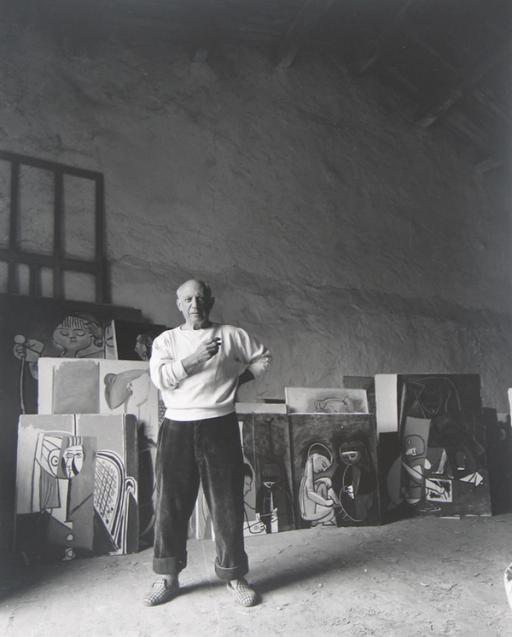
Pablo Picasso
Spanish, 1881–1973 1257 works onlineWith these words, Picasso shed light on two central principles of his artistic production over nearly 80 years: his openness to a diverse range of styles, subject matters, and mediums, and his resistance to the notion that change in art necessarily corresponds to improvement or progress.
Learn more →
Assemblage
A three-dimensional work of art made from combinations of materials including found or purchased objects.
Learn more →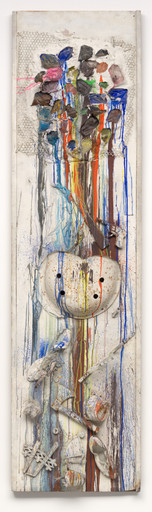

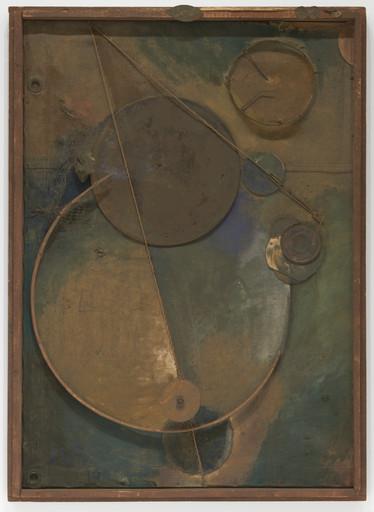

A Cubist Salon
Gallery 503What does Cubism look like? For the international network of artists who first engaged with this movement, it was a work in progress.
Learn more →




Audio
Audio from the playlist Collection 1880s–1940s
Audio from the playlist Kids
Audio from the playlist Verbal Descriptions
From MoMA Design Store


Installation views
We have identified this work in the following photos from our exhibition history.
Provenance Research Project
This work is included in the Provenance Research Project, which investigates the ownership history of works in MoMA's collection.
1914 - 1971, Pablo Picasso, Paris.
1971, The Museum of Modern Art, New York, acquired as gift from the artist.
Provenance research is a work in progress, and is frequently updated with new information. If you have any questions or information to provide about the listed works, please email [email protected] or write to:
Provenance Research Project
The Museum of Modern Art
11 West 53 Street
New York, NY 10019
Licensing
Artwork or archival images
If you would like to reproduce an image of a work of art in MoMA's collection, or an image of a MoMA publication or archival material (including installation views, checklists, and press releases), please contact Art Resource (publication in North America) or Scala Archives (publication in all other geographic locations).
Audio and film clips
MoMA licenses archival audio and select out of copyright film clips from our film collection. At this time, MoMA produced video cannot be licensed by MoMA/Scala. All requests to license archival audio or out of copyright film clips should be addressed to Scala Archives at [email protected]. Motion picture film stills cannot be licensed by MoMA/Scala. For access to motion picture film stills for research purposes, please contact the Film Study Center at [email protected]. For more information about film loans and our Circulating Film and Video Library, please visit Circulating Film and Video Library.
Text from a publication or the archives
If you would like to reproduce text from a MoMA publication, please email [email protected]. If you would like to publish text from MoMA's archival materials, please fill out this permission form and send to [email protected].
Feedback
This record is a work in progress. If you have additional information or spotted an error, please fill out this feedback form.