Not on view
For Friendship, Martin covered an underlayer of oil paint with a thin layer of goldleaf, which she then scored by hand to reveal the ground beneath. Gold, with its connotations of luxury and opulence, was an unusual choice for the artist, who once said that to paint was “to accept the necessity of the simple, going into a field of vision as you would cross an empty beach to look at the ocean.” Though Martin’s trademark format of a six-by-six-foot gridded canvas links her practice to the serial repetition and geometric forms of Minimalism, the use of goldleaf evokes the religious tradition of Christian icon painting. Indeed, Martin often drew on spiritual ideas, particularly those found in Taoism, Zen Buddhism, and American Transcendentalism, in her work. Here, the luminous quality of the work’s textured surface suggests, in the artist’s words, “a world without objects, without interruption.”
Artist’s Choice: Grace Wales Bonner—Spirit Movers, November 18, 2023 – April 07, 2024
Publication excerpt from MoMA Highlights: 375 Works from The Museum of Modern Art, New York (New York: The Museum of Modern Art, 2019)
Spanning just over six feet on each side, Friendship is one of three paintings Martin made with gold leaf and gesso, materials rich with historical associations that stand out in an era defined by commercial images and industrial production. Though the painting’s lavish gold-leaf medium is unique within Martin’s body of work, its format—a square canvas, covered from edge to edge with a meticulous grid—had become the painter’s hallmark by the early 1960s. Martin would continue to explore this abstract geometric language throughout her long career, initially in New York and later in Taos, New Mexico, where she settled in 1968.
Though she often showed with other New York abstractionists, Martin charted new terrain outside both the broad gestural vocabulary of Abstract Expressionism and the systematic repetitions of Minimalism. Her practice was tethered to spirituality and drew from a mix of ideas stemming from Zen Buddhism and American Transcendentalism, a nineteenth-century movement that emphasized the power of individuality and the importance of nature. Painting is “a world without objects, without interruption . . . or obstacle,” Martin said. “It is to accept the necessity of . . . going into a field of vision as you would cross an empty beach to look at the ocean.”
MoMA Highlights: 375 Works from The Museum of Modern Art, New York (New York: The Museum of Modern Art, 2019)
Explore more
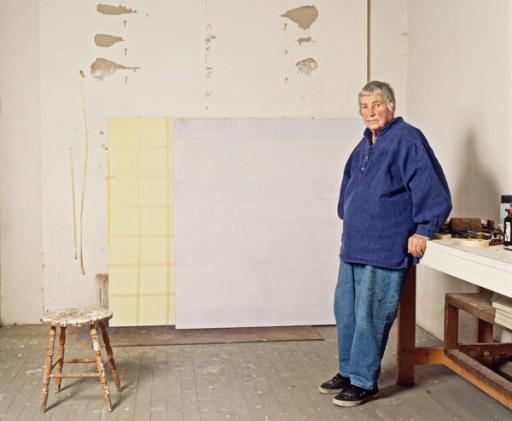
Agnes Martin
American, born Canada. 1912–2004 55 works onlineBorn on a farm in rural Saskatchewan, Canada, Agnes Martin immigrated to the United States in 1932 in the hopes of becoming a teacher.
Learn more →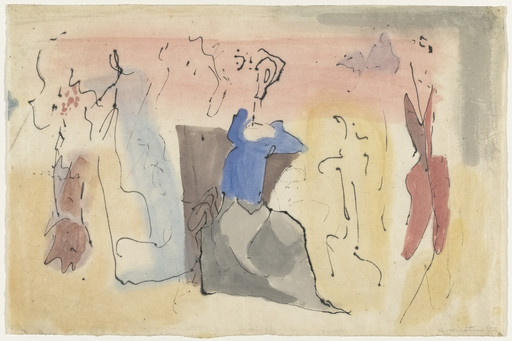

Coenties Slip
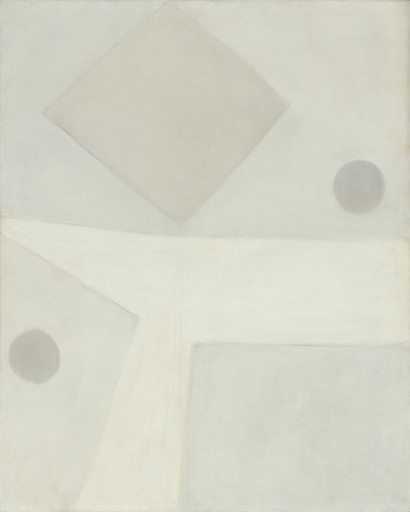
For a brief period in the 1950s and ’60s, an out-of-the-way street at the southeastern edge of Manhattan hosted a community of artists whose work there would change art history.
Learn more →
Monochrome
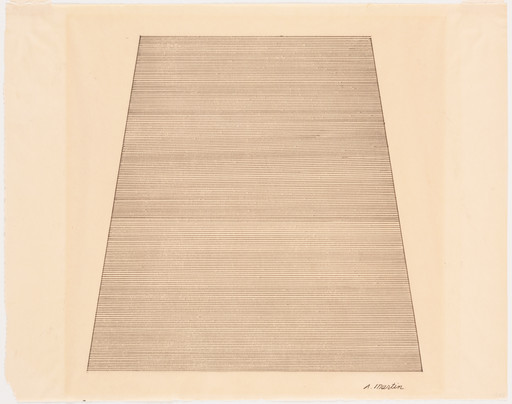
A work of art rendered in only one color.
Learn more →
Audio
Audio from the playlist 1950–1980: Works from the Collection
From MoMA Design Store


Installation views
We have identified this work in the following photos from our exhibition history.
Licensing
Artwork or archival images
If you would like to reproduce an image of a work of art in MoMA's collection, or an image of a MoMA publication or archival material (including installation views, checklists, and press releases), please contact Art Resource (publication in North America) or Scala Archives (publication in all other geographic locations).
Audio and film clips
MoMA licenses archival audio and select out of copyright film clips from our film collection. At this time, MoMA produced video cannot be licensed by MoMA/Scala. All requests to license archival audio or out of copyright film clips should be addressed to Scala Archives at [email protected]. Motion picture film stills cannot be licensed by MoMA/Scala. For access to motion picture film stills for research purposes, please contact the Film Study Center at [email protected]. For more information about film loans and our Circulating Film and Video Library, please visit Circulating Film and Video Library.
Text from a publication or the archives
If you would like to reproduce text from a MoMA publication, please email [email protected]. If you would like to publish text from MoMA's archival materials, please fill out this permission form and send to [email protected].
Feedback
This record is a work in progress. If you have additional information or spotted an error, please fill out this feedback form.