Not on view
At first glance, Abstract Painting may appear to be a monochromatic black canvas, but a careful look reveals that this painting is a three-by-three grid with squares in varying shades of black. Ad Reinhardt once said, “There is a black which is old and a black which is fresh. Lustrous black and dull black, black in sunlight and black in shadow.” To create the work, Reinhardt mixed black oil paint with small amounts of red, green, or blue and allowed the paint to sit for several weeks in order to separate the pigment from the solvent. He would then pour out the solvent and use the remaining concentrated paint to apply a completely smooth, matte surface that left no trace of the artist’s brush. Reinhardt explained that he hoped to achieve “a pure, abstract, non-objective, timeless, spaceless, changeless, relationless, disinterested painting—an object that is self-conscious (no unconsciousness), ideal, transcendent, aware of no thing but art.”
Reinhardt shared with his contemporaries an interest in experimenting with the process and materials of painting as well as a concern for the viewer’s perception of the painting. But his simple geometric compositions stand in stark contrast to the more expressive works of the action painters, and in fact many Abstract Expressionists ridiculed his later paintings. The artists associated with Minimalism, however, found resonance in Reinhardt’s works, and he would prove to be a great influence on them.
Publication excerpt from The Museum of Modern Art, MoMA Highlights , New York: The Museum of Modern Art, revised 2004, originally published 1999, p. 243.
To the hasty viewer, Abstract Painting must present a flat blackness. But the work holds more than one shade of black, and longer viewing reveals an abstract geometrical image. Reinhardt has divided the canvas into a three-by-three grid of squares. The black in each corner square has a reddish tone; the shape between them—a cross, filling the center square of the canvas and the square in the middle of each side—is a bluish black in its vertical bar and a greenish black in its horizontal one.
Works like this were strongly influential for the Minimalist and Conceptual artists of the 1960s, who admired their reductive and systematic rigor. But the poetry of their finely handled surfaces, and their deeply contemplative character, tie them to the Abstract Expressionist generation of which Reinhardt was a member, if a dissident one. Insisting on the separation of art from life, Reinhardt tried to erase from his work any content other than art itself. In the late black canvases that include Abstract Painting (he called them his "ultimate" paintings) he was trying to produce what he described as "a pure, abstract, non-objective, timeless, spaceless, changeless, relationless, disinterested painting—an object that is self-conscious (no unconsciousness), ideal, transcendent, aware of no thing but art."
The Museum of Modern Art, MoMA Highlights, New York: The Museum of Modern Art, revised 2004, originally published 1999, p. 243.
Gallery label from Focus: Ad Reinhardt and Mark Rothko , 2008.
In the last ten years of his life, Reinhardt focused solely on square, black paintings. In his unpublished writings, the artist indicates that these pictures relate aesthetically to monotonal Chinese paintings rather than Western painting's concepts of light and dark. These canvases are intentionally enigmatic, painted to resist interpretation and to represent the beginning of a new way of seeing and thinking about art. In 1961, Reinhardt described them thus:
A square (neutral, shapeless) canvas, five feet wide, five feet high, as high as a man, as wide as a man's outstretched arms (not large, not small, sizeless), trisected (no composition), one horizontal form negating one vertical form (formless, no top, no bottom, directionless), three (more or less) dark (lightless) no–contrasting (colorless) colors, brushwork brushed out to remove brushwork, a matte, flat, free–hand, painted surface (glossless, textureless, non–linear, no hard-edge, no soft edge) which does not reflect its surroundings—a pure, abstract, non–objective, timeless, spaceless, changeless, relationless, disinterested painting—an object that is self–conscious (no unconsciousness) ideal, transcendent, aware of no thing but art (absolutely no anti–art).
Focus: Ad Reinhardt and Mark Rothko, 2008.
Gallery label from Abstract Expressionist New York , October 3, 2010-April 25, 2011.
Abstract Painting contains three distinct shades of black, which become visible only after prolonged looking. Reinhardt was intensely sensitive to such subtle variations. He explained, “There is a black which is old and a black which is fresh. Lustrous black and dull black, black in sunlight and black in shadow.” When Reinhardt’s black paintings were first exhibited at MoMA, in 1963, their reductive imagery and stark palette shocked visitors, prompting at least one Museum membership cancellation in protest.
Abstract Expressionist New York, October 3, 2010-April 25, 2011.
Gallery label from 2007.
At first glance this painting presents a flat black surface. But longer viewing reveals more than one shade of black and an underlying geometric structure. Reinhardt has divided the canvas into a three-by-three grid of squares. The black in each corner square has a reddish tone; the shape between them formed by the center squares is bluish-black in its vertical bar and greenish-black in its horizontal bar. Reinhardt tried to produce what he described as "a pure, abstract, non-objective, timeless, spaceless, changeless, relationless, disinterested painting—an object that is self-conscious (no unconsciousness), ideal, transcendent, aware of no thing but art."
2007.
Explore more
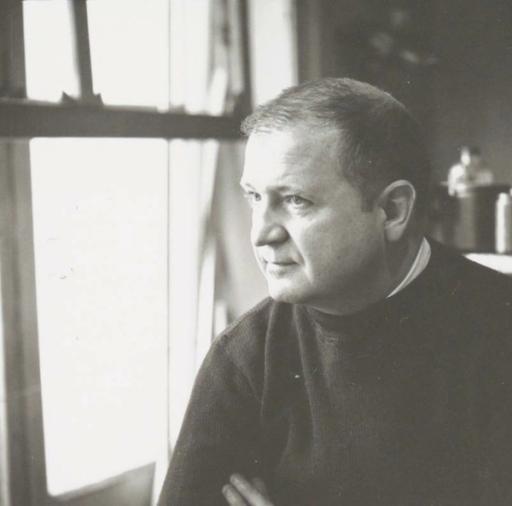
Ad Reinhardt
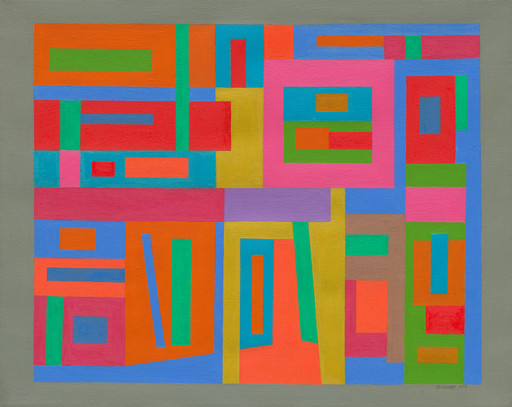
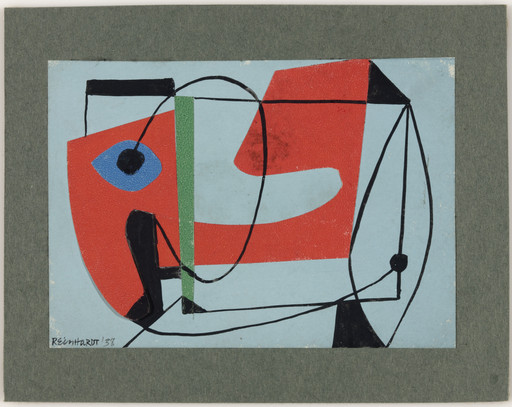
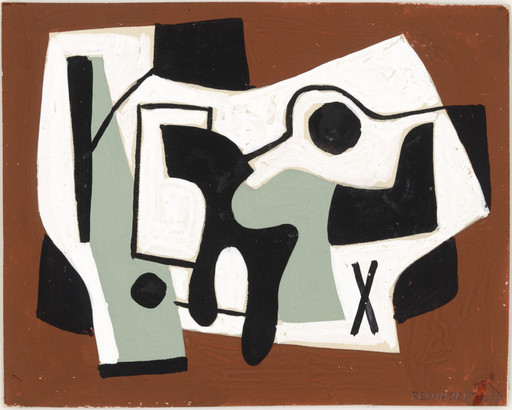
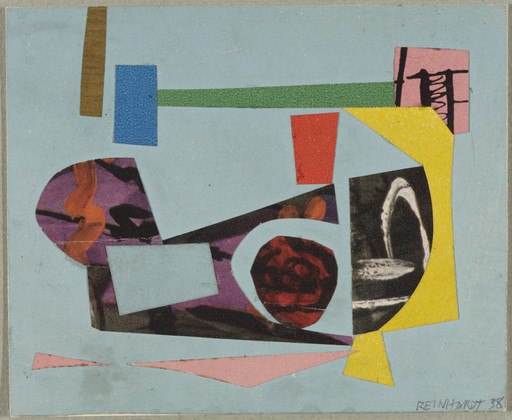
American, 1913–1967 29 works onlineAd Reinhardt was one of the most relentless defenders of the purity of abstraction. For Reinhardt, this manifested as an evolving effort to strip his paintings of everything external to the fundamental fact of paint on canvas.
Learn more →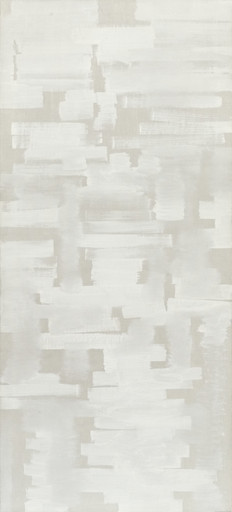
Monochrome
A work of art rendered in only one color.
Learn more →
From MoMA Design Store


Installation views
We have identified this work in the following photos from our exhibition history.
Licensing
Artwork or archival images
If you would like to reproduce an image of a work of art in MoMA's collection, or an image of a MoMA publication or archival material (including installation views, checklists, and press releases), please contact Art Resource (publication in North America) or Scala Archives (publication in all other geographic locations).
Audio and film clips
MoMA licenses archival audio and select out of copyright film clips from our film collection. At this time, MoMA produced video cannot be licensed by MoMA/Scala. All requests to license archival audio or out of copyright film clips should be addressed to Scala Archives at [email protected]. Motion picture film stills cannot be licensed by MoMA/Scala. For access to motion picture film stills for research purposes, please contact the Film Study Center at [email protected]. For more information about film loans and our Circulating Film and Video Library, please visit Circulating Film and Video Library.
Text from a publication or the archives
If you would like to reproduce text from a MoMA publication, please email [email protected]. If you would like to publish text from MoMA's archival materials, please fill out this permission form and send to [email protected].
Feedback
This record is a work in progress. If you have additional information or spotted an error, please fill out this feedback form.