Much of Pollock's early work is characterized by a somber palette and congested pictorial space, but Stenographic Figure is bright and airy. Reflecting, perhaps, his new relationship with painter Lee Krasner, it is often read as a reclining female whose head in profile is at the upper left, whose arms and hands are opened wide over a torso that stretches across the middle of the canvas, and whose legs and paw-like feet are spread across the right edge. Another possible interpretation is that there is an upright figure near the right edge of the canvas and another just left of center. To finish the painting, Pollock covered the surface with a layer of scratchy, calligraphic lines.
When Stenographic Figure was first shown in 1943, at the Spring Salon for Young Artists held by Peggy Guggenheim at her gallery Art of This Century, it garnered praise from, among others, Dutch artist Piet Mondrian, who described it as “the most interesting work I’ve seen so far in America.”
Jackson Pollock: A Collection Survey, 1934-1954, November 22, 2015–May 1, 2016.
Explore more
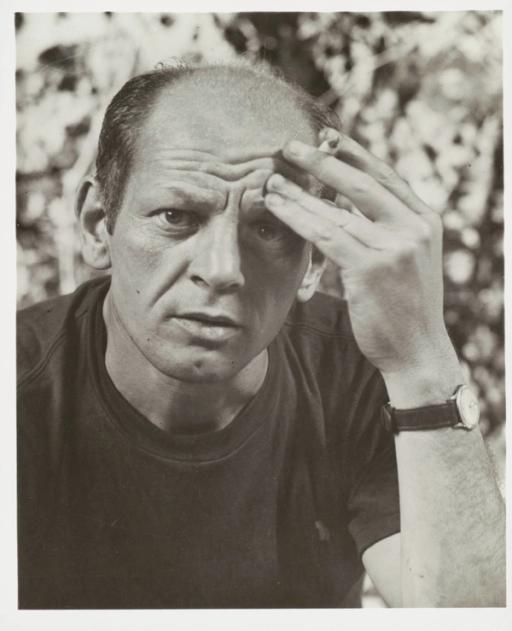
Jackson Pollock
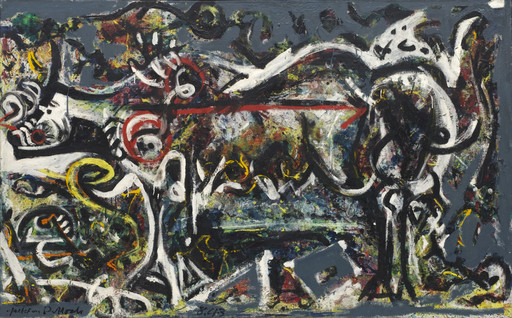
American, 1912–1956 86 works onlineIn 1947 Jackson Pollock arrived at a new mode of working that brought him international fame. His method consisted of flinging and dripping thinned enamel paint onto an unstretched canvas laid on the floor of his studio.
Learn more →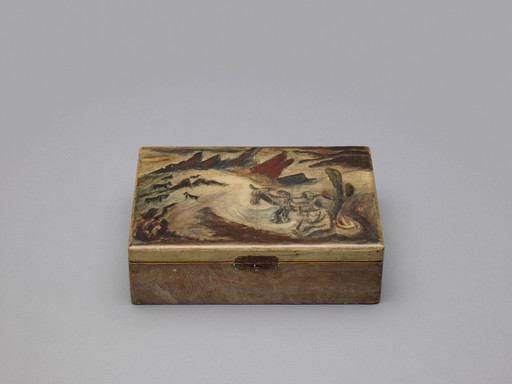
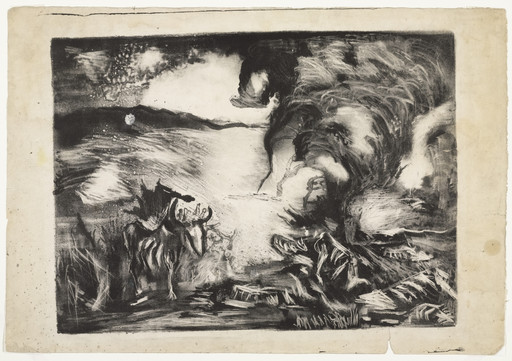

From MoMA Design Store


Installation views
We have identified this work in the following photos from our exhibition history.
Licensing
Artwork or archival images
If you would like to reproduce an image of a work of art in MoMA's collection, or an image of a MoMA publication or archival material (including installation views, checklists, and press releases), please contact Art Resource (publication in North America) or Scala Archives (publication in all other geographic locations).
Audio and film clips
MoMA licenses archival audio and select out of copyright film clips from our film collection. At this time, MoMA produced video cannot be licensed by MoMA/Scala. All requests to license archival audio or out of copyright film clips should be addressed to Scala Archives at [email protected]. Motion picture film stills cannot be licensed by MoMA/Scala. For access to motion picture film stills for research purposes, please contact the Film Study Center at [email protected]. For more information about film loans and our Circulating Film and Video Library, please visit Circulating Film and Video Library.
Text from a publication or the archives
If you would like to reproduce text from a MoMA publication, please email [email protected]. If you would like to publish text from MoMA's archival materials, please fill out this permission form and send to [email protected].
Feedback
This record is a work in progress. If you have additional information or spotted an error, please fill out this feedback form.