Painted primarily in shades of gray and divided roughly along its horizontal axis into a velvety upper expanse and a mostly lighter lower half, Diary of a Seducer evokes a landscape, even as Gorky’s sinuous drawing and a smattering of orifice-like ovals suggest a distinctly erotic context. Set within the shadowy, indeterminate space opened up visually by the artist’s thin washes of pigment and intermittently blurred lines, smoldering zones of yellow and burnt-orange paint evoke the heat of desire. Gorky’s handling insists equally on the literal constituents of painting, highlighting both the woven nature of his cloth support and the liquidity of oil—as evinced, for example, by the long, lone drip leading down to the artist’s signature at lower left.
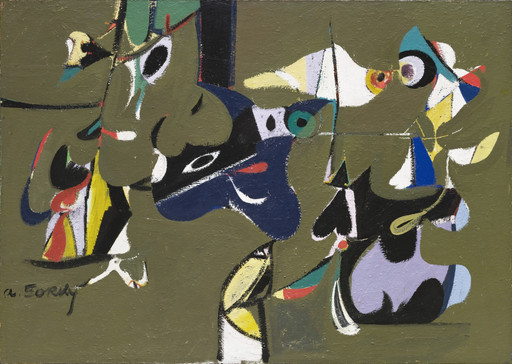
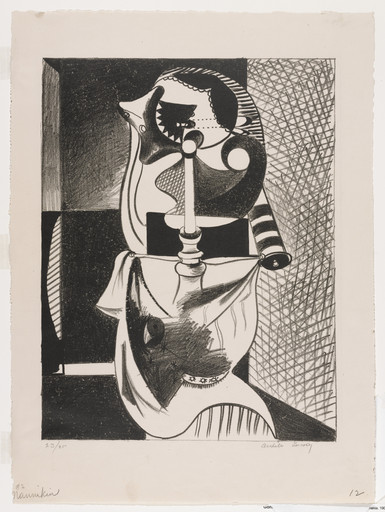
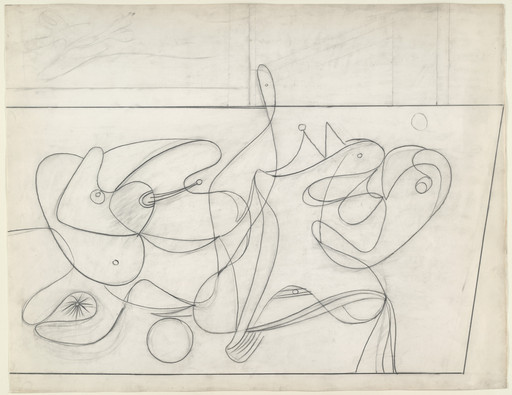
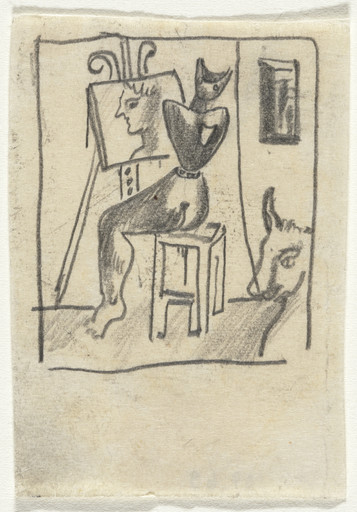
Upon moving to New York in 1924, Gorky developed a style of painting that drew on the work of various prominent modern artists, including Pablo Picasso and Paul Cezanne. By the early 1940s, he had come in close contact with the Surrealist artists living in exile in the city, particularly the French writer André Breton. Gorky absorbed their aesthetic strategies and their interest in the subconscious while developing his own unique approach: rather than depicting recognizable imagery, his paintings are entirely abstract. As a result, Gorky’s work is often seen as a bridge between Surrealism and the Abstract Expressionism of the subsequent generation.
MoMA Highlights: 375 Works from The Museum of Modern Art, New York (New York: The Museum of Modern Art, 2019)
Explore more

Art of This Century
Gallery 522In the 1940s the New York City art world expanded with the arrival of European émigrés escaping World War II.
Learn more →
From MoMA Design Store


Installation views
We have identified this work in the following photos from our exhibition history.
Provenance Research Project
This work is included in the Provenance Research Project, which investigates the ownership history of works in MoMA's collection.
1945 - 1946, Arshile Gorky.
1946 - 1951, Julien Levy Gallery, New York, acquired from the artist.
1951 - 1985, Mr. and Mrs. William A. M. Burden, New York, purchased from Julien Levy Gallery.
1985, The Museum of Modern Art, New York, acquired as gift from Mr. and Mrs. William A. M. Burden.
Provenance research is a work in progress, and is frequently updated with new information. If you have any questions or information to provide about the listed works, please email [email protected] or write to:
Provenance Research Project
The Museum of Modern Art
11 West 53 Street
New York, NY 10019
Licensing
Artwork or archival images
If you would like to reproduce an image of a work of art in MoMA's collection, or an image of a MoMA publication or archival material (including installation views, checklists, and press releases), please contact Art Resource (publication in North America) or Scala Archives (publication in all other geographic locations).
Audio and film clips
MoMA licenses archival audio and select out of copyright film clips from our film collection. At this time, MoMA produced video cannot be licensed by MoMA/Scala. All requests to license archival audio or out of copyright film clips should be addressed to Scala Archives at [email protected]. Motion picture film stills cannot be licensed by MoMA/Scala. For access to motion picture film stills for research purposes, please contact the Film Study Center at [email protected]. For more information about film loans and our Circulating Film and Video Library, please visit Circulating Film and Video Library.
Text from a publication or the archives
If you would like to reproduce text from a MoMA publication, please email [email protected]. If you would like to publish text from MoMA's archival materials, please fill out this permission form and send to [email protected].
Feedback
This record is a work in progress. If you have additional information or spotted an error, please fill out this feedback form.