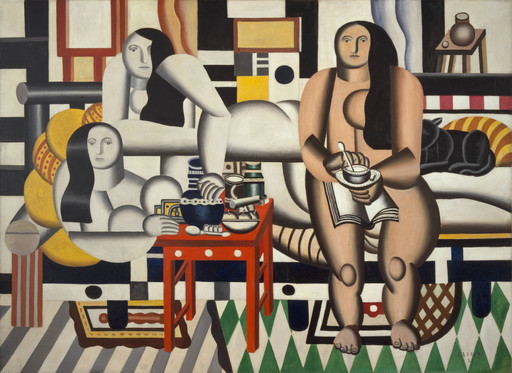
In this monumental canvas, three self-possessed women, flanked by a black cat, luxuriate in a chic, modern apartment. Their bodies appear as metallic as the stylized furniture on which they lounge—decor very much in the same spirit as the designs by Le Corbusier and Charlotte Perriand in the center of this gallery. Léger orchestrated the interlocking components of this busy composition as if it were a machine, imparting a sense of the industrial into the domestic sphere, and suggesting a harmony between man and machine in the modern era.
2021
Gallery label from 2021
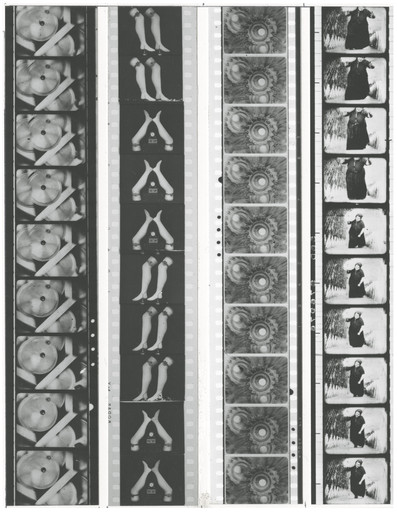
In this scene, the film’s main character (played by opera singer Georgette Leblanc) is taken to a scientist’s laboratory to be revived after a deadly snake bite. The set’s reduced geometries and whirring mechanics were designed by Fernand Léger (note its resemblance to his painting Three Women, on view nearby). Léger was just one of many figures from the Parisian art world invited to collaborate on this film, which L’Herbier envisioned as a “fairy story of modern decorative art”: architect Robert Mallet-Stevens, designer Pierre Chareau, fashion designer Paul Poiret, composer Darius Milhaud, and Ballets Suédois choreographer Jean Börlin all contributed elements.
2021
Publication excerpt from MoMA Highlights: 375 Works from The Museum of Modern Art, New York (New York: The Museum of Modern Art, 2019)
Three Women offers a machine-age update to a time-honored subject in the history of painting: the group portrait of female nudes in repose. In this monumental canvas, a self-possessed trio, flanked by a black dog, luxuriates around a coffee table in a chic, modern apartment. Their bodies consist of clusters of spheres and sharply contoured forms precisely shaded so that their silver and ocher skin as well as their slick, sideswept hair gleam like sheet metal. The features of these anonymous, impassive women, who gaze unflinchingly at the viewer, appear interchangeable, like mass-produced machine parts. The concatenation of bodies offsets a lushly vibrant domestic interior filled with brightly colored decor, stylized furniture, and an acutely slanted, dazzlingly patterned floor. The gridded background of interlocking angles and curvilinear forms gives the painting a shallow, mural-like appearance.
Léger had emerged from his experience as a combat engineer in the French army during World War I with a strong conviction in the beauty of modern machinery. The machinelike precision with which the figures in Three Women are rendered, and their seamless integration with their setting, reflects Léger’s singular vision of a harmonious reconciliation between man and machine in the modern era.
MoMA Highlights: 375 Works from The Museum of Modern Art, New York (New York: The Museum of Modern Art, 2019)
Explore more

The New Spirit in Paris
Gallery 513This wide-ranging list, which appeared on the cover of the inaugural issue of the journal L’Esprit nouveau, in 1920, summarizes the energetic, boundary-crossing spirit of Paris between the two world wars.
Learn more →

From MoMA Design Store


Installation views
We have identified this work in the following photos from our exhibition history.
Provenance Research Project
This work is included in the Provenance Research Project, which investigates the ownership history of works in MoMA's collection.
1921, Fernand Léger, Paris.
1921 - April 27, 1923, Léonce Rosenberg (Galerie L’effort modern), Paris, acquired from the artist.
April 27, 1923 - at least 1925, Fernand Léger, Paris, received back from Léonce Rosenberg.
By 1928 - 1942, Paul Rosenberg, Paris, New York, probably acquired from the artist.
1942, The Museum of Modern Art, New York, purchased from Paul Rosenberg.
Provenance research is a work in progress, and is frequently updated with new information. If you have any questions or information to provide about the listed works, please email [email protected] or write to:
Provenance Research Project
The Museum of Modern Art
11 West 53 Street
New York, NY 10019
Licensing
Artwork or archival images
If you would like to reproduce an image of a work of art in MoMA's collection, or an image of a MoMA publication or archival material (including installation views, checklists, and press releases), please contact Art Resource (publication in North America) or Scala Archives (publication in all other geographic locations).
Audio and film clips
MoMA licenses archival audio and select out of copyright film clips from our film collection. At this time, MoMA produced video cannot be licensed by MoMA/Scala. All requests to license archival audio or out of copyright film clips should be addressed to Scala Archives at [email protected]. Motion picture film stills cannot be licensed by MoMA/Scala. For access to motion picture film stills for research purposes, please contact the Film Study Center at [email protected]. For more information about film loans and our Circulating Film and Video Library, please visit Circulating Film and Video Library.
Text from a publication or the archives
If you would like to reproduce text from a MoMA publication, please email [email protected]. If you would like to publish text from MoMA's archival materials, please fill out this permission form and send to [email protected].
Feedback
This record is a work in progress. If you have additional information or spotted an error, please fill out this feedback form.