Oil on canvas
The False Mirror presents an enormous lashless eye with a luminous cloud-swept blue sky filling the iris and an opaque, dead-black disc for a pupil. The allusive title, provided by the Belgian Surrealist writer Paul Nougé, seems to insinuate limits to the authority of optical vision: a mirror provides a mechanical reflection, but the eye is selective and subjective. Magritte's single eye functions on multiple enigmatic levels: the viewer both looks through it, as through a window, and is looked at by it, thus seeing and being seen simultaneously. The Surrealist photographer Man Ray, who owned the work from 1933 to 1936, recognized this compelling duality when he memorably described The False Mirror as a painting that "sees as much as it itself is seen."
2015.
Publication excerpt from MoMA Highlights: 375 Works from The Museum of Modern Art, New York (New York: The Museum of Modern Art, 2019)
A huge, isolated eye stares out at the viewer. Its left, inner corner has a vivid, viscous quality. The anatomical detailing of this area and its surface sheen contrast with the matte, dead-black of the eye’s pupil, which floats, unmoored, against a limpid, cloud-filled sky of cerulean blue. Although the areas surrounding the eye’s iris are carefully shaded and modeled, giving the illusion of a play of light on three-dimensional form, the sky displays no trace of convexity; its puffy clouds are beautifully rendered, but not its blue expanse. As a result, the sky appears as though seen through a circular window rather than mirrored in the spherical, liquid surface of an eye.
The eye was a subject that fascinated many Surrealist poets and visual artists, given its threshold position between inner, subjective self and the external world. The Surrealist photographer Man Ray once owned The False Mirror, which he memorably described as a painting that “sees as much as it itself is seen.” His words capture the work’s unsettling character: it places the viewer on the spot, caught between looking through and being watched by an eye that proves to be empty. It opens onto a void that, for all its radiant, cumulus-cloud-filled beauty, seems to deny the possibility of human existence.
MoMA Highlights: 375 Works from The Museum of Modern Art, New York (New York: The Museum of Modern Art, 2019)
Gallery label from Magritte: The Mystery of the Ordinary, 1926-1938 , September 28, 2013–January 12, 2014.
Le Faux Miroir presents an enormous lashless eye with a luminous cloud-swept blue sky filling the iris and an opaque, dead-black disc for a pupil. The allusive title, provided by the Belgian Surrealist writer Paul Nougé, seems to insinuate limits to the authority of optical vision: a mirror provides a mechanical reflection, but the eye is selective and subjective. Magritte’s single eye functions on multiple enigmatic levels: the viewer both looks through it, as through a window, and is looked at by it, thus seeing and being seen simultaneously. The Surrealist photographer Man Ray, who owned the work from 1933 to 1936, recognized this compelling duality when he memorably described Le Faux Miroir as a painting that “sees as much as it itself is seen.”
Magritte: The Mystery of the Ordinary, 1926-1938, September 28, 2013–January 12, 2014.
Explore more
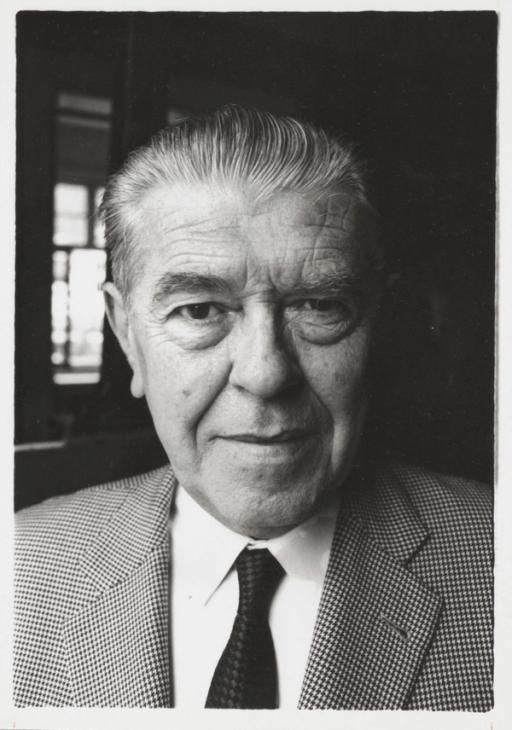
René Magritte
Belgian, 1898–1967 14 works onlineClouds, pipes, bowler hats, and green apples: these remain some of the most immediately recognizable icons of René Magritte, the Belgian painter and well-known Surrealist .
Learn more →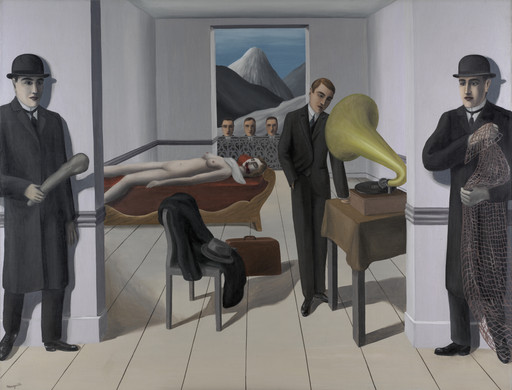
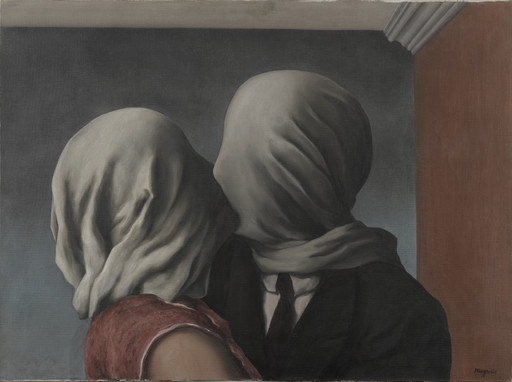

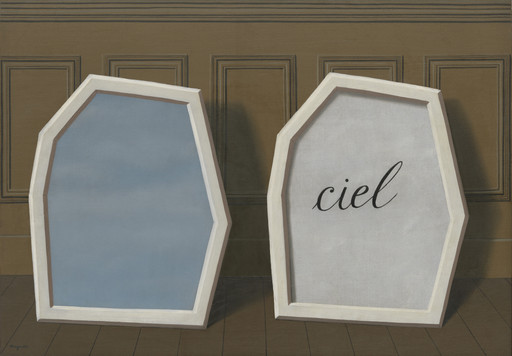
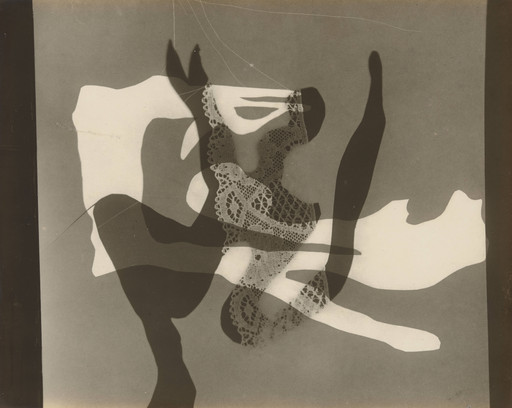
A Surreal Lens
Gallery 517In 1924, André Breton published his Manifesto of Surrealism, which, guided by Sigmund Freud’s psychoanalytic theories, declared a radical break from the rationalism of modern society in favor of imagination, erotic desire, and unconscious thought.
Learn more →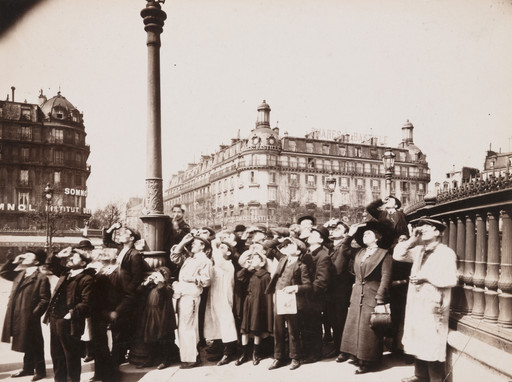

Audio
Audio from the playlist Collection 1880s–1940s
From MoMA Design Store


Installation views
We have identified this work in the following photos from our exhibition history.
Provenance Research Project
This work is included in the Provenance Research Project, which investigates the ownership history of works in MoMA's collection.
1928 – June 1930, René Magritte, Brussels
June 1930 – 1933, E. L. T. (Edouard Léon Théodore) Mesens, Brussels, purchased from the artist
1933 – 1936, Man Ray, acquired from E. L. T. Mesens
1936, The Museum of Modern Art, New York, purchased from Man Ray
Provenance research is a work in progress, and is frequently updated with new information. If you have any questions or information to provide about the listed works, please email [email protected] or write to:
Provenance Research Project
The Museum of Modern Art
11 West 53 Street
New York, NY 10019
Licensing
Artwork or archival images
If you would like to reproduce an image of a work of art in MoMA's collection, or an image of a MoMA publication or archival material (including installation views, checklists, and press releases), please contact Art Resource (publication in North America) or Scala Archives (publication in all other geographic locations).
Audio and film clips
MoMA licenses archival audio and select out of copyright film clips from our film collection. At this time, MoMA produced video cannot be licensed by MoMA/Scala. All requests to license archival audio or out of copyright film clips should be addressed to Scala Archives at [email protected]. Motion picture film stills cannot be licensed by MoMA/Scala. For access to motion picture film stills for research purposes, please contact the Film Study Center at [email protected]. For more information about film loans and our Circulating Film and Video Library, please visit Circulating Film and Video Library.
Text from a publication or the archives
If you would like to reproduce text from a MoMA publication, please email [email protected]. If you would like to publish text from MoMA's archival materials, please fill out this permission form and send to [email protected].
Feedback
This record is a work in progress. If you have additional information or spotted an error, please fill out this feedback form.