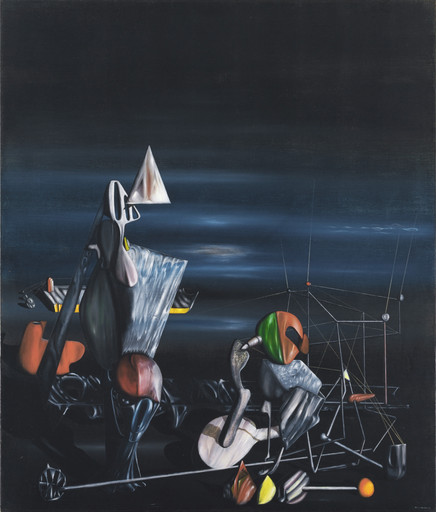
The Vertigo of Eros is what Matta called an “inscape,” one of a series of imaginary landscapes he conceived of as projections of his psyche. In 1939, to escape the war in Europe, Matta emigrated from Paris to New York, where he stayed until 1948. His use of spontaneous, unplanned “automatic” drawing and his interest in mysticism, evident in paintings such as this, had a tremendous influence on many New York–based artists.
Together with other Surrealists in exile, he quickly made acquaintance with painters, including Jackson Pollock. “We spoke of automatism,” Matta recalled. “The New Yorkers became aware of these things through contact with us, although, as in a [Charlie] Chaplin movie, we had arrived utterly lost.”
2011.
Publication excerpt from The Modern Museum of Art, MoMA Highlights , New York: The Museum of Modern Art, revised 2004, originally published 1999, p. 189.
Matta's paintings do not describe the world we see when we open our eyes. Nor are these the dream or fantasy scenes of his fellow Surrealists Salvador Dalí and René Magritte, which include commonplace objects from waking life; the forms in Matta's works suggest many things but can be firmly identified with none. In the late 1930s and early 1940s Matta had produced works he called "inscapes," imaginary landscapes that he imagined as projections of psychological states. The Vertigo of Eros evokes an infinite space that suggests both the depths of the psyche and the vastness of the universe.
A galaxy of shapes suggesting liquid, fire, roots, and sexual parts floats in a dusky continuum of light. It is as if Matta's forms reached back beyond the level of the dream to the central source of life, proposing an iconography of consciousness before it has hatched into the recognizable coordinates of everyday experience. There is a sense of suspension in space, and indeed the work's title relates to Freud's location of human consciousness as caught between Eros, the life force, and Thanatos, the death wish. Constantly challenged by Thanatos, Eros produces vertigo. The human problem, then, is to achieve physical and spiritual equilibrium.
In French, the work's title is a pun, Le Vertige d'Eros doubling as Le Vert Tige des roses (the green stem of the roses).
The Modern Museum of Art, MoMA Highlights, New York: The Museum of Modern Art, revised 2004, originally published 1999, p. 189.
Explore more


Art of This Century
Gallery 522In the 1940s the New York City art world expanded with the arrival of European émigrés escaping World War II.
Learn more →
Audio
Audio from the playlist 1880–1950: Works from the Collection
From MoMA Design Store


Installation views
We have identified this work in the following photos from our exhibition history.
Provenance Research Project
This work is included in the Provenance Research Project, which investigates the ownership history of works in MoMA's collection.
1944, The Museum of Modern Art, New York, purchased from the artist through Pierre Matisse Gallery, New York.
Provenance research is a work in progress, and is frequently updated with new information. If you have any questions or information to provide about the listed works, please email [email protected] or write to:
Provenance Research Project
The Museum of Modern Art
11 West 53 Street
New York, NY 10019
Licensing
Artwork or archival images
If you would like to reproduce an image of a work of art in MoMA's collection, or an image of a MoMA publication or archival material (including installation views, checklists, and press releases), please contact Art Resource (publication in North America) or Scala Archives (publication in all other geographic locations).
Audio and film clips
MoMA licenses archival audio and select out of copyright film clips from our film collection. At this time, MoMA produced video cannot be licensed by MoMA/Scala. All requests to license archival audio or out of copyright film clips should be addressed to Scala Archives at [email protected]. Motion picture film stills cannot be licensed by MoMA/Scala. For access to motion picture film stills for research purposes, please contact the Film Study Center at [email protected]. For more information about film loans and our Circulating Film and Video Library, please visit Circulating Film and Video Library.
Text from a publication or the archives
If you would like to reproduce text from a MoMA publication, please email [email protected]. If you would like to publish text from MoMA's archival materials, please fill out this permission form and send to [email protected].
Feedback
This record is a work in progress. If you have additional information or spotted an error, please fill out this feedback form.