Oil on canvas
Three Musicians, painted by Pablo Picasso in 1921, revisits the early years of Synthetic Cubism. The artist helped invent this Cubist mode in 1912 with the adoption of collage, in which newspapers, wallpapers, advertisements, and other found objects are glued to a supporting surface. The mural-sized Three Musicians evokes collage through its flat, interlocking planes of unshaded color, as well as the sheet music at right. Held up by one of the three musicians referenced in the title, this painted sheet music recalls the cut-and-pasted sheet music that Picasso had often added to his early Cubist collages.
2026
Gallery label from 2024
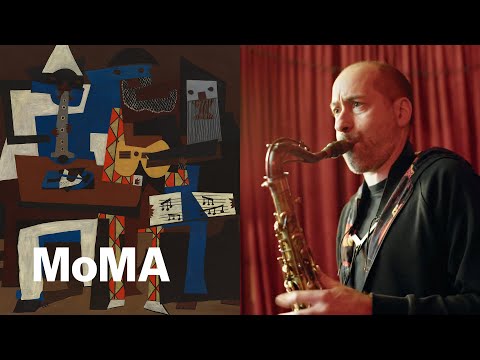
This intricate, jigsaw-puzzle-like composition features variations on stock characters from the Italian comic theater tradition known as commedia dell’arte. At left, a masked Pierrot plays the clarinet and strumming a guitar at center is Harlequin, a figure Picasso often treats as a stand-in for himself. They are joined by, at right, a singing monk holding sheet music and, hiding below the table, an outstretched dog. The levity of these clown-like figures is countered by the painting’s somber palette, which lends an air of melancholy to the scene.
2024
Publication excerpt from The Museum of Modern Art, MoMA Highlights , New York: The Museum of Modern Art, revised 2004, originally published 1999, p. 101.
At the left of a bare and boxlike space, a masked Pierrot plays the clarinet. At the right, a singing monk holds sheet music. And in the center, strumming a guitar, is a Harlequin, in Picasso's art a recurring stand-in for the artist himself. Pierrot and Harlequin are stock characters in the old Italian comic theater known as commedia dell'arte, a familiar theme in Picasso's work. The painting, then, has a whimsical side, epitomized by the near-invisible dog: its head is about halfway up the canvas on the left, one of several subtle browns, and we can also make out front paws, a hind leg, and a jaunty tail popping up between Harlequin's legs. Overall, though, the work's somber background and large size make the musicians a solemn, even majestic trio.
The intricate, jigsaw-puzzle-like composition sums up the Synthetic Cubist style, the flat planes of unshaded color recalling the cutout and pasted paper forms with which the style began. These overlapping shapes are at their most complex at the center of the picture, which is also where the lightest hues are concentrated, so that an aura of darkness surrounds a brighter center. Along with the frontal poses of the figures, this creates a feeling of gravity and monumentality, and gives Three Musicians a mysterious, otherworldly air.
The Museum of Modern Art, MoMA Highlights, New York: The Museum of Modern Art, revised 2004, originally published 1999, p. 101.
Explore more
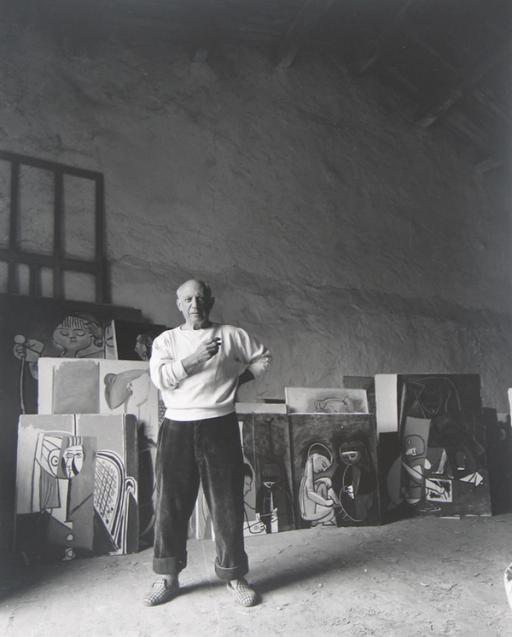
Pablo Picasso
Spanish, 1881–1973 1251 works onlineWith these words, Picasso shed light on two central principles of his artistic production over nearly 80 years: his openness to a diverse range of styles, subject matters, and mediums, and his resistance to the notion that change in art necessarily corresponds to improvement or progress.
Learn more →
Cubism
An artistic style invented in Paris during the first decade of the 20th century, Cubism was soon adopted by an international network of artists who sought to create a new art for a new century.
Learn more →

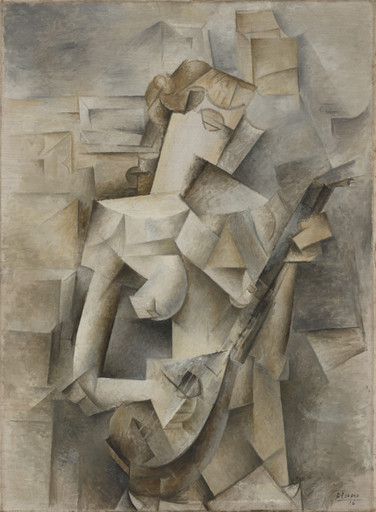
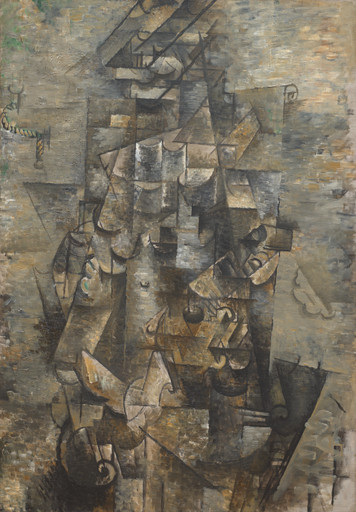
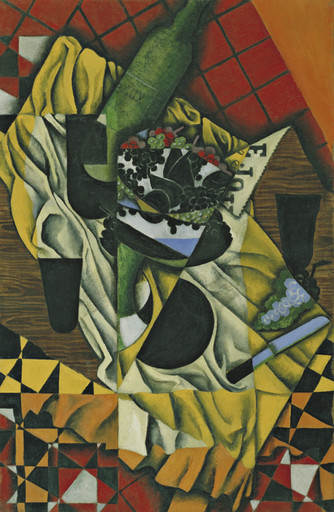
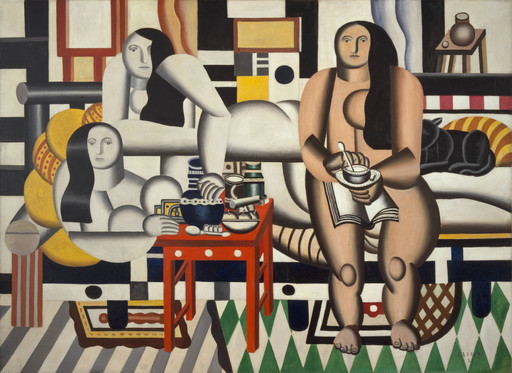
The New Spirit in Paris
Gallery 513This wide-ranging list, which appeared on the cover of the inaugural issue of the journal L’Esprit nouveau, in 1920, summarizes the energetic, boundary-crossing spirit of Paris between the two world wars.
Learn more →

Audio
Audio from the playlist Collection 1880s–1940s
Audio from the playlist Kids
Audio from the playlist Verbal Descriptions
Articles and videos
From MoMA Design Store


Installation views
We have identified this work in the following photos from our exhibition history.
Provenance Research Project
This work is included in the Provenance Research Project, which investigates the ownership history of works in MoMA's collection.
The artist
Paul Rosenberg's private collection, Paris. Purchased from the artist in fall 1921 - 1949
The Museum of Modern Art, New York. Purchased from Rosenberg family with Mrs. Simon Guggenheim Fund, 1949
Provenance research is a work in progress, and is frequently updated with new information. If you have any questions or information to provide about the listed works, please email [email protected] or write to:
Provenance Research Project
The Museum of Modern Art
11 West 53 Street
New York, NY 10019
Licensing
Artwork or archival images
If you would like to reproduce an image of a work of art in MoMA's collection, or an image of a MoMA publication or archival material (including installation views, checklists, and press releases), please contact Art Resource (publication in North America) or Scala Archives (publication in all other geographic locations).
Audio and film clips
MoMA licenses archival audio and select out of copyright film clips from our film collection. At this time, MoMA produced video cannot be licensed by MoMA/Scala. All requests to license archival audio or out of copyright film clips should be addressed to Scala Archives at [email protected]. Motion picture film stills cannot be licensed by MoMA/Scala. For access to motion picture film stills for research purposes, please contact the Film Study Center at [email protected]. For more information about film loans and our Circulating Film and Video Library, please visit Circulating Film and Video Library.
Text from a publication or the archives
If you would like to reproduce text from a MoMA publication, please email [email protected]. If you would like to publish text from MoMA's archival materials, please fill out this permission form and send to [email protected].
Feedback
This record is a work in progress. If you have additional information or spotted an error, please fill out this feedback form.