This series of four canvases was commissioned by Edwin R. Campbell, founder of Chevrolet Motor Company, for the entrance foyer of his Park Avenue apartment. In 1913, Kandinsky coined the expression "nonobjective painting" to refer to painting that depicted no recognizable objects. Although preliminary studies for one of these paintings suggest that Kandinsky had a landscape in mind when he conceived it, he ultimately envisioned these works as free of descriptive devices. Kandinsky stressed the impact of color and its association with music, explaining that "color is a means of exerting direct influence upon the soul. Color is a keyboard. The eye is the hammer. The soul is the piano, with its many strings."
2006.
Explore more
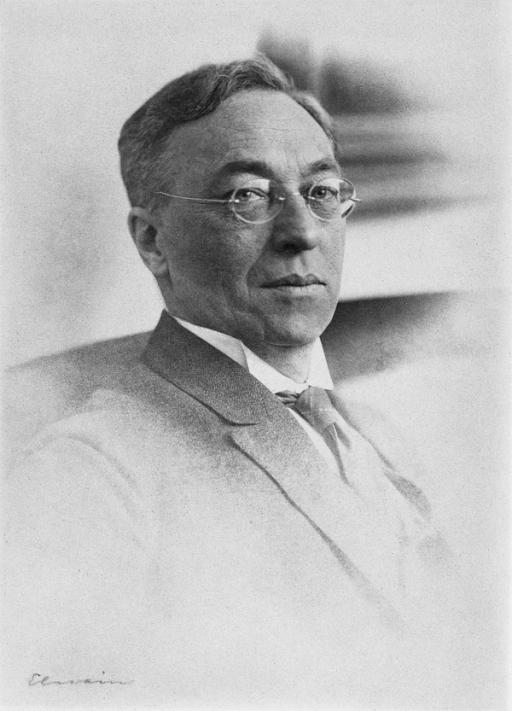
Vasily Kandinsky
French, born Russia. 1866–1944 153 works onlineVasily Kandinsky posed this question in December 1911, in Concerning the Spiritual in Art , a text that laid out his argument for abstraction.
Learn more →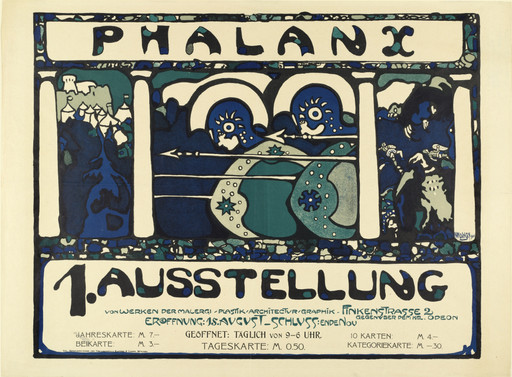
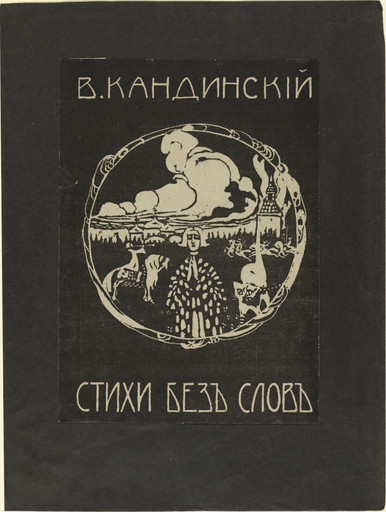
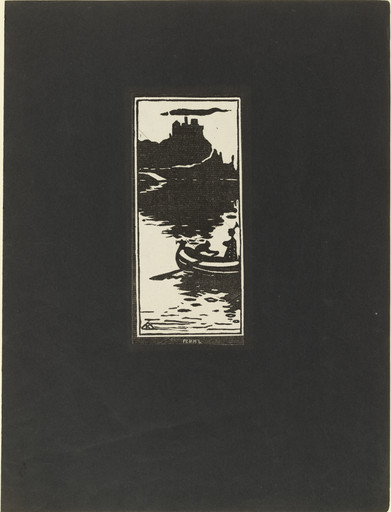

From MoMA Design Store


Installation views
We have identified this work in the following photos from our exhibition history.
Provenance Research Project
This work is included in the Provenance Research Project, which investigates the ownership history of works in MoMA's collection.
(same as Panel for Edwin R. Campbell No. 3)
(Willem Beffie, Amsterdam. Left in care of Beffie by Kandinsky with instructions to ship them to New York, 1914 – 1916)
Mr. and Mrs. Edwin R. Campbell, 1914 – 1929. (Commissioned in 1914, together with Painting Number 199, Painting Number 200, and Painting Number 201, as a mural ensemble for their New York apartment at 635 Park Avenue. First exhibited in Stockholm in February 1916, then shipped to New York in summer 1916, and installed in Campbell’s foyer in fall 1916, until 1921 when Edwin Campbell (1874-1929) was divorced and moved. The panels later were found in his widow’s storage in Ridgefield, Connecticut.)
Mrs. Fitzhugh Green (formerly Mrs. Campbell), Ridgefield, Connecticut. 1929 – 1953
Auction, Green Estate, Ridgefield, Connecticut. March 1953
Virginia Freeman. Purchased at Green Estate auction, March 1953
The Museum of Modern Art, New York. Purchased from Virginia Freeman (together with Panel no. 3 [2.54]) with Ms. Simon Guggenheim Fund, 1954
Provenance research is a work in progress, and is frequently updated with new information. If you have any questions or information to provide about the listed works, please email [email protected] or write to:
Provenance Research Project
The Museum of Modern Art
11 West 53 Street
New York, NY 10019
Licensing
Artwork or archival images
If you would like to reproduce an image of a work of art in MoMA's collection, or an image of a MoMA publication or archival material (including installation views, checklists, and press releases), please contact Art Resource (publication in North America) or Scala Archives (publication in all other geographic locations).
Audio and film clips
MoMA licenses archival audio and select out of copyright film clips from our film collection. At this time, MoMA produced video cannot be licensed by MoMA/Scala. All requests to license archival audio or out of copyright film clips should be addressed to Scala Archives at [email protected]. Motion picture film stills cannot be licensed by MoMA/Scala. For access to motion picture film stills for research purposes, please contact the Film Study Center at [email protected]. For more information about film loans and our Circulating Film and Video Library, please visit Circulating Film and Video Library.
Text from a publication or the archives
If you would like to reproduce text from a MoMA publication, please email [email protected]. If you would like to publish text from MoMA's archival materials, please fill out this permission form and send to [email protected].
Feedback
This record is a work in progress. If you have additional information or spotted an error, please fill out this feedback form.