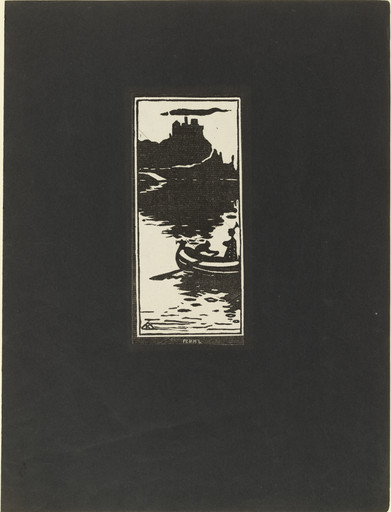
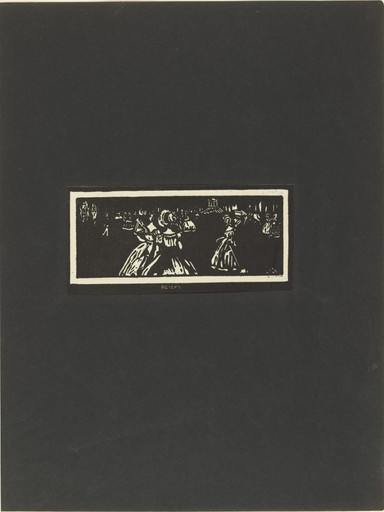
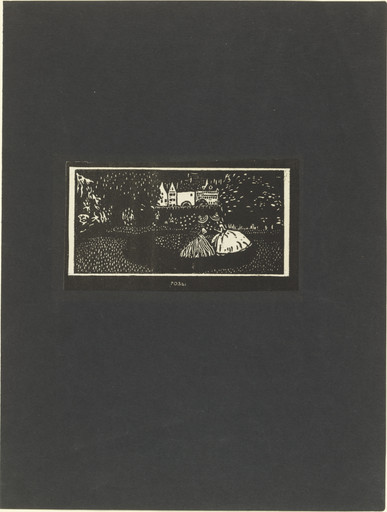
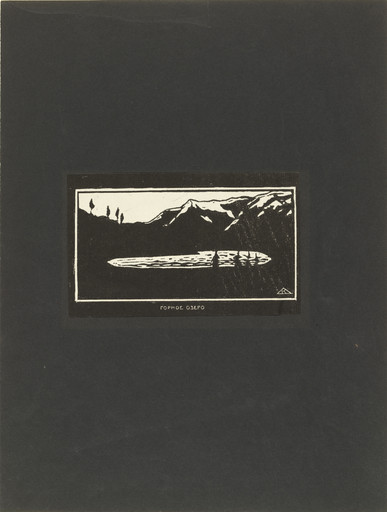
Woodcut title page from a portfolio of twelve woodcuts, one woodcut title page, one woodcut table of contents, one supplementary woodcut and one woodcut colophon
Not on view
In the portfolio Stichi bez slov (Verses without words) Vasily Kandinsky leaves the modern world and all its distractions and sails away on Viking ships and down the Rhine to a fairy-tale world filled with gallant mounted riders, elegant ladies, peaceful landscapes, and onion-domed churches. Frustrated with his attempts at writing poetry in German, Kandinsky used these woodcuts to give shape to the nostalgia for his Russian homeland that he found impossible to put into words. As he explained to his companion, painter Gabriele Münter, "I must do them, for I cannot rid myself of my thoughts (or possibly dreams) any other way."
The imagery in these prints was central to the symbolic vocabulary that appeared throughout Kandinsky's work. Five of the woodcuts repeat previous compositions, and Kandinsky returned to five others in later prints and paintings. Most significantly, Kandinsky used the horse and rider motif, his symbol of a warrior for new art, for the first time here.
Kandinsky saw the woodcut medium as being akin to lyric poetry: both forms demanded concentration on the essential. Woodcut pushed him to simplify his imagery; his undulating lines and decorative patterns are in fact potent symbols of longing. These experimentations, prompted by the technical requirements of printmaking, played a crucial role in Kandinsky's development of abstraction.
Heather Hess, German Expressionist Digital Archive Project, German Expressionism: Works from the Collection. 2011.
Explore more
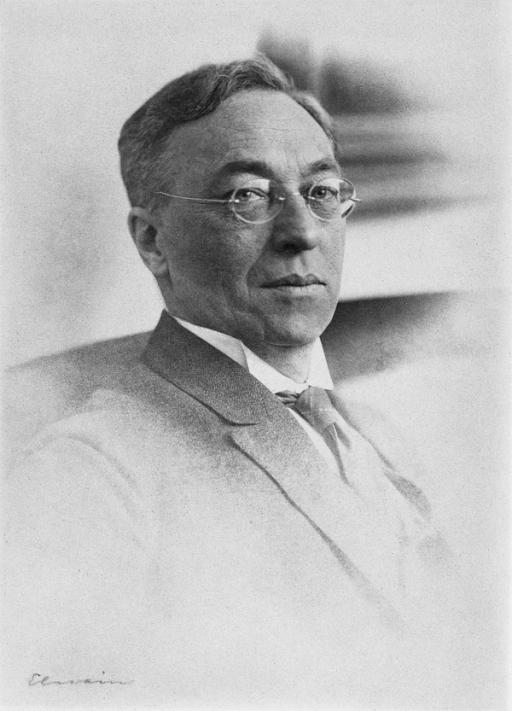
Vasily Kandinsky
French, born Russia. 1866–1944 153 works onlineVasily Kandinsky posed this question in December 1911, in Concerning the Spiritual in Art , a text that laid out his argument for abstraction.
Learn more →
From MoMA Design Store


Licensing
Artwork or archival images
If you would like to reproduce an image of a work of art in MoMA's collection, or an image of a MoMA publication or archival material (including installation views, checklists, and press releases), please contact Art Resource (publication in North America) or Scala Archives (publication in all other geographic locations).
Audio and film clips
MoMA licenses archival audio and select out of copyright film clips from our film collection. At this time, MoMA produced video cannot be licensed by MoMA/Scala. All requests to license archival audio or out of copyright film clips should be addressed to Scala Archives at [email protected]. Motion picture film stills cannot be licensed by MoMA/Scala. For access to motion picture film stills for research purposes, please contact the Film Study Center at [email protected]. For more information about film loans and our Circulating Film and Video Library, please visit Circulating Film and Video Library.
Text from a publication or the archives
If you would like to reproduce text from a MoMA publication, please email [email protected]. If you would like to publish text from MoMA's archival materials, please fill out this permission form and send to [email protected].
Feedback
This record is a work in progress. If you have additional information or spotted an error, please fill out this feedback form.