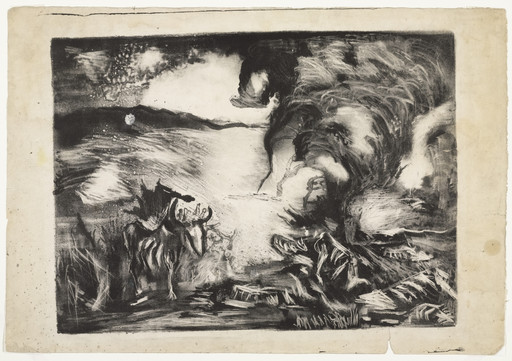
Lithograph with airbrushed lacquer additions
Not on view
Eager from the very beginning to try his hand at different techniques that might offer new expressive possibilities, Pollock made twelve lithographs, including Landscape with Steer, between about 1934 and 1937. The subject, a Western scene, speaks to his upbringing in the American West. Pollock's loose gestures and evocative washes and scratches hint at the increasingly experimental direction in which his art was headed. Pollock added color to the second impression using an airbrush, a technique that he may have learned from David Alfaro Siquieros, the Mexican painter and muralist whose New York workshop he frequented at the time.
Jackson Pollock: A Collection Survey, 1934-1954, November 22, 2015–May 1, 2016.
Additional text from In The Studio: Postwar Abstract Painting online course, Coursera, 2017
Like many of his fellow New York School painters, Pollock played down his influences, stoking the mythos of the individuality of the artist-genius working in isolation in his studio. In reality, he drew inspiration from a wide range of sources, many of which are reflected in this early lithograph airbrushed with synthetic paints. When he made this edition, Pollock was studying with Mexican painter and muralist David Alfaro Siqueiros at his Experimental Workshop in New York. There Pollock was exposed to a variety of radical approaches to painting—including spraying and dripping commercial enamel paints—that were designed to break with European traditions. This Western scene of a steer nestled into a forcefully executed landscape reflects his romanticizing of his upbringing in the American West (he actually grew up in suburban Los Angeles) and the rugged rebel image that he cultivated. It also reveals his roots in figurative painting and the influence of his early mentor, American Regionalist painter Thomas Hart Benton. The expressive, gestural treatment of the landscape foreshadows Pollock’s increasing experimentation with abstraction.
In The Studio: Postwar Abstract Painting online course, Coursera, 2017
Explore more
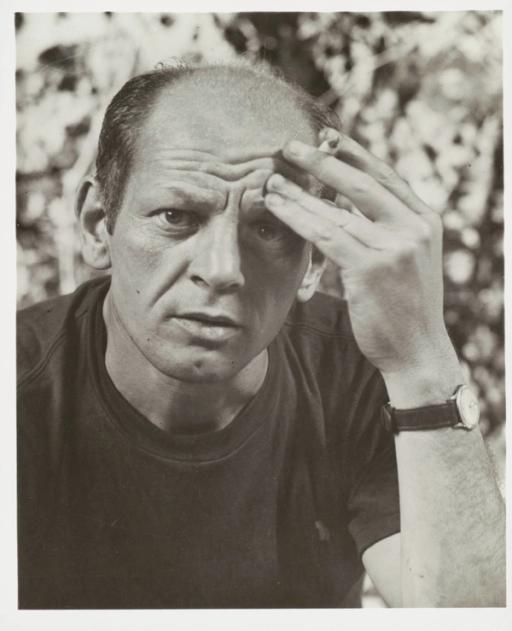
Jackson Pollock
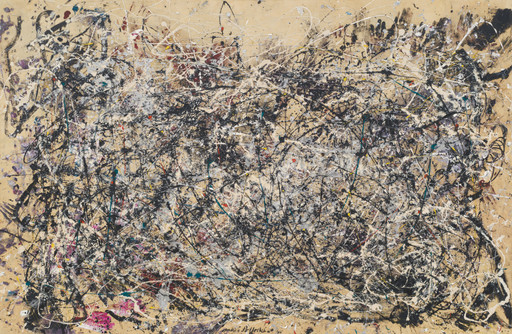
American, 1912–1956 86 works onlineIn 1947 Jackson Pollock arrived at a new mode of working that brought him international fame. His method consisted of flinging and dripping thinned enamel paint onto an unstretched canvas laid on the floor of his studio.
Learn more →

From MoMA Design Store


Installation views
We have identified this work in the following photos from our exhibition history.
Licensing
Artwork or archival images
If you would like to reproduce an image of a work of art in MoMA's collection, or an image of a MoMA publication or archival material (including installation views, checklists, and press releases), please contact Art Resource (publication in North America) or Scala Archives (publication in all other geographic locations).
Audio and film clips
MoMA licenses archival audio and select out of copyright film clips from our film collection. At this time, MoMA produced video cannot be licensed by MoMA/Scala. All requests to license archival audio or out of copyright film clips should be addressed to Scala Archives at [email protected]. Motion picture film stills cannot be licensed by MoMA/Scala. For access to motion picture film stills for research purposes, please contact the Film Study Center at [email protected]. For more information about film loans and our Circulating Film and Video Library, please visit Circulating Film and Video Library.
Text from a publication or the archives
If you would like to reproduce text from a MoMA publication, please email [email protected]. If you would like to publish text from MoMA's archival materials, please fill out this permission form and send to [email protected].
Feedback
This record is a work in progress. If you have additional information or spotted an error, please fill out this feedback form.