From 1944 to 1945, Pollock made a group of eleven engravings (a type of print in which lines are incised into a metal plate with a sharp-pointed tool). He worked on them sporadically over several months at Atelier 17, a print workshop transplanted from Paris to New York during World War II by the British emigré printmaker Stanley William Hayter. Hayter encouraged automatist techniques influenced by Surrealist ideas, for example, moving the plate around while the engraving tool remains still, which allows for spontaneous generation of line and composition.
Pollock's engravings were never shown during his lifetime. Ten years after his death, his widow Lee Krasner found them, along with nine of the eleven plates from which they were printed, in his barn studio; she donated them to MoMA in 1969.
Jackson Pollock: A Collection Survey, 1934-1954, November 22, 2015–May 1, 2016.
Explore more
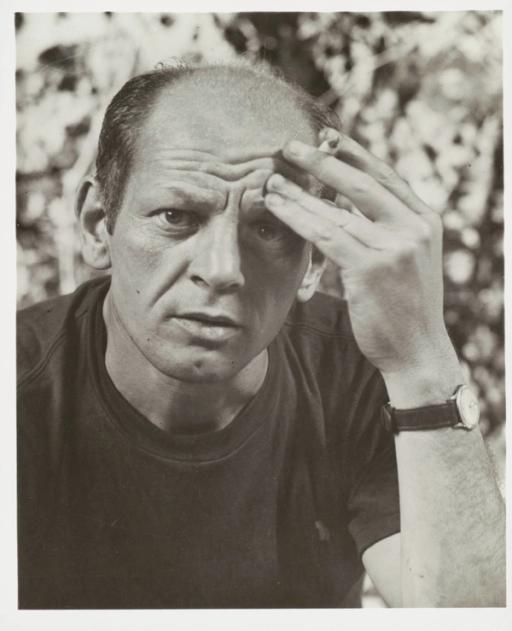
Jackson Pollock
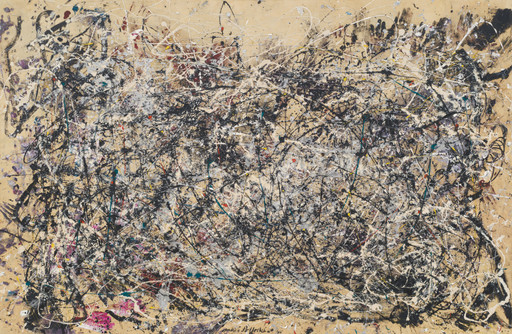
American, 1912–1956 86 works onlineIn 1947 Jackson Pollock arrived at a new mode of working that brought him international fame. His method consisted of flinging and dripping thinned enamel paint onto an unstretched canvas laid on the floor of his studio.
Learn more →

From MoMA Design Store


Installation views
We have identified this work in the following photos from our exhibition history.
Licensing
Artwork or archival images
If you would like to reproduce an image of a work of art in MoMA's collection, or an image of a MoMA publication or archival material (including installation views, checklists, and press releases), please contact Art Resource (publication in North America) or Scala Archives (publication in all other geographic locations).
Audio and film clips
MoMA licenses archival audio and select out of copyright film clips from our film collection. At this time, MoMA produced video cannot be licensed by MoMA/Scala. All requests to license archival audio or out of copyright film clips should be addressed to Scala Archives at [email protected]. Motion picture film stills cannot be licensed by MoMA/Scala. For access to motion picture film stills for research purposes, please contact the Film Study Center at [email protected]. For more information about film loans and our Circulating Film and Video Library, please visit Circulating Film and Video Library.
Text from a publication or the archives
If you would like to reproduce text from a MoMA publication, please email [email protected]. If you would like to publish text from MoMA's archival materials, please fill out this permission form and send to [email protected].
Feedback
This record is a work in progress. If you have additional information or spotted an error, please fill out this feedback form.