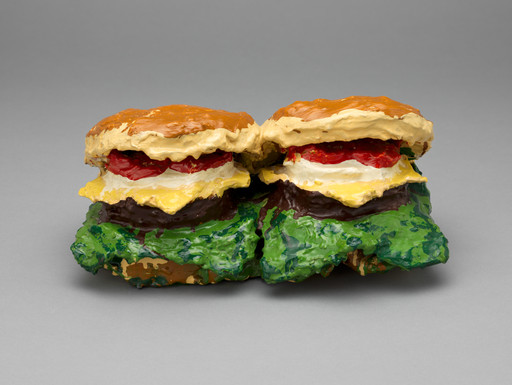
Best known for his oversized soft sculptures of food and consumer objects of the Pop art period, Claes Oldenburg began his career staging avant-garde performances, constructing environments, publishing writings, and generally embracing the commerce of everyday life. Printed work has always played a central role in his art, beginning with commercially produced announcements and ephemera for his Happenings, and continuing with traditional printmaking. Unlike most Pop artists, Oldenburg has been drawn to lithography because of its affinity to drawing rather than to the commercial look of screenprint. He has also produced a significant body of etchings. Engaging various concepts of reproduction and mass-circulation over the course of his career, Oldenburg has created more than two hundred fifty works, designated as "printed stuff" by the compilers of his catalogue raisonné.
Oldenburg's environment called The Store—a storefront display on New York's Lower East Side, shown from December 1961 to January 1962—epitomized the artist's mingling of art, commodity, and commerce. At The Store, he sold painted plaster-and-wire constructions of familiar foodstuffs, clothing, and merchandise, elevating the status of these objects to art. To advertise his endeavor, Oldenburg created numerous printed works, such as business cards, stationery, and posters, including this hand-colored lithograph. Characterized by both a spontaneity of artistic gesture and the desire to self-promote, this print combines the tendencies of 1950s Abstract Expressionists with art's new embrace of consumer culture. The title of the enterprise, The Store, appears at the top, its address of 107 East 2nd Street at the bottom, and the artist's signature in reverse below the title. Oldenburg's array of objects, including a shirt and tie and a piece of cake, capture the humor and irony of this seminal event in contemporary American art.
an essay by Judith Hecker, in Deborah Wye, Artists and Prints: Masterworks from The Museum of Modern Art, New York: The Museum of Modern Art, 2004, p. 154.
Explore more


Audio
Audio from the playlist Made in New York
Audio from the playlist 1950–1980: Works from the Collection
From MoMA Design Store


Installation views
We have identified this work in the following photos from our exhibition history.
Licensing
Artwork or archival images
If you would like to reproduce an image of a work of art in MoMA's collection, or an image of a MoMA publication or archival material (including installation views, checklists, and press releases), please contact Art Resource (publication in North America) or Scala Archives (publication in all other geographic locations).
Audio and film clips
MoMA licenses archival audio and select out of copyright film clips from our film collection. At this time, MoMA produced video cannot be licensed by MoMA/Scala. All requests to license archival audio or out of copyright film clips should be addressed to Scala Archives at [email protected]. Motion picture film stills cannot be licensed by MoMA/Scala. For access to motion picture film stills for research purposes, please contact the Film Study Center at [email protected]. For more information about film loans and our Circulating Film and Video Library, please visit Circulating Film and Video Library.
Text from a publication or the archives
If you would like to reproduce text from a MoMA publication, please email [email protected]. If you would like to publish text from MoMA's archival materials, please fill out this permission form and send to [email protected].
Feedback
This record is a work in progress. If you have additional information or spotted an error, please fill out this feedback form.