Not on view
This "ray gun," as Oldenburg calls it, hardly looks threatening. Its bloated shape, made out of flimsy papier–mâché, resembles a hairdryer as much as it does a weapon. It was made, however, in the spirit of assault, as a parody of artistic traditions and consumer culture. In the 1960s, this work was part of a cacophonous installation called The Street in the basement of Judson Memorial Church in lower Manhattan. The space was filled with an unruly assortment of cardboard and newspaper scraps, burlap objects covered in soot and black paint, and other materials that appeared destined for (if not taken from) the trash. Oldenburg performed in the space on several occasions and in one particularly memorable instance issued one million dollars of Ray Gun currency to audience members, which could be used for purchasing works from the installation.
2008.
Gallery label from Claes Oldenburg: The Street and The Store , April 14–August 5, 2013.
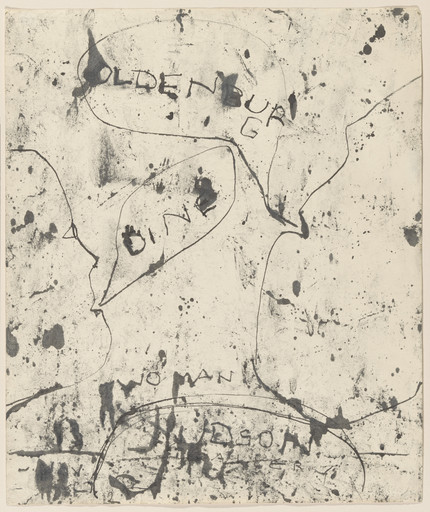
Oldenburg first showed this work in a 1959 two-person exhibition, with Jim Dine, at the Judson Gallery. Constructed of torn newspaper pasted to wire armatures and loosely painted with a wash of casein, the sculptures in that exhibition marked a radical departure from the figurative paintings and drawings that had dominated Oldenburg’s artistic production in the preceding years. Thematically, the ray gun epitomized this shift. “Ray Gun is both a form of deception (to everyone, including myself) and a form of play . . . i.e., only the comic is serious, only the offhand is effective,” Oldenburg wrote in his notebook. “Therefore Ray Gun is a series of contradictions, paradoxes. Ray Gun is ultimately the unknowable, pursued futilely through all its disguises.” An impossible invention of science fiction, the ray gun in Oldenburg’s work can assume any number of forms and exist in a range of materials.
Claes Oldenburg: The Street and The Store, April 14–August 5, 2013.
Explore more


Papier mâché
French for “chewed-up paper,” a technique for creating three-dimensional objects, such as sculpture, from pulped or pasted paper and binders such as glue or plaster.
Learn more →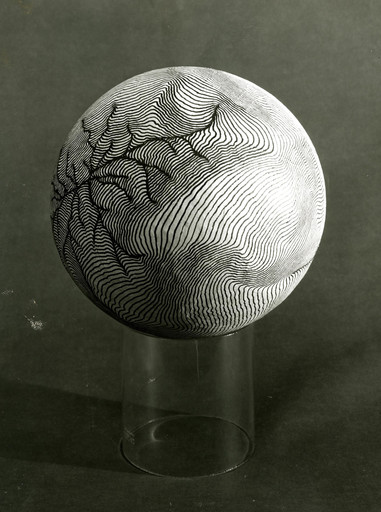


Audio
Audio from the playlist Claes Oldenburg: The Street and The Store
Audio from the playlist 1950–1980: Works from the Collection
From MoMA Design Store


Installation views
We have identified this work in the following photos from our exhibition history.
Licensing
Artwork or archival images
If you would like to reproduce an image of a work of art in MoMA's collection, or an image of a MoMA publication or archival material (including installation views, checklists, and press releases), please contact Art Resource (publication in North America) or Scala Archives (publication in all other geographic locations).
Audio and film clips
MoMA licenses archival audio and select out of copyright film clips from our film collection. At this time, MoMA produced video cannot be licensed by MoMA/Scala. All requests to license archival audio or out of copyright film clips should be addressed to Scala Archives at [email protected]. Motion picture film stills cannot be licensed by MoMA/Scala. For access to motion picture film stills for research purposes, please contact the Film Study Center at [email protected]. For more information about film loans and our Circulating Film and Video Library, please visit Circulating Film and Video Library.
Text from a publication or the archives
If you would like to reproduce text from a MoMA publication, please email [email protected]. If you would like to publish text from MoMA's archival materials, please fill out this permission form and send to [email protected].
Feedback
This record is a work in progress. If you have additional information or spotted an error, please fill out this feedback form.