Lithograph with collage additions from a portfolio of six lithographs (three with collage additions) and two letterpress prints with collage additions (including cover and title page)
Not on view
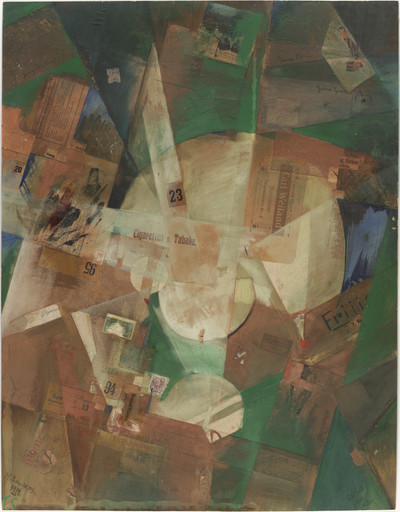
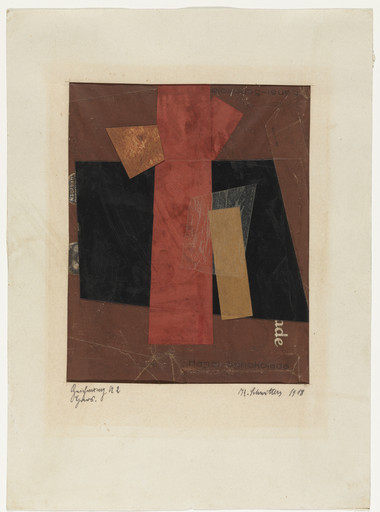
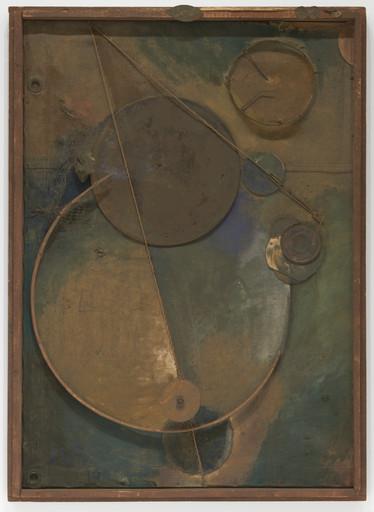
According to Schwitters, his collage-based art form called Merz “denotes essentially the combination of all conceivable materials for artistic purposes.” Merz fused found materials—from paper scraps to fragments of overheard conversations—into art forms ranging from poetry to assemblage. Between 1923 and 1932, Schwitters sporadically published twenty–two issues of Merz; the third issue comprises a portfolio of six unbound lithographs. The grids of squares and rectangles that appear in various scales, shades, and patterns throughout these prints are layered with colorful fragments from advertisements and children’s books—additions that reflect the fragmented social, political, and economic realities of postwar Germany. The prints are detailed with large capital letters, human and doll–like figures, and a duplicated kitten. This layering of commercial ephemera, hand–drawn imagery, and collage demonstrates how Schwitters applied chance and improvisation to his printmaking process and exposes the additive nature of printmaking.
There Will Never Be Silence: Scoring John Cage’s 4’33”, October 12, 2013–June 22, 2014.
Publication excerpt from Deborah Wye, Artists and Prints: Masterworks from The Museum of Modern Art , New York: The Museum of Modern Art, 2004.
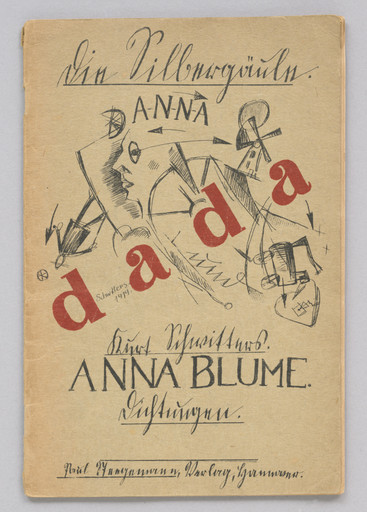
A seminal figure among European avant-garde artists of the 1920s, Kurt Schwitters participated in the Expressionist and Dada movements in Germany and in the international phenomenon known as Constructivism. The printed word—its appearance, meaning, and sound—was a constant source of inspiration for Schwitters. He used printed and stamped letters in his collages and poems, and by the mid-1920s had become a successful graphic designer. Schwitters's involvement with traditional printmaking techniques, however, was limited, as he focused more on ephemeral printed projects.
In 1918, after serving in World War I, Schwitters began publishing his poetry in the Expressionist journal Der Sturm and associating with the artists surrounding this journal and gallery of the same name. The title of Schwitters's book, Die Kathedrale, reflects the Expressionists' embrace of the Gothic cathedral as an emblem of unification in the arts. The white square of paper on the cover, part of a wraparound seal added by Schwitters, declares, "Beware: Anti-Dada." At this point, the Dadaists were antagonistic toward Schwitters, whom they considered bourgeois and not sufficiently political.
"Merz," a play on the German word for commerce, was an overarching term Schwitters used to describe collages, poems, and performances he created by combining such elements as bits of odd paper found in the streets, snippets of overheard conversation, or fragments of text from everyday sources. Between 1923 and 1932 he also published a journal entitled Merz, which comprised twenty-four issues. The third issue is a portfolio of lithographs that served as a special edition of the journal. In typical Dada fashion, he included random elements such as found typographic fragments and photographic images in these prints. However, his concurrent incorporation of geometric abstraction demonstrates his growing involvement with the Constructivist aesthetic.
Deborah Wye, Artists and Prints: Masterworks from The Museum of Modern Art, New York: The Museum of Modern Art, 2004.
Explore more


From MoMA Design Store


Installation views
We have identified this work in the following photos from our exhibition history.
Licensing
Artwork or archival images
If you would like to reproduce an image of a work of art in MoMA's collection, or an image of a MoMA publication or archival material (including installation views, checklists, and press releases), please contact Art Resource (publication in North America) or Scala Archives (publication in all other geographic locations).
Audio and film clips
MoMA licenses archival audio and select out of copyright film clips from our film collection. At this time, MoMA produced video cannot be licensed by MoMA/Scala. All requests to license archival audio or out of copyright film clips should be addressed to Scala Archives at [email protected]. Motion picture film stills cannot be licensed by MoMA/Scala. For access to motion picture film stills for research purposes, please contact the Film Study Center at [email protected]. For more information about film loans and our Circulating Film and Video Library, please visit Circulating Film and Video Library.
Text from a publication or the archives
If you would like to reproduce text from a MoMA publication, please email [email protected]. If you would like to publish text from MoMA's archival materials, please fill out this permission form and send to [email protected].
Feedback
This record is a work in progress. If you have additional information or spotted an error, please fill out this feedback form.