Lyonel Feininger
Cathedral (Kathedrale) for Program of the State Bauhaus in Weimar (Programm des Staatlichen Bauhauses in Weimar)
1919
Woodcut
Not on view
This black-and-white woodcut served as a cover design for the Bauhaus manifesto by architect and founder Walter Gropius. The image reflects the aura of medievalism that pervaded the initial phase of the Bauhaus, whose academic system harks back to the training employed by Late Gothic craft guilds. Lyonel Feininger was invited by Gropius in 1919 to head the printmaking workshop, and he retained his connection with the school until it closed, in 1933.
2006.
Publication excerpt from an essay by Jennifer Roberts, in Deborah Wye, Artists and Prints: Masterworks from The Museum of Modern Art , New York: The Museum of Modern Art, 2004, p. 67.
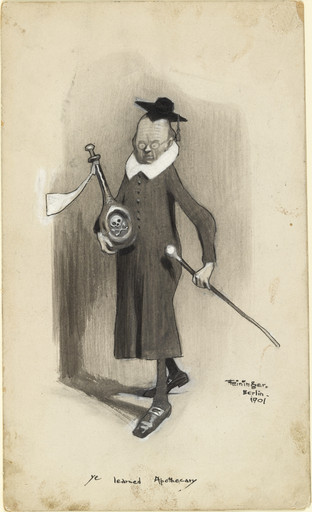
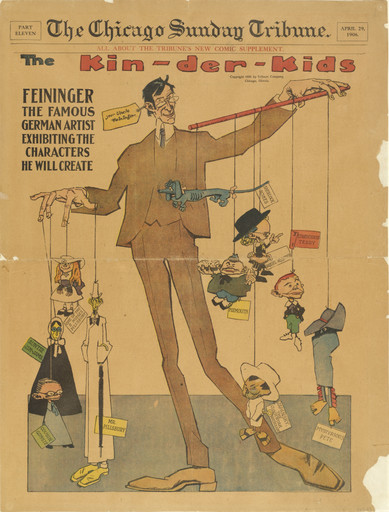
A major figure in German avant-garde art of the early twentieth century, expatriate American painter Lyonel Feininger began his career in Berlin in the 1890s as an illustrator of satirical subjects. He later served as the first artistic director of the printing shop of the Bauhaus, a progressive arts-and-crafts school founded at Weimar in 1919. Of the more than three hundred woodcuts Feininger produced, the one initially titled The Cathedral of Socialism is the most historically significant and widely admired. It served as a cover design for the Bauhaus manifesto by architect Walter Gropius and was meant to symbolize both the unity and the spiritual basis of the various arts under the primacy of architecture.
The fragmented and intersecting planes that convey dynamism in Cathedral first appeared in Feininger's work about 1911, under the influence of Cubism. His drypoint The Gate, depicting tiny figures in a medieval setting animated by exaggerated proportions, includes stark contrasts of light and dark and skewed forms. Feininger's love of Gothic architecture is evident in this town gate, which he depicted in woodcuts and paintings. This print, a high point in Feininger's oeuvre of some sixty-five intaglios from 1906 to 1924, was published after the war in an important series of German print portfolios entitled Die Schaffenden. After Feininger returned to the United States in 1937 to avoid Nazi accusations of being a "degenerate" artist, his printmaking was confined to a small group of lithographs made with noted printer George C. Miller in New York in the 1950s.
an essay by Jennifer Roberts, in Deborah Wye, Artists and Prints: Masterworks from The Museum of Modern Art, New York: The Museum of Modern Art, 2004, p. 67.
Explore more
Bauhaus
The school of art and design founded in Germany by Walter Gropius in 1919, and shut down by the Nazis in 1933.
Learn more →




From MoMA Design Store


Installation views
We have identified this work in the following photos from our exhibition history.
Licensing
Artwork or archival images
If you would like to reproduce an image of a work of art in MoMA's collection, or an image of a MoMA publication or archival material (including installation views, checklists, and press releases), please contact Art Resource (publication in North America) or Scala Archives (publication in all other geographic locations).
Audio and film clips
MoMA licenses archival audio and select out of copyright film clips from our film collection. At this time, MoMA produced video cannot be licensed by MoMA/Scala. All requests to license archival audio or out of copyright film clips should be addressed to Scala Archives at [email protected]. Motion picture film stills cannot be licensed by MoMA/Scala. For access to motion picture film stills for research purposes, please contact the Film Study Center at [email protected]. For more information about film loans and our Circulating Film and Video Library, please visit Circulating Film and Video Library.
Text from a publication or the archives
If you would like to reproduce text from a MoMA publication, please email [email protected]. If you would like to publish text from MoMA's archival materials, please fill out this permission form and send to [email protected].
Feedback
This record is a work in progress. If you have additional information or spotted an error, please fill out this feedback form.