Not on view
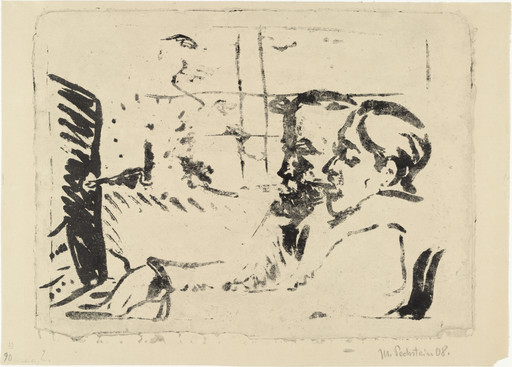
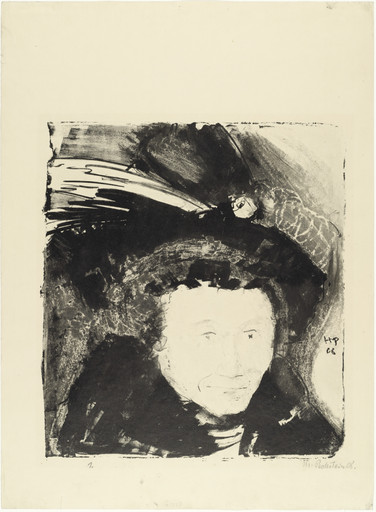
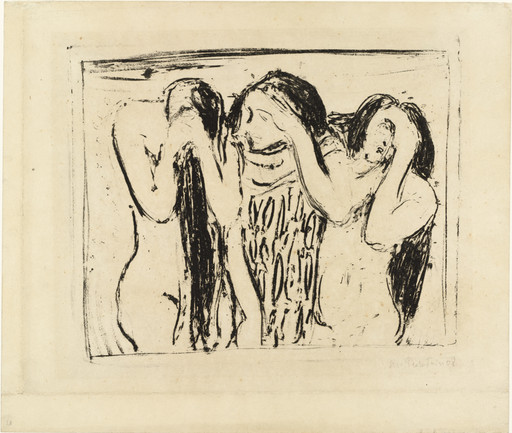
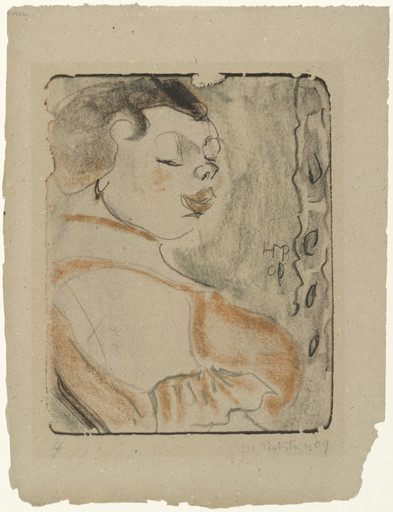
Max Pechstein, who joined the German Expressionist group Brücke (Bridge) in Dresden in 1906, was the only member with academic training as a painter (the founders were all architecture students). He was a dedicated printmaker, completing more than nine hundred prints between 1905 and 1950. Although he moved to Berlin in 1908, three years ahead of the rest of the Brücke group, he remained close, both personally and stylistically, to fellow members Ernst Ludwig Kirchner and Erich Heckel.
Dancers is an exuberant example of the Brücke artists' aspirations for art to be a force for social and cultural renewal. Their anti-bourgeois taste for subjects taken from the fringes of society led them to base many images on the cabaret, with dance especially valued as an immediate and uninhibited form of expression. Stylistically the print is similarly radical, with Pechstein's scribbled outlines and fuzzy, speckled inking causing the overall composition to verge on the abstract. His unusual choice of an acidic yellow paper helps to suggest the lurid atmosphere of a nightclub.
In 1912 Pechstein was expelled from Brücke for exhibiting his work at the Berlin Secession without the other members' consent. Two years later, he traveled to the South Seas, inspired by Oceanic sculpture in the ethnographic museum in Berlin. He later served in the infantry in World War I.
Dancer Reflected in a Mirror was created during the postwar years, a time of confusion and instability in German society. In contrast to the exultant airborne dancer in Pechstein's earlier image, the performer here seems bored and oppressed by her role. The male observers appear similarly disengaged, staring in various directions with unfocused eyes. The mood of indifference in this print contrasts with its bold compositional structure and strong colors, qualities that typified the Expressionist idiom.
an essay by Starr Figura, in Deborah Wye, Artists and Prints: Masterworks from The Museum of Modern Art, New York: The Museum of Modern Art, 2004, p. 58.
Publication excerpt from The Museum of Modern Art, MoMA Highlights , New York: The Museum of Modern Art, revised 2004, originally published 1999, p. 112.
The dramatic gestures of a seductively clad cabaret dancer, seen raising her skirt and pointing her toes, ironically clash with the bored expression on her face. The lines of her skirt and her bent right leg create strong diagonals that draw the viewer's attention to the row of men's faces, making them major protagonists in the scene. These men seem disconnected from their spatially compressed surroundings, and two of them appear overtly disinterested as they stare out with unfocused eyes. Pechstein, who himself had been a soldier at the Somme front in France, executed Dancer Reflected in a Mirror during the post–World War I years, a time of political unrest and financial insecurity in Germany. Reading this woodcut as social commentary, one senses the apathetic decadence that permeated the era.
Early in his career, Pechstein was a member of Brücke, the German Expressionist group. Although he disagreed with their policy of exhibiting exclusively together and was officially expelled in 1912, he continued to create Expressionist images.
The Museum of Modern Art, MoMA Highlights, New York: The Museum of Modern Art, revised 2004, originally published 1999, p. 112.
Explore more
Expressionism
Encompasses varying stylistic approaches that emphasize intense personal expression. Renouncing the stiff bourgeois social values that prevailed at the turn of the 20th century, and rejecting the traditions of the state-sponsored art academies, Expressionist artists turned to boldly simplified or distorted forms and exaggerated, sometimes clashing colors.
Learn more →

Audio
Audio from the playlist Collection 1880s–1940s
From MoMA Design Store


Installation views
We have identified this work in the following photos from our exhibition history.
Provenance Research Project
This work is included in the Provenance Research Project, which investigates the ownership history of works in MoMA's collection.
Margarete Schultz, New York; sold to The Museum of Modern Art, New York, 1957
Provenance research is a work in progress, and is frequently updated with new information. If you have any questions or information to provide about the listed works, please email [email protected] or write to:
Provenance Research Project
The Museum of Modern Art
11 West 53 Street
New York, NY 10019
Licensing
Artwork or archival images
If you would like to reproduce an image of a work of art in MoMA's collection, or an image of a MoMA publication or archival material (including installation views, checklists, and press releases), please contact Art Resource (publication in North America) or Scala Archives (publication in all other geographic locations).
Audio and film clips
MoMA licenses archival audio and select out of copyright film clips from our film collection. At this time, MoMA produced video cannot be licensed by MoMA/Scala. All requests to license archival audio or out of copyright film clips should be addressed to Scala Archives at [email protected]. Motion picture film stills cannot be licensed by MoMA/Scala. For access to motion picture film stills for research purposes, please contact the Film Study Center at [email protected]. For more information about film loans and our Circulating Film and Video Library, please visit Circulating Film and Video Library.
Text from a publication or the archives
If you would like to reproduce text from a MoMA publication, please email [email protected]. If you would like to publish text from MoMA's archival materials, please fill out this permission form and send to [email protected].
Feedback
This record is a work in progress. If you have additional information or spotted an error, please fill out this feedback form.