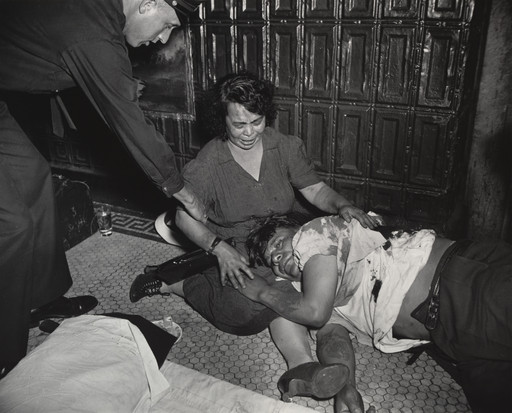
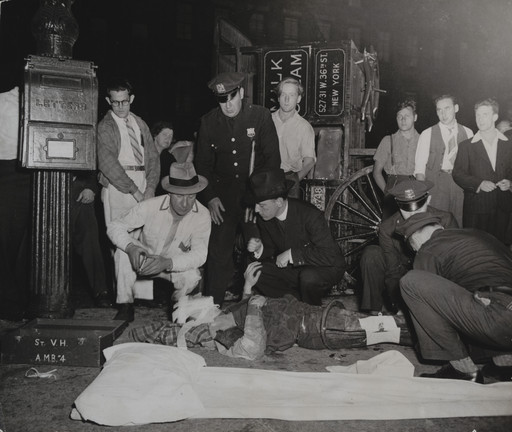
Weegee, a news photographer, borrowed his professional name from the ouija board as a way of advertising his uncanny ability to show up in the right place at the right time. On this occasion, however, it appears that he was not the first to arrive at the scene. Instead of a grisly close-up of the corpse, he gives us a generous view of the aftermath of the crime: the cops have seen it all before and pass the time in bored distraction while the photographers work.
Photographs began to appear in newspapers around the turn of the century, and the heyday of newspaper photography did not get under way until the 1920s. But it did not take long thereafter to establish the staples of the trade: winners and losers, heroes and villains, catastrophes and celebrations—timeless dramas reinvigorated on a daily basis by the specificity of photographic fact. The genre was at its most pure in the tabloid papers, which dispensed with the facade of journalistic reserve in their headlong pursuit of sensation. Nevertheless, as the writer Luc Sante notes: "In Weegee's hands, this cynicism is so extreme it almost becomes a kind of innocence."
The Museum of Modern Art, MoMA Highlights, New York: The Museum of Modern Art, revised 2004, originally published 1999, p. 183.
Explore more
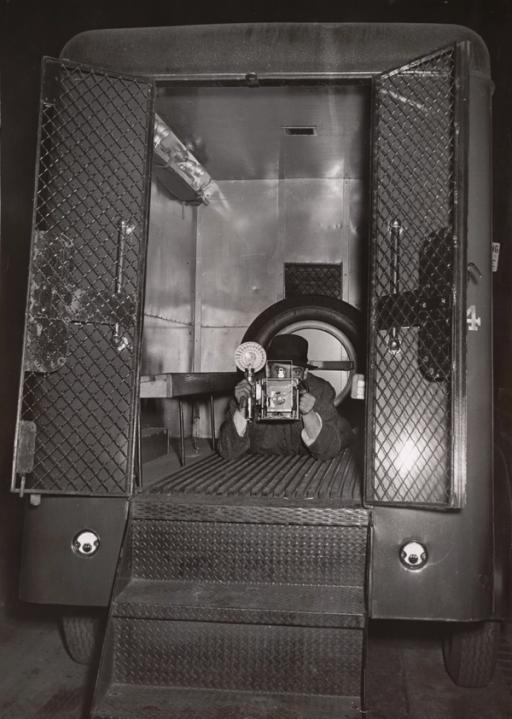
Weegee (Arthur Fellig)
American, born Zloczow, Austria-Hungary (now Zolochiv, Ukraine). 1899–1968 22 works onlineUsher Fellig became Arthur Fellig at the age of 10, when he entered the United States through Ellis Island. He had arrived in New York from Zloczow, Poland (now part of Ukraine) in 1910 with his family; they were fleeing another wave of violent pogroms that had begun sweeping across the Pale of Settlement in 1903.
Learn more →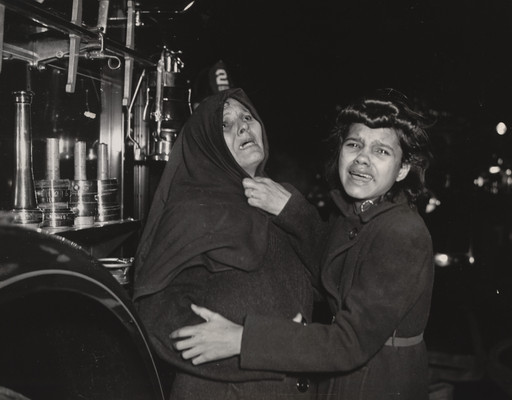
From MoMA Design Store


Installation views
We have identified this work in the following photos from our exhibition history.
Licensing
Artwork or archival images
If you would like to reproduce an image of a work of art in MoMA's collection, or an image of a MoMA publication or archival material (including installation views, checklists, and press releases), please contact Art Resource (publication in North America) or Scala Archives (publication in all other geographic locations).
Audio and film clips
MoMA licenses archival audio and select out of copyright film clips from our film collection. At this time, MoMA produced video cannot be licensed by MoMA/Scala. All requests to license archival audio or out of copyright film clips should be addressed to Scala Archives at [email protected]. Motion picture film stills cannot be licensed by MoMA/Scala. For access to motion picture film stills for research purposes, please contact the Film Study Center at [email protected]. For more information about film loans and our Circulating Film and Video Library, please visit Circulating Film and Video Library.
Text from a publication or the archives
If you would like to reproduce text from a MoMA publication, please email [email protected]. If you would like to publish text from MoMA's archival materials, please fill out this permission form and send to [email protected].
Feedback
This record is a work in progress. If you have additional information or spotted an error, please fill out this feedback form.