Gelatin silver print, printed 1949
Not on view
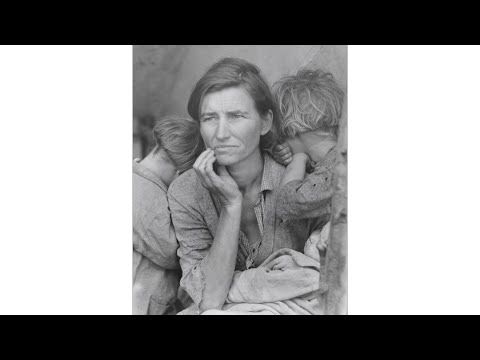
Dorothea Lange took this photograph in 1936, while employed by the U.S. government’s Farm Security Administration (FSA) program, formed during the Great Depression to raise awareness of and provide aid to impoverished farmers. In Nipomo, California, Lange came across Florence Owens Thompson and her children in a camp filled with field workers whose livelihoods were devastated by the failure of the pea crops.
Recalling her encounter with Thompson years later, she said, “I saw and approached the hungry and desperate mother, as if drawn by a magnet. I do not remember how I explained my presence or my camera to her, but I do remember she asked me no questions. I made five exposures, working closer and closer from the same direction.” One photograph from that shoot, now known as Migrant Mother, was widely circulated to magazines and newspapers and became a symbol of the plight of migrant farm workers during the Great Depression.
As Lange described Thompson’s situation, “She and her children had been living on frozen vegetables from the field and wild birds the children caught. The pea crop had frozen; there was no work. Yet they could not move on, for she had just sold the tires from the car to buy food.” However, Thompson later contested Lange’s account. When a reporter interviewed her in the 1970s, she insisted that she and Lange did not speak to each other, nor did she sell the tires of her car. Thompson said that Lange had either confused her for another farmer or embellished what she had understood of her situation in order to make a better story.
Gallery label from 2022
Migrant Mother depicts an impoverished farmworker and her children at a pea-pickers’ camp in California. Lange created this iconic photograph by emulating well-known Christian iconography of Mary and the infant Jesus in an attempt to compel 1930s viewers to extend religious compassion to rural families experiencing famine. The Farm Security Administration commissioned photographs like this one to promote New Deal social programs aiding those afflicted by the Dust Bowl. Historians have recently observed that images of white suffering were more likely to garner support and receive wide circulation than images of Black families in similar poses and conditions.
2022
Publication excerpt from MoMA Highlights: 375 Works from The Museum of Modern Art, New York (New York: The Museum of Modern Art, 2019)
For many, Lange’s Migrant Mother, Nipomo, California is the single most recognizable image from the Great Depression, epitomizing the desperate circumstances many found themselves in during that period. The now-iconic photograph was made for the US government’s Resettlement Administration (renamed the Farm Security Administration, or FSA, in 1937), a federal agency created to document and remedy the plight of the urban and rural poor in the 1930s. The photograph’s pictorial strength and emotional impact, combined with its recurring presence in newspapers, magazines, exhibitions, and displays, cemented its place in America’s collective memory of the era.
In the image, thirty-two-year-old migrant farmworker Florence Owens Thompson and three of her children are depicted huddled together in a tent at a pea-pickers’ camp in Nipomo, California. Lange’s taut composition excludes all but the most essential information. In lieu of the girls’ faces, we see their tousled heads nestling against their mother’s shoulders; their anonymity serves to lend these familial bonds a sense of universality. Still, Lange’s large negative captures a wealth of detail that anchors our experience in specific fact, from the frayed fabric to Thompson’s weary, concerned, strikingly beautiful face.
Lange’s work connected the descriptive style of documentary photography with the principle of social engagement. It has become a touchstone for photographers who feel that their work should not only record social conditions but also persuade people to improve them.
MoMA Highlights: 375 Works from The Museum of Modern Art, New York (New York: The Museum of Modern Art, 2019)
Explore more
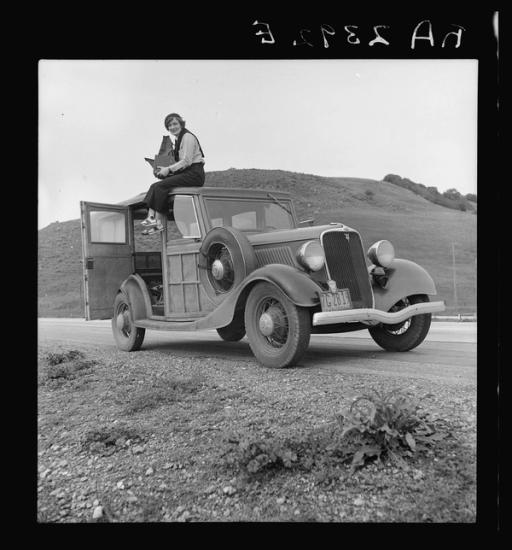
Dorothea Lange
American, 1895–1965 470 works onlineIn early March, 1936, Dorothea Lange drove past a sign reading, “PEA-PICKERS CAMP,” in Nipomo, California. At the time, she was working as a photographer for the Resettlement Administration (RA), a Depression-era government agency formed to raise public awareness of and provide aid to struggling farmers.
Learn more →
Modern art
Art made from the 1880s to the 1970s—a time marked by the growth of cities, the rise of industry, a surge in technologies, and the development of mass media.
Learn more →
Audio
Audio from the playlist Audio Descriptions
Audio from the playlist 1880–1950: Works from the Collection
Audio from the playlist Dorothea Lange: Words & Pictures
Articles and videos
From MoMA Design Store


Installation views
We have identified this work in the following photos from our exhibition history.
Licensing
Artwork or archival images
If you would like to reproduce an image of a work of art in MoMA's collection, or an image of a MoMA publication or archival material (including installation views, checklists, and press releases), please contact Art Resource (publication in North America) or Scala Archives (publication in all other geographic locations).
Audio and film clips
MoMA licenses archival audio and select out of copyright film clips from our film collection. At this time, MoMA produced video cannot be licensed by MoMA/Scala. All requests to license archival audio or out of copyright film clips should be addressed to Scala Archives at [email protected]. Motion picture film stills cannot be licensed by MoMA/Scala. For access to motion picture film stills for research purposes, please contact the Film Study Center at [email protected]. For more information about film loans and our Circulating Film and Video Library, please visit Circulating Film and Video Library.
Text from a publication or the archives
If you would like to reproduce text from a MoMA publication, please email [email protected]. If you would like to publish text from MoMA's archival materials, please fill out this permission form and send to [email protected].
Feedback
This record is a work in progress. If you have additional information or spotted an error, please fill out this feedback form.