Not on view
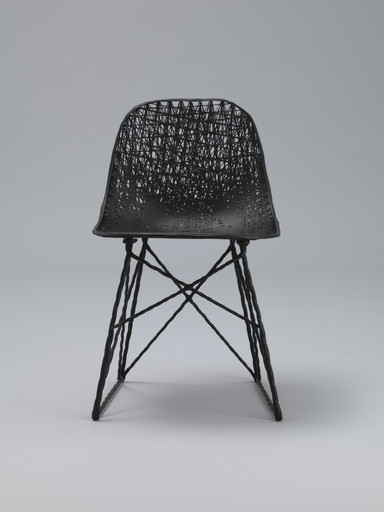
“That a piece of rope became stable, [and] we could sit on it—it was a little miracle,” Wanders has said of the Knotted Chair. Designed for the Dutch collective Droog Design, the chair blends the traditional technique of macramé, through which textiles are made using knotting, with high-tech industrial processes. Wanders collaborated with the Delft University of Technology’s aviation faculty to produce a cord composed of aramid fibers—a strong, lightweight, and heat-resistant material used in aerospace engineering. To make the chair, aramid cords are twisted around a carbon core, knotted together by hand, and draped over a mold. The soft net is then infused with epoxy resin that hardens as it dries.
Pirouette: Turning Points in Design, January 26, 2025–November 15, 2025
Publication excerpt from The Museum of Modern Art, MoMA Highlights since 1980 , New York: The Musuem of Modern Art, 2007, p. 174.
Knotted Chair, designed by Wanders for the Dutch design group Droog Design, is an adaptation of macramé, a technique of knotting thread or cord to create a textile similar to coarse lace. The chair is a product of Droog's collaboration with the faculty of aviation at Delft Technical University in the investigation of new materials and fabrication techniques. Knotted Chair was the first project by Wanders to attract international interest, and the Italian furniture manufacturer Cappellini soon developed a prototype for production.
To make the chair, cords composed of aramid fibers twisted around a carbon core are knotted together by hand before being draped over a mold. The soft net is then infused with epoxy resin and dried to harden the textile and set the chair's shape. This process, termed Dry Tech, employs passive, low-energy techniques—saturating, molding, and drying—to achieve strength and stability of form. The resulting chair is lightweight, delicate, and intricately formed, yet is surprisingly sturdy, supportive, and durable. A marriage of high-technology materials with the methods of traditional craft, Knotted Chair confounds expectations of how a textile should perform; Wanders has created a surreal doll's chair for adults.
The Museum of Modern Art, MoMA Highlights since 1980, New York: The Musuem of Modern Art, 2007, p. 174.
Gallery label from Applied Design , March 2, 2013–January 31, 2014
Knotted Chair, designed by Wanders for the Dutch design collective Droog Design, is an adaptation of macramé, a technique of knotting thread or cord to create a textile similar to coarse lace. The chair is a product of Droog’s collaboration with the faculty of aviation at Delft Technical University in the investigation of new materials and fabrication techniques. To make the chair, cords composed of aramid fibers—a strong and lightweight heat-resistant material commonly used in aerospace—twisted around a carbon core are knotted together by hand before being draped over a mold. The soft net is then infused with epoxy resin and dried to harden the textile and set the chair’s shape.
Applied Design, March 2, 2013–January 31, 2014
Explore more
Furniture and interiors
An object or environment designed to accommodate human activities such as sitting, sleeping, or eating. Examples include chairs, tables, and kitchens.
Learn more →




From MoMA Design Store


Installation views
We have identified this work in the following photos from our exhibition history.
Licensing
Artwork or archival images
If you would like to reproduce an image of a work of art in MoMA's collection, or an image of a MoMA publication or archival material (including installation views, checklists, and press releases), please contact Art Resource (publication in North America) or Scala Archives (publication in all other geographic locations).
Audio and film clips
MoMA licenses archival audio and select out of copyright film clips from our film collection. At this time, MoMA produced video cannot be licensed by MoMA/Scala. All requests to license archival audio or out of copyright film clips should be addressed to Scala Archives at [email protected]. Motion picture film stills cannot be licensed by MoMA/Scala. For access to motion picture film stills for research purposes, please contact the Film Study Center at [email protected]. For more information about film loans and our Circulating Film and Video Library, please visit Circulating Film and Video Library.
Text from a publication or the archives
If you would like to reproduce text from a MoMA publication, please email [email protected]. If you would like to publish text from MoMA's archival materials, please fill out this permission form and send to [email protected].
Feedback
This record is a work in progress. If you have additional information or spotted an error, please fill out this feedback form.