George Grosz
"The Convict" Monteur John Heartfield After Franz Jung's Attempt to Get Him Up on His Feet ("Der Sträfling" Monteur John Heartfield nach Franz Jungs Versuch ihn auf die Beine zu stellen)
1920
Watercolor, ink, pencil, and cut-and-pasted printed paper on paper
Not on view
The title of this dual portrait refers to the artist’s close friend and collaborator John Heartfield, while the face is that of Grosz himself. The figure’s uniform and the drab, spartan surroundings suggest a sanatorium, where both artists spent time: Heartfield in 1915, after having feigned a nervous breakdown during his military service; and Grosz in 1917, after having suffered or simulated mental instability just one month after he was drafted. Pasted fragments of a postcard, including the words "Good luck in [your] new home," serve as a window for the tiny cell. Franz Jung, referred to in the title, was an expressionist writer and founding member of Club Dada.
Dada, June 18–September 11, 2006
Publication excerpt from MoMA Highlights: 375 Works from The Museum of Modern Art, New York (New York: The Museum of Modern Art, 2019)
In this work, Grosz combined traditional, delicately hued watercolor with printed reproductions pasted in an unreal space that was inspired by the work of the Italian painter Giorgio de Chirico. These pictorial devices convey the satirical ideology that Grosz shared with his subject, John Heartfield, a friend and fellow Berlin Dada artist with whom he frequently collaborated. Heartfield is depicted as bald and grim-faced, with clenched fists and a machine for a heart—the personification of the politically defiant antiauthoritarian, which was the stance Heartfield took in his own art.
His uniform and the drab walls and floor suggest a prisoner in his cell, and the segmented view of a building in the distance, as if glimpsed through a narrow window, bears the mordant inscription “Lots of luck in your new home.” The mechanical device indicates Heartfield’s identity as an engineer or constructor (monteur) of photomontages, collages made with cut-and-pasted photographs. In fact, Heartfield called himself a monteur-dada rather than an artist, and he intended his assembled images for mass reproduction only, in magazines and on book covers and posters.
MoMA Highlights: 375 Works from The Museum of Modern Art, New York (New York: The Museum of Modern Art, 2019)
Gallery label from 2024
In this work Grosz depicts John Heartfield, a friend, collaborator, and fellow artist involved in Berlin Dada, a politically engaged artistic movement that formed after World War I and was characterized by satire, provocation, and critical social commentary. The portrait combines delicately hued watercolors with printed images and represents Heartfield as bald and grim-faced, with clenched fists and a machine for a heart. The mechanical device indicates his identity as a constructor (monteur) of photomontages, collages made with cut-and-pasted photographs. Heartfield called himself a monteur-dada rather than an artist, and he intended his assembled images for mass reproduction only, in magazines and on book covers and posters.
2024
Explore more
![George Grosz. The End of the Road (Out of Fear of Starvation) [Das Ende des Weges (Aus Nahrungssorgen)]](https://www.moma.org/media/W1siZiIsIjEyMTkwNyJdLFsicCIsImNvbnZlcnQiLCItcXVhbGl0eSA5MCAtcmVzaXplIDUxMng1MTJcdTAwM2UiXV0.jpg?sha=850dbdbeee9e852c)
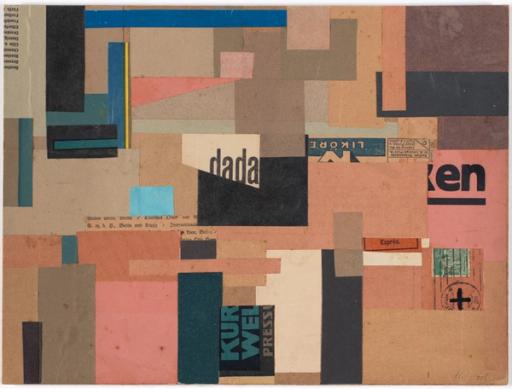
Dada
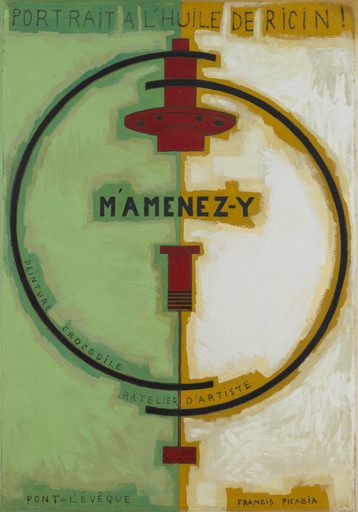
An artistic and literary movement formed in response to the disasters of World War I (1914–18) and to an emerging modern media and machine culture.
Learn more →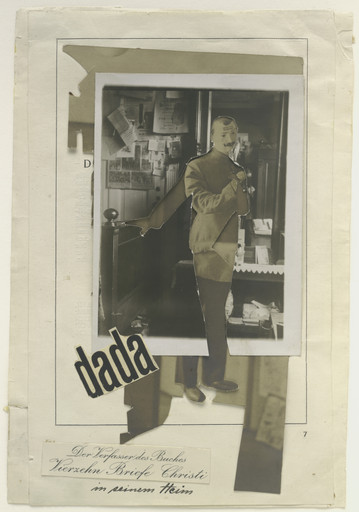


From MoMA Design Store


Installation views
We have identified this work in the following photos from our exhibition history.
Provenance Research Project
This work is included in the Provenance Research Project, which investigates the ownership history of works in MoMA's collection.
Dr. Hermann Post, Berlin, then New York. Purchased from Grosz in Berlin in 1920 - at least until 1934 in New York
A. Conger Goodyear, New York. [Purchased from Hermann Post,] by 1936 – 1952
The Museum of Modern Art, New York. Gift of A. Conger Goodyear, October 1952
Provenance research is a work in progress, and is frequently updated with new information. If you have any questions or information to provide about the listed works, please email [email protected] or write to:
Provenance Research Project
The Museum of Modern Art
11 West 53 Street
New York, NY 10019
Licensing
Artwork or archival images
If you would like to reproduce an image of a work of art in MoMA's collection, or an image of a MoMA publication or archival material (including installation views, checklists, and press releases), please contact Art Resource (publication in North America) or Scala Archives (publication in all other geographic locations).
Audio and film clips
MoMA licenses archival audio and select out of copyright film clips from our film collection. At this time, MoMA produced video cannot be licensed by MoMA/Scala. All requests to license archival audio or out of copyright film clips should be addressed to Scala Archives at [email protected]. Motion picture film stills cannot be licensed by MoMA/Scala. For access to motion picture film stills for research purposes, please contact the Film Study Center at [email protected]. For more information about film loans and our Circulating Film and Video Library, please visit Circulating Film and Video Library.
Text from a publication or the archives
If you would like to reproduce text from a MoMA publication, please email [email protected]. If you would like to publish text from MoMA's archival materials, please fill out this permission form and send to [email protected].
Feedback
This record is a work in progress. If you have additional information or spotted an error, please fill out this feedback form.