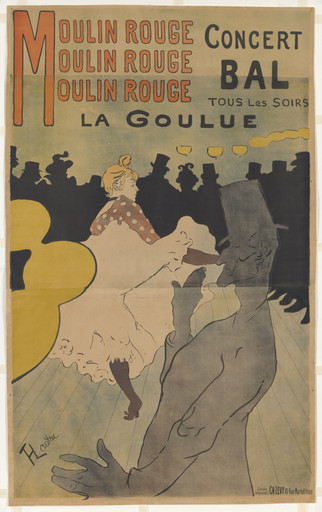
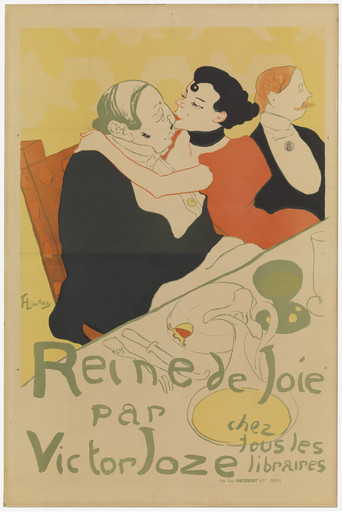
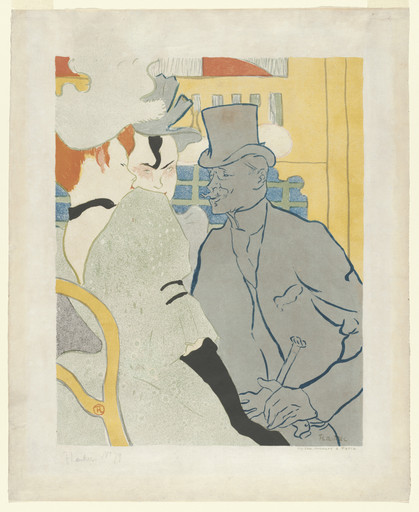
La Goulue (The Glutton), born Louise Weber, was an ambitious country laundress who became famous dancing the cancan. Nicknamed for her insatiable appetite for both life and food, she aggressively courted fame, dancing in transparent muslin knickers, posing topless in publicity photos, and cultivating a reputation for bawdiness. Her costume consisted of a low-cut gown, a much-copied hairstyle, and a black ribbon choker. Her look was so distinctive that in Lautrec’s most famous images of her, he did not even need to show her from the front. These images reveal his debt to Japanese ukiyo-e woodcuts, in which subjects are often identified by gestures, hairstyles, or accessories rather than a traditional likeness.
The Paris of Toulouse-Lautrec: Prints and Posters, July 26, 2014–March 22, 2015.
Gallery label from 2008.
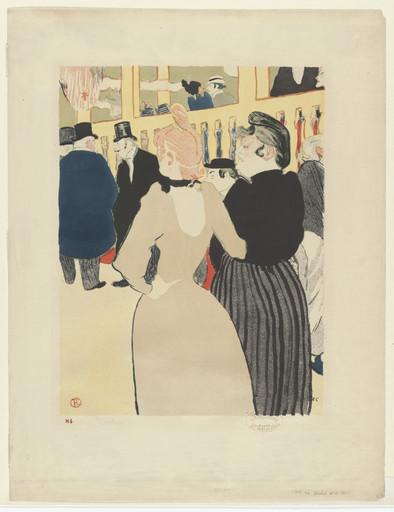
Louise Weber, nicknamed La Goulue (the glutton), is depicted in the Moulin Rouge—a Montmartre cabaret frequented by the Parisian demimonde—flanked by her sister to her right and, to her left, her lover. Toulouse-Lautrec made many paintings of Weber, a star performer known for her appetite. Throughout his work he portrayed unconventional individuals in an audacious manner both frank and sympathetic. The shallow space, bold cropping, and heavy, form-flattening outlines reflect the pictorial devices of Japanese woodblock prints and the work of Edgar Degas, which Toulouse–Lautrec greatly admired. The artist considered this work to be the best of his dance-hall paintings and exhibited it four times the year it was completed.
2008.
Explore more
Henri de Toulouse-Lautrec
French, 1864–1901 165 works onlineDuring his brief artistic career, Henri de Toulouse-Lautrec captured the lively and often sordid atmosphere of Montmartre’s late-19th-century dance halls, cabarets, and theaters.
Learn more →
Post-Impressionism
A term coined in 1910 by the English art critic and painter Roger Fry and applied to the reaction against the naturalistic depiction of light and color in Impressionism.
Learn more →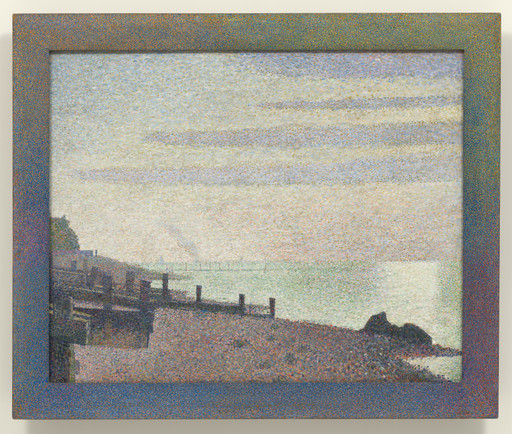

From MoMA Design Store


Installation views
We have identified this work in the following photos from our exhibition history.
Provenance Research Project
This work is included in the Provenance Research Project, which investigates the ownership history of works in MoMA's collection.
[Madame Holzer, Paris]
[M. Julien, Paris]
By 1919 - [April 15, 1940], Gaston Bernheim-Jeune (Gaston Bernheim de Villers, 1870-1953), Paris.
April 15 - May 1940, Knoedler & Co., New York (stock no. A2227) and Sam Salz, New York, jointly purchased from "Bernheim Jeune Paris".
May 1940 - 1957, Adele R. and David M. Levy, New York, purchased from Knoedler & Co. and Sam Salz.
1957, The Museum of Modern Art, New York, acquired as gift from Adele R. Levy.
Provenance research is a work in progress, and is frequently updated with new information. If you have any questions or information to provide about the listed works, please email [email protected] or write to:
Provenance Research Project
The Museum of Modern Art
11 West 53 Street
New York, NY 10019
Licensing
Artwork or archival images
If you would like to reproduce an image of a work of art in MoMA's collection, or an image of a MoMA publication or archival material (including installation views, checklists, and press releases), please contact Art Resource (publication in North America) or Scala Archives (publication in all other geographic locations).
Audio and film clips
MoMA licenses archival audio and select out of copyright film clips from our film collection. At this time, MoMA produced video cannot be licensed by MoMA/Scala. All requests to license archival audio or out of copyright film clips should be addressed to Scala Archives at [email protected]. Motion picture film stills cannot be licensed by MoMA/Scala. For access to motion picture film stills for research purposes, please contact the Film Study Center at [email protected]. For more information about film loans and our Circulating Film and Video Library, please visit Circulating Film and Video Library.
Text from a publication or the archives
If you would like to reproduce text from a MoMA publication, please email [email protected]. If you would like to publish text from MoMA's archival materials, please fill out this permission form and send to [email protected].
Feedback
This record is a work in progress. If you have additional information or spotted an error, please fill out this feedback form.