Not on view
A dancer kicks her right foot high, petticoats swirling, while the crowd, silhouetted against the low gaslight of the dance hall, forms a circle around her. Moulin Rouge, La Goulue was commissioned for the Moulin Rouge—a newly opened cabaret that aspired to be the most luxurious nightspot in Paris—and features a well-known cancan dancer whose stage name was La Goulue, or “the glutton”: Louise Weber, a laundress who had left the countryside to seek fame and fortune in the city.
This was the first poster by Toulouse-Lautrec, and it marked the start of his meteoric rise to recognition as one of the most innovative and influential printmakers of the late nineteenth century. The lithograph is ambitiously large—so big that it had to be printed on three separate sheets of paper—and compositionally audacious, using the white of the paper, essentially an unprinted, blank area, to serve as the central form of La Goulue’s skirts. Moulin Rouge, La Goulue is also a group portrait of Paris’s famed demimonde, the society of fringe celebrities whose various members, such as the dancer Jane Avril, the hostess Misia Natanson, and man-about-town William Warrener (all subjects in Toulouse-Lautrec’s other work), are identifiable, even as silhouettes, by their distinctive hats.
MoMA Highlights: 375 Works from The Museum of Modern Art, New York (New York: The Museum of Modern Art, 2019)
Explore more
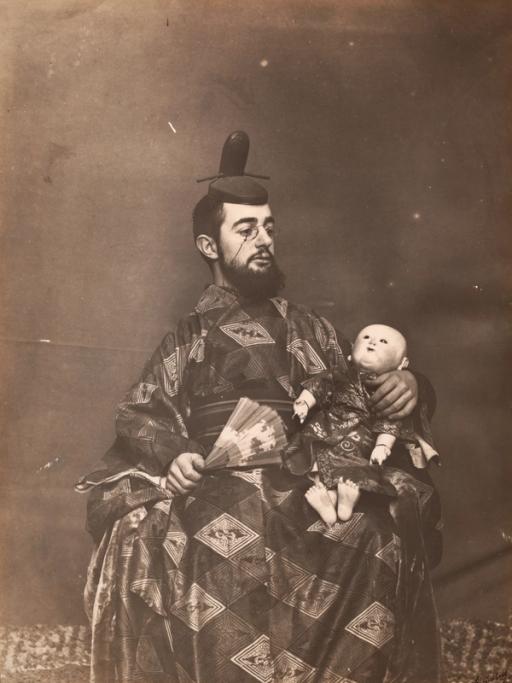
Henri de Toulouse-Lautrec
French, 1864–1901 165 works onlineDuring his brief artistic career, Henri de Toulouse-Lautrec captured the lively and often sordid atmosphere of Montmartre’s late-19th-century dance halls, cabarets, and theaters.
Learn more →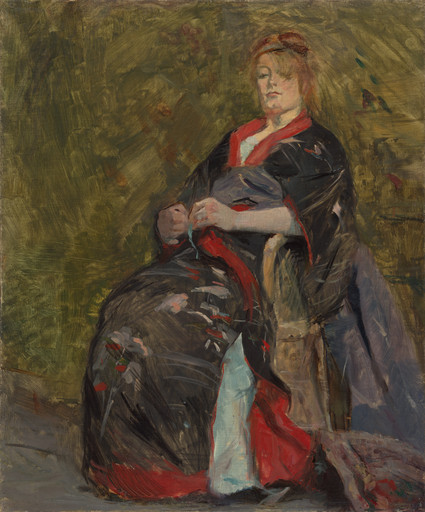
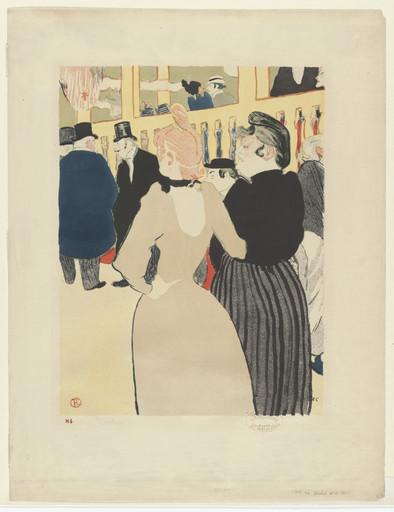
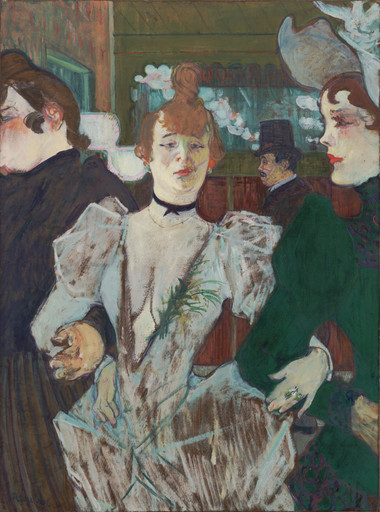
From MoMA Design Store


Installation views
We have identified this work in the following photos from our exhibition history.
Licensing
Artwork or archival images
If you would like to reproduce an image of a work of art in MoMA's collection, or an image of a MoMA publication or archival material (including installation views, checklists, and press releases), please contact Art Resource (publication in North America) or Scala Archives (publication in all other geographic locations).
Audio and film clips
MoMA licenses archival audio and select out of copyright film clips from our film collection. At this time, MoMA produced video cannot be licensed by MoMA/Scala. All requests to license archival audio or out of copyright film clips should be addressed to Scala Archives at [email protected]. Motion picture film stills cannot be licensed by MoMA/Scala. For access to motion picture film stills for research purposes, please contact the Film Study Center at [email protected]. For more information about film loans and our Circulating Film and Video Library, please visit Circulating Film and Video Library.
Text from a publication or the archives
If you would like to reproduce text from a MoMA publication, please email [email protected]. If you would like to publish text from MoMA's archival materials, please fill out this permission form and send to [email protected].
Feedback
This record is a work in progress. If you have additional information or spotted an error, please fill out this feedback form.