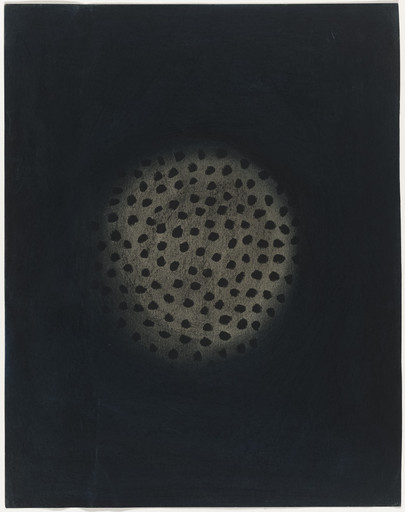
In this particular accumulation, Kusama put aside her brushes and paint and picked up paper savers (circular adhesives used to reinforce holes punched into paper) and charcoal. She affixed the white paper savers to white paper as “found” polka dots, covering its entire surface. She then delicately shaded much of the space between the paper savers with smoky, gestural charcoal marks. Here she merges traditional artistic mediums—charcoal, paper—with everyday materials, in this case, a common office supply. Kusama continued to incorporate everyday items like postage stamps, furniture, clothing, and household items into her works on paper, paintings, sculptures, and installations. She covered some of these items with accretions of protuberances or polka dots, and crowded others into compositions reflecting the massing, hallucinatory images that assailed her. “So many different images leaped into my eyes that I was left dazzled and dumbfounded,” she has said about one such hallucination.
In The Studio: Postwar Abstract Painting online course, Coursera, 2017
Explore more
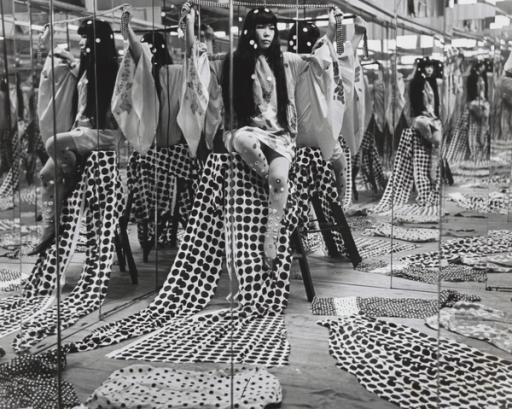
Yayoi Kusama
Japanese, 1929–2026 112 works onlineA vital part of New York’s avant-garde art scene from the late 1950s to the early 1970s, Yayoi Kusama developed a distinctive style utilizing approaches associated with Abstract Expressionism , Minimalism , Pop art , Feminist art , and institutional critique —but she always defined herself in her own terms.
Learn more →

From MoMA Design Store


Installation views
We have identified this work in the following photos from our exhibition history.
Licensing
Artwork or archival images
If you would like to reproduce an image of a work of art in MoMA's collection, or an image of a MoMA publication or archival material (including installation views, checklists, and press releases), please contact Art Resource (publication in North America) or Scala Archives (publication in all other geographic locations).
Audio and film clips
MoMA licenses archival audio and select out of copyright film clips from our film collection. At this time, MoMA produced video cannot be licensed by MoMA/Scala. All requests to license archival audio or out of copyright film clips should be addressed to Scala Archives at [email protected]. Motion picture film stills cannot be licensed by MoMA/Scala. For access to motion picture film stills for research purposes, please contact the Film Study Center at [email protected]. For more information about film loans and our Circulating Film and Video Library, please visit Circulating Film and Video Library.
Text from a publication or the archives
If you would like to reproduce text from a MoMA publication, please email [email protected]. If you would like to publish text from MoMA's archival materials, please fill out this permission form and send to [email protected].
Feedback
This record is a work in progress. If you have additional information or spotted an error, please fill out this feedback form.