Not on view
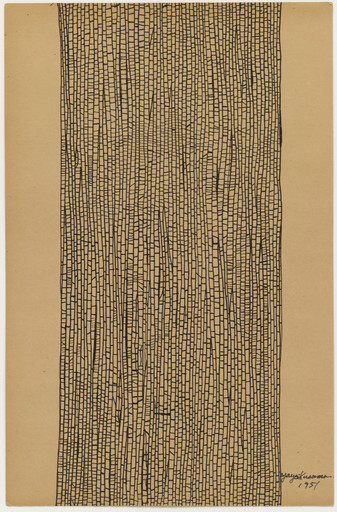
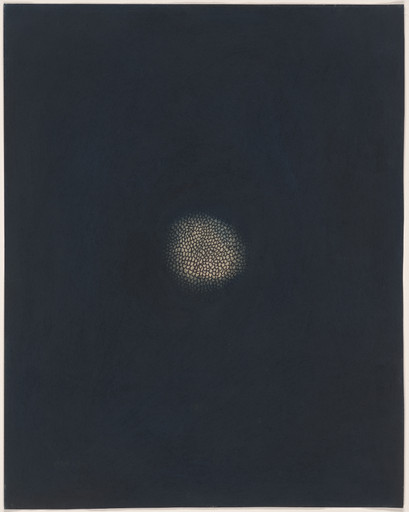
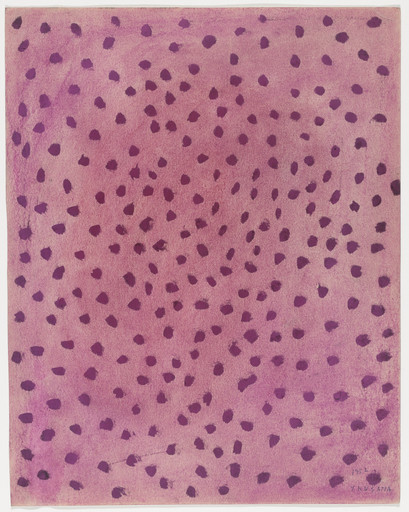
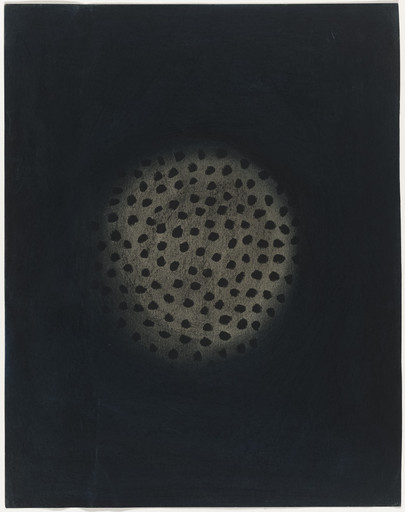
Kusama’s regular use of polka dots has made her name synonymous with this motif. They begin to appear in her earliest compositions, including Accumulation, an ink-on-paperboard field of black polka dots in empty space. This drawing is among the thousands of paintings and drawings on paper she began producing in 1951 in Japan. Though the scale of these compositions is intimate, for the artist they evoke a sense of vastness. She once described them as reflecting “the great depth of my inner heart.” Like much of her work to come, Accumulation is based on repetition—or as its title suggests, on the accumulation of her repeating marks—and stems largely from the aural and visual hallucinations Kusama had been experiencing since she was 10 years old. “I translate the hallucinations and obsessional images that plague me into sculptures and paintings,” she once explained.
In The Studio: Postwar Abstract Painting online course, Coursera, 2017
Explore more
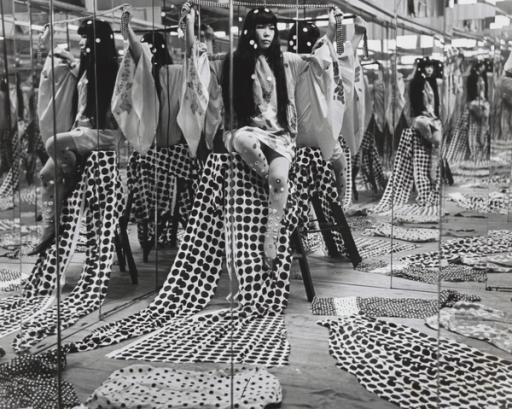
Yayoi Kusama
Japanese, 1929–2026 112 works onlineA vital part of New York’s avant-garde art scene from the late 1950s to the early 1970s, Yayoi Kusama developed a distinctive style utilizing approaches associated with Abstract Expressionism , Minimalism , Pop art , Feminist art , and institutional critique —but she always defined herself in her own terms.
Learn more →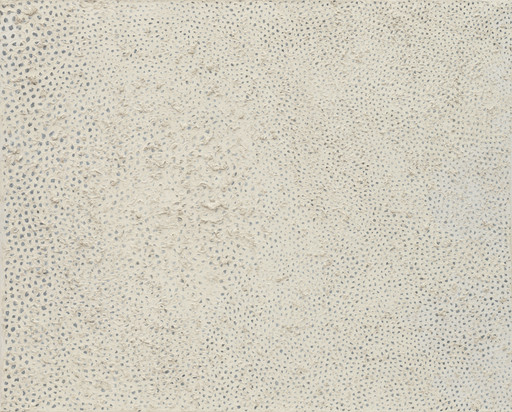


Articles and videos
From MoMA Design Store


Installation views
We have identified this work in the following photos from our exhibition history.
Licensing
Artwork or archival images
If you would like to reproduce an image of a work of art in MoMA's collection, or an image of a MoMA publication or archival material (including installation views, checklists, and press releases), please contact Art Resource (publication in North America) or Scala Archives (publication in all other geographic locations).
Audio and film clips
MoMA licenses archival audio and select out of copyright film clips from our film collection. At this time, MoMA produced video cannot be licensed by MoMA/Scala. All requests to license archival audio or out of copyright film clips should be addressed to Scala Archives at [email protected]. Motion picture film stills cannot be licensed by MoMA/Scala. For access to motion picture film stills for research purposes, please contact the Film Study Center at [email protected]. For more information about film loans and our Circulating Film and Video Library, please visit Circulating Film and Video Library.
Text from a publication or the archives
If you would like to reproduce text from a MoMA publication, please email [email protected]. If you would like to publish text from MoMA's archival materials, please fill out this permission form and send to [email protected].
Feedback
This record is a work in progress. If you have additional information or spotted an error, please fill out this feedback form.