Charcoal and watercolor on paper
Not on view
At first glance, this drawing appears to be totally abstract, despite its descriptive title. In fact, the vertical lines at the base of the oval represent a pier that stretches into an ocean of short horizontal and vertical lines above and around it. At times crossing or lying perpendicular to one another, these lines reflect the rhythmic ebb and flow of the sea, and, with the areas of white paint, the reflected starlight overhead.
Mondrian had begun to experiment with abstraction before 1912, when he left for Paris, where for two years he was exposed to Cubism. He returned to the Netherlands with renewed determination to create a purer abstract form at the expense of more illustrative elements. His highly individual version of Cubism simplified it into a vertical-horizontal grid, in which shading was flattened to the surface to form areas of muted color.
In the Pier and Ocean series of 1914–15, color is eliminated, and the grid opens to form a cluster of "plus-and-minus" signs within a Cubist oval. The reduction to vertical and horizontal generalizes the artist's sources in nature into a symbolic structure representing what Mondrian saw as a cosmic dualism between the masculine and spiritual (vertical) and the feminine and material (horizontal). His system of cruciform signs here speaks to flickering light and movement on water and also to a spiritual structure within nature itself—in his words, "a true vision of reality."
The Museum of Modern Art, MoMA Highlights, New York: The Museum of Modern Art, revised 2004, originally published 1999.
Gallery label from Geo/Metric: Prints and Drawings from the Collection , June 11–August 18, 2008.
Mondrian's abstracted pier—the vertical lines at the base of the oval—stretches into an ocean of short lines and crosses that suggest flickering light on the surface of water. The artist forged his approach to abstraction through Cubism, which he encountered during the two years he lived in Paris, from 1912 to 1914. He said, "I wish to approach truth as closely as is possible, and therefore I abstract everything until I arrive at the fundamental quality of objects."
Geo/Metric: Prints and Drawings from the Collection, June 11–August 18, 2008.
Explore more
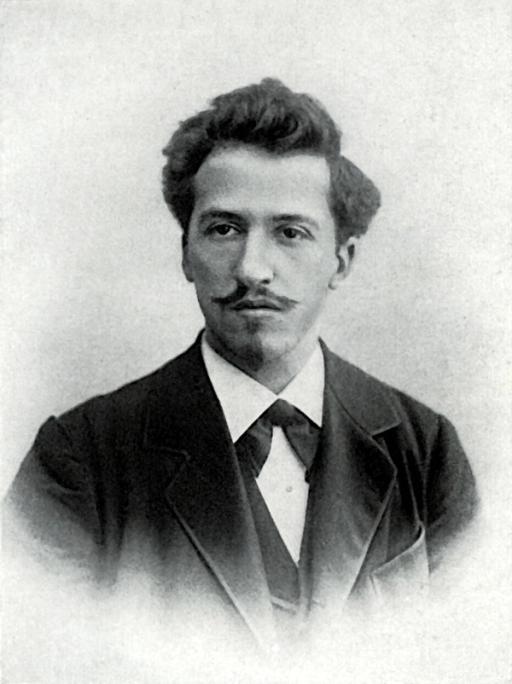
Piet Mondrian
Dutch, 1872–1944 30 works onlineFor Piet Mondrian, abstract painting was the means of achieving an equilibrium between the “concrete” (the tangible and specific aspects of reality perceived by the senses) and the “universal” (the underlying, essential truths that he believed were constant and unchanging).
Learn more →




From MoMA Design Store


Installation views
We have identified this work in the following photos from our exhibition history.
Provenance Research Project
This work is included in the Provenance Research Project, which investigates the ownership history of works in MoMA's collection.
Collection of the artist, at least until 1926
E. Cabos, Rotterdam / Utrecht
Valentine Gallery (Valentine Dudensing), New York. By 1942
The Museum of Modern Art, New York. Purchased from Dudensing with Mrs. Simon Guggenheim Fund, 1942
Provenance research is a work in progress, and is frequently updated with new information. If you have any questions or information to provide about the listed works, please email [email protected] or write to:
Provenance Research Project
The Museum of Modern Art
11 West 53 Street
New York, NY 10019
Licensing
Artwork or archival images
If you would like to reproduce an image of a work of art in MoMA's collection, or an image of a MoMA publication or archival material (including installation views, checklists, and press releases), please contact Art Resource (publication in North America) or Scala Archives (publication in all other geographic locations).
Audio and film clips
MoMA licenses archival audio and select out of copyright film clips from our film collection. At this time, MoMA produced video cannot be licensed by MoMA/Scala. All requests to license archival audio or out of copyright film clips should be addressed to Scala Archives at [email protected]. Motion picture film stills cannot be licensed by MoMA/Scala. For access to motion picture film stills for research purposes, please contact the Film Study Center at [email protected]. For more information about film loans and our Circulating Film and Video Library, please visit Circulating Film and Video Library.
Text from a publication or the archives
If you would like to reproduce text from a MoMA publication, please email [email protected]. If you would like to publish text from MoMA's archival materials, please fill out this permission form and send to [email protected].
Feedback
This record is a work in progress. If you have additional information or spotted an error, please fill out this feedback form.