Not on view
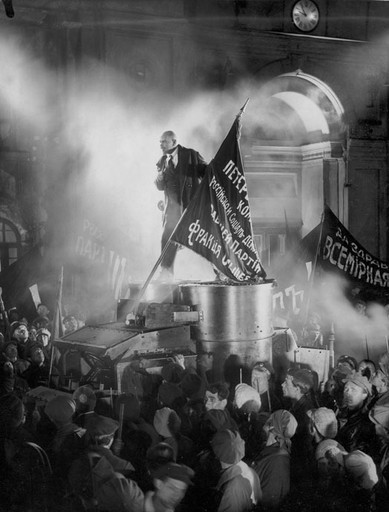
In this film, Eisenstein used the events of the 1905 rebellion against czarist troops in the port of Odessa as a metaphor for the Russian Revolution of 1917. Potemkin is made up of five major sequences: the rebellion of the crew of the Imperial Russian Navy battleship Potemkin over rotten food, their mutiny on the quarterdeck, the display of the body of the killed rebel leader on the quay in Odessa, the massacre of civilians by soldiers on the Odessa steps, and the crew’s triumphant sailing of the battleship to meet the fleet. All of them exhibit Eisenstein’s self-conscious manipulation of the medium of film. One of the most memorable shots, a part of the Odessa steps sequence, captures the horror of the massacre in a close-up of a screaming woman, wounded by the advancing soldiers. Eisenstein’s brilliantly percussive editing, detailed shots, repetitions, contrasts, compressions and expansions of time, and collisions of images ran counter to the trend toward a seamless illusion of reality in other national cinemas of the 1920s.
After the Russian Revolution, young film directors searched for a cinematic style that, by destroying tradition, would help to bring about a new, proletarian society. In films on revolutionary subjects, they abandoned conventional structure and experimented with novel techniques, including montage. With Potemkin, Soviet cinema took a central place on the world scene, in spite of the fact that the film was censored, even banned, in many countries for its powerful glorification of the Soviet ideal.
MoMA Highlights: 375 Works from The Museum of Modern Art, New York (New York: The Museum of Modern Art, 2019)
Explore more
Montage
An assembly of images that relate to one another in some way to create a single work or part of a work of art.
Learn more →



From MoMA Design Store


Installation views
We have identified this work in the following photos from our exhibition history.
Licensing
Artwork or archival images
If you would like to reproduce an image of a work of art in MoMA's collection, or an image of a MoMA publication or archival material (including installation views, checklists, and press releases), please contact Art Resource (publication in North America) or Scala Archives (publication in all other geographic locations).
Audio and film clips
MoMA licenses archival audio and select out of copyright film clips from our film collection. At this time, MoMA produced video cannot be licensed by MoMA/Scala. All requests to license archival audio or out of copyright film clips should be addressed to Scala Archives at [email protected]. Motion picture film stills cannot be licensed by MoMA/Scala. For access to motion picture film stills for research purposes, please contact the Film Study Center at [email protected]. For more information about film loans and our Circulating Film and Video Library, please visit Circulating Film and Video Library.
Text from a publication or the archives
If you would like to reproduce text from a MoMA publication, please email [email protected]. If you would like to publish text from MoMA's archival materials, please fill out this permission form and send to [email protected].
Feedback
This record is a work in progress. If you have additional information or spotted an error, please fill out this feedback form.