Not on view
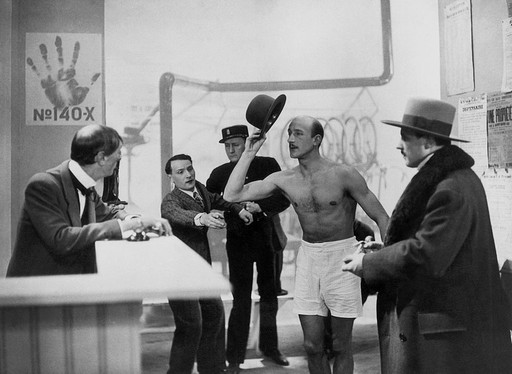
Still one of the best-known avant-garde films of the 1920s, Entr’acte was immediately heralded as a “cinematic masterpiece.” It stages a series of zany, disconnected scenes, including a chess match between Marcel Duchamp and Man Ray that is swept away by a jet of water, a dizzying roller coaster course, a hearse pulled by a camel, and a high-speed chase through Paris’s Luna Park. During its first public projection, this silent film was accompanied by an orchestra. The composer, Erik Satie, carefully pegged the music to each filmic sequence, thereby creating what the film’s director, René Clair, would later call “the first composition written for the cinema ‘shot by shot.’”
Francis Picabia: Our Head Are Round so Our Thoughts Can Change Direction, 2016.
Publication excerpt from In Still Moving: The Film and Media Collections of the Museum of Modern Art by Steven Higgins, New York: The Museum of Modern Art, 2006, p. 104.
A classic of avant-garde cinema, Entr'acte was made as an intermission piece for the Ballets Suédois production of Relâche, a Dada theater work that premiered in Paris in December of 1924. The ballet's director, Francis Picabia, gave René Clair a short scenario around which to build the film, and Erik Satie composed an original score to accompany it, but the finished work is "pure" cinema—the individual shots and the connections between them resulting in what Clair described as "visual babblings." Key figures of the contemporary Parisian art world appear in the film in absurd comic cameos, including Man Ray, Marcel Duchamp, Jean Borlin (director of the Ballets Suédois), Georges Auric, Picabia, and Clair himself. As Picabia declared, Entr'acte "respects nothing except the right to roar with laughter."
In Still Moving: The Film and Media Collections of the Museum of Modern Art by Steven Higgins, New York: The Museum of Modern Art, 2006, p. 104.
Explore more

From MoMA Design Store


Installation views
We have identified this work in the following photos from our exhibition history.
Licensing
Artwork or archival images
If you would like to reproduce an image of a work of art in MoMA's collection, or an image of a MoMA publication or archival material (including installation views, checklists, and press releases), please contact Art Resource (publication in North America) or Scala Archives (publication in all other geographic locations).
Audio and film clips
MoMA licenses archival audio and select out of copyright film clips from our film collection. At this time, MoMA produced video cannot be licensed by MoMA/Scala. All requests to license archival audio or out of copyright film clips should be addressed to Scala Archives at [email protected]. Motion picture film stills cannot be licensed by MoMA/Scala. For access to motion picture film stills for research purposes, please contact the Film Study Center at [email protected]. For more information about film loans and our Circulating Film and Video Library, please visit Circulating Film and Video Library.
Text from a publication or the archives
If you would like to reproduce text from a MoMA publication, please email [email protected]. If you would like to publish text from MoMA's archival materials, please fill out this permission form and send to [email protected].
Feedback
This record is a work in progress. If you have additional information or spotted an error, please fill out this feedback form.