Sonia Delaunay
La Prose du Transsibérien et de la Petite Jehanne de France (Prose of the Trans-Siberian and of Little Joan of France)
1913
Accordion-format book with pochoir illustrations, letterpress text, and inscriptions in colored ink and pencil; hand-painted parchment wrapper
Not on view
To create a work appropriate to the dynamism of modern life, Delaunay transformed the traditional book into an object that unfolds accordion style, to be seen all at once. Her collaborator Cendrars’s poem narrates an epic, mostly imaginary journey on the Trans-Siberian Railway with a young French prostitute, “little Jehanne” (a name invoking Joan of Arc, patron saint of France). They travel from Moscow to Siberia, China, the North Pole, and Paris, suggested by the Eiffel Tower, a symbol of early modernity, at bottom left. When the work is folded up, it tucks into a parchment cover hand-painted by Delaunay.
2019
Publication excerpt from MoMA Highlights: 375 Works from The Museum of Modern Art, New York (New York: The Museum of Modern Art, 2019)
Delaunay and her collaborator Blaise Cendrars, a modernist poet, called this “the first simultaneous book.” This reference to Simultanism, a new movement that the artist and her husband Robert Delaunay were pioneering in Paris, connected the work’s visual impact to the thrilling simultaneity of modern life—the fast-paced, consciousness-altering dynamism brought about by innovations in transportation and communication. Delaunay and Cendrars transformed the traditional book format from a handheld volume that is read sequentially from page to page into an object that unfolds accordion-style—a dazzlingly colorful, nearly seven-foot-long sheet on which text and illustration can be apprehended all at once. While Cendrars’s poem appears on the right, in various typefaces and colors, Delaunay’s geometries cascade down the left, and the blank spaces around the text have been stenciled with color as well.
Using flashbacks and flash-forwards that upend conventional notions of time and space, Cendrars’s poem narrates an epic, mostly imaginary journey on the Trans-Siberian Railroad that he takes with a young French prostitute, the “little Joan” of the title. Their train travels from Moscow to Siberia, China, the North Pole, and, finally, Paris, which is suggested by the motif of the Eiffel Tower—itself a famous symbol of modernity at the time—at bottom left. When the work is folded up, like a map, it tucks into a small parchment cover hand-painted by Delaunay.
MoMA Highlights: 375 Works from The Museum of Modern Art, New York (New York: The Museum of Modern Art, 2019)
Explore more
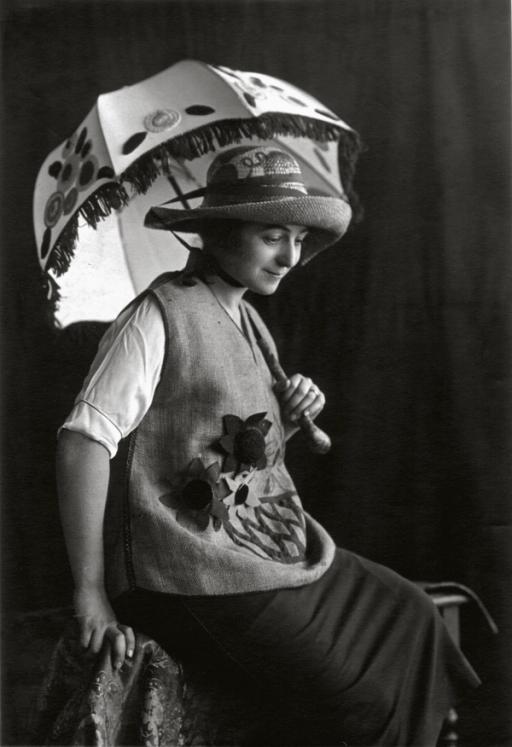
Sonia Delaunay
French, born Ukraine. 1885–1979 52 works onlineRed and green, blue and orange, yellow and violet: these color combinations were vital to the artistic practice and theory of Sonia Delaunay, whose vast body of work—paintings and drawings, prints and illustrations, textiles and furnishings, clothing and accessories—enthralled its earliest viewers, users, and wearers.
Learn more →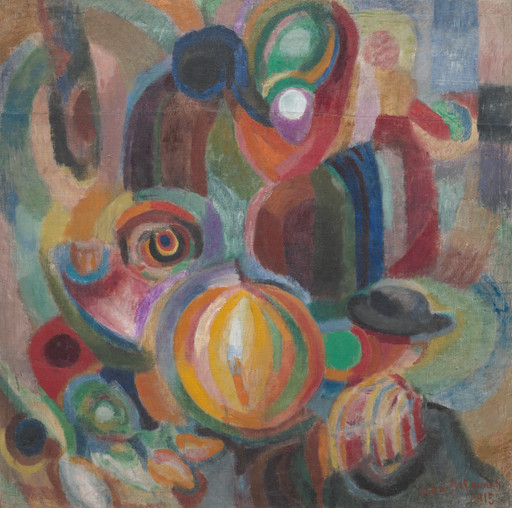


Audio
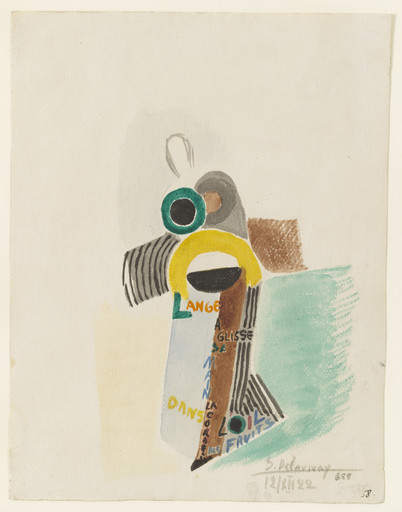
Audio from the playlist Inventing Abstraction, 1910–1925
From MoMA Design Store


Licensing
Artwork or archival images
If you would like to reproduce an image of a work of art in MoMA's collection, or an image of a MoMA publication or archival material (including installation views, checklists, and press releases), please contact Art Resource (publication in North America) or Scala Archives (publication in all other geographic locations).
Audio and film clips
MoMA licenses archival audio and select out of copyright film clips from our film collection. At this time, MoMA produced video cannot be licensed by MoMA/Scala. All requests to license archival audio or out of copyright film clips should be addressed to Scala Archives at [email protected]. Motion picture film stills cannot be licensed by MoMA/Scala. For access to motion picture film stills for research purposes, please contact the Film Study Center at [email protected]. For more information about film loans and our Circulating Film and Video Library, please visit Circulating Film and Video Library.
Text from a publication or the archives
If you would like to reproduce text from a MoMA publication, please email [email protected]. If you would like to publish text from MoMA's archival materials, please fill out this permission form and send to [email protected].
Feedback
This record is a work in progress. If you have additional information or spotted an error, please fill out this feedback form.