Molded walnut veneered plywood, chrome-plated steel rods, and rubber shock mounts
Not on view
The LCM (Lounge Chair Metal) was conceived by Eames, who, with his wife and professional partner, Ray, formed one of the most influential design teams of the twentieth century. First produced in 1946, the LCM and its companion, the DCM (Dining Chair Metal), met with great commercial success and have become icons of modern design. The LCM's molded–plywood seat and back sit on a chrome–plated steel frame, with rubber shock mounts in between. That the back and seat are separate pieces simplified production, while also providing visual interest.
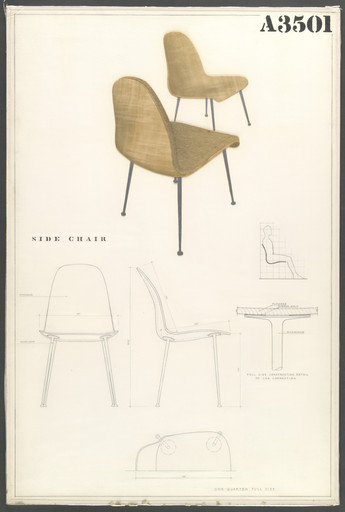
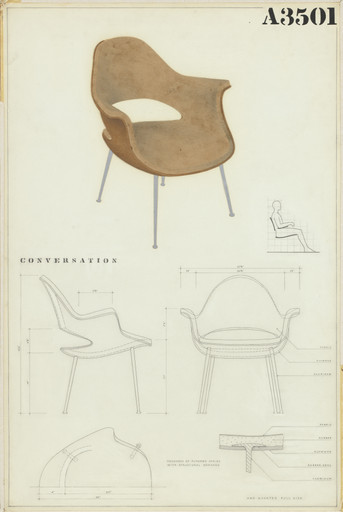
Together with Eero Saarinen, Eames had first experimented with bent plywood for a group of prize–winning designs they submitted to the 1940 competition "Organic Design in Home Furnishings," organized by The Museum of Modern Art. These, however, proved difficult to manufacture, and most were upholstered for comfort. Intent on producing high–quality objects at economical manufacturing costs, the Eameses devoted the better part of the next five years to refining the technique of molding plywood to create thin shells with compound curves. The chair was initially manufactured by the Evans Products Company; in 1949 Herman Miller Inc. bought the rights to produce it.
The Museum of Modern Art , MoMA Highlights, New York: The Museum of Modern Art, revised 2004, originally published 1999, p. 202.
Explore more
Charles Eames
American, 1907–1978 85 works onlineEverything was architecture to Charles and Ray Eames: the construction plans for a chair, the layout of an exhibition pavilion, the structure of a film, even the placement of silverware, plates, flowers, and objects on a dining table.
Learn more →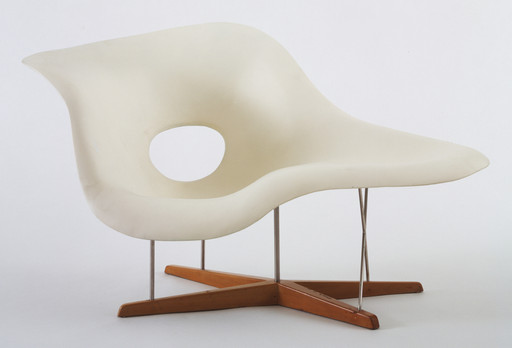
Ray Eames
American, 1912–1988 43 works onlineEverything was architecture to Charles and Ray Eames: the construction plans for a chair, the layout of an exhibition pavilion, the structure of a film, even the placement of silverware, plates, flowers, and objects on a dining table.
Learn more →




From MoMA Design Store


Installation views
We have identified this work in the following photos from our exhibition history.
Licensing
Artwork or archival images
If you would like to reproduce an image of a work of art in MoMA's collection, or an image of a MoMA publication or archival material (including installation views, checklists, and press releases), please contact Art Resource (publication in North America) or Scala Archives (publication in all other geographic locations).
Audio and film clips
MoMA licenses archival audio and select out of copyright film clips from our film collection. At this time, MoMA produced video cannot be licensed by MoMA/Scala. All requests to license archival audio or out of copyright film clips should be addressed to Scala Archives at [email protected]. Motion picture film stills cannot be licensed by MoMA/Scala. For access to motion picture film stills for research purposes, please contact the Film Study Center at [email protected]. For more information about film loans and our Circulating Film and Video Library, please visit Circulating Film and Video Library.
Text from a publication or the archives
If you would like to reproduce text from a MoMA publication, please email [email protected]. If you would like to publish text from MoMA's archival materials, please fill out this permission form and send to [email protected].
Feedback
This record is a work in progress. If you have additional information or spotted an error, please fill out this feedback form.