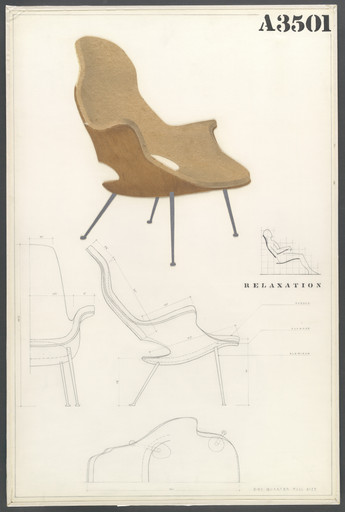
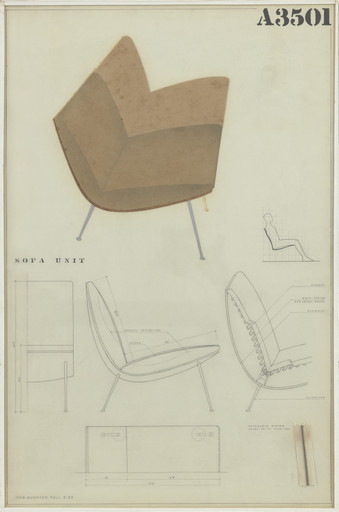
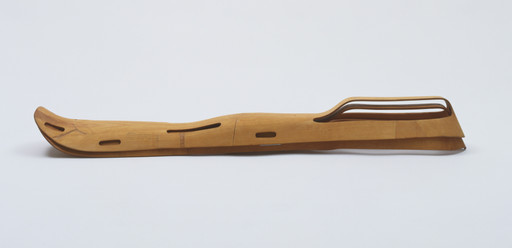
This chaise longue was inspired by Gaston Lachaise's 1927 sculpture Floating Figure and nicknamed after the artist. It did not receive a prize because it was considered too "specialized in use" and too expensive to manufacture at the time. However, it was highlighted by the judges, who admired its "striking, good-looking and inventive" molded construction. La Chaise finally went into production in 1990 and is now one of the Eameses's signature works.
What Was Good Design? MoMA's Message, 1944-56, May 6, 2009–January 10, 2011.
Publication excerpt from MoMA Highlights: 375 Works from The Museum of Modern Art, New York (New York: The Museum of Modern Art, 2019)
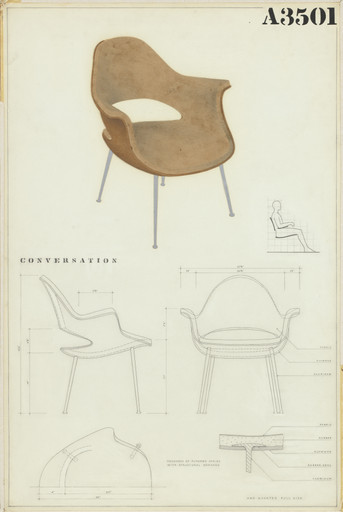
Developed for MoMA’s international Low-Cost Furniture design competition, this chaise longue is a highlight of the nearly four-decade collaboration between designers Charles and Ray Eames. Ray trained in painting with the German-American abstract artist Hans Hofmann, who introduced her to the biomorphic Surrealism of Joan Miró and Jean (Hans) Arp. Charles studied architecture at Washington University, St. Louis, and later made his way to the Cranbrook Academy of Art in Michigan. At Cranbrook, Charles and Ray met and eventually married. Together they went on to create a body of work that includes film, photography, furniture design, and architecture.
A marvel of technical engineering and expressive form, La Chaise alludes to the 1927 work Floating Figure by the French sculptor Gaston Lachaise, a bronze depicting a stylized female nude elegantly suspended in the air. Its hovering design recalls earlier work by the Eameses, including their experiments with molded plywood furniture and sculpture. Eager to use new technologies and materials developed during World War II, they selected a plastic-and-rubber composite for
La Chaise, which was part of a series of molded-plastic furniture they developed in the late 1940s and early ’50s.
Considered too “specialized in use,” the design did not win the competition, but it was singled out for its “striking, good-looking and inventive” molded construction. It went into production in 1990, cementing its status as one of the Eameses’ signature works.
MoMA Highlights: 375 Works from The Museum of Modern Art, New York (New York: The Museum of Modern Art, 2019)
Explore more
Charles Eames
American, 1907–1978 85 works onlineEverything was architecture to Charles and Ray Eames: the construction plans for a chair, the layout of an exhibition pavilion, the structure of a film, even the placement of silverware, plates, flowers, and objects on a dining table.
Learn more →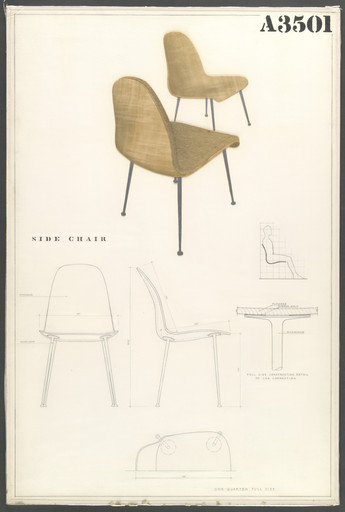
Ray Eames
American, 1912–1988 43 works onlineEverything was architecture to Charles and Ray Eames: the construction plans for a chair, the layout of an exhibition pavilion, the structure of a film, even the placement of silverware, plates, flowers, and objects on a dining table.
Learn more →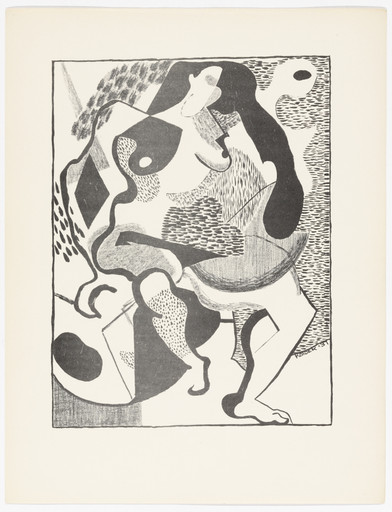


Plastic
A term applied to many natural and synthetic materials with different forms, properties, and appearances that are malleable and can be molded into different shapes or objects.
Learn more →
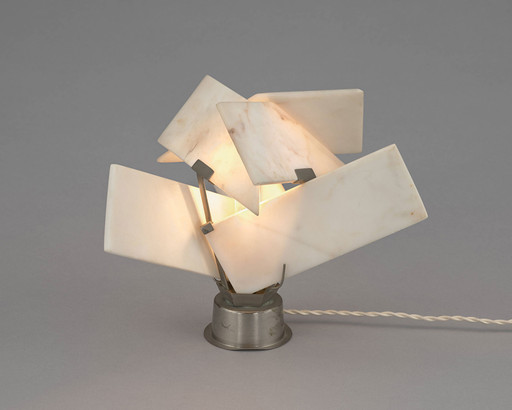
Living Forms
Gallery 516As steam and steel reshaped the modern world, another, quieter revolution took place. While many artists and designers celebrated the machine’s precision, others turned to the vocabulary of nature: the unfolding leaf, the spiral shell, the architecture of growth itself.
Learn more →


From MoMA Design Store


Installation views
We have identified this work in the following photos from our exhibition history.
Licensing
Artwork or archival images
If you would like to reproduce an image of a work of art in MoMA's collection, or an image of a MoMA publication or archival material (including installation views, checklists, and press releases), please contact Art Resource (publication in North America) or Scala Archives (publication in all other geographic locations).
Audio and film clips
MoMA licenses archival audio and select out of copyright film clips from our film collection. At this time, MoMA produced video cannot be licensed by MoMA/Scala. All requests to license archival audio or out of copyright film clips should be addressed to Scala Archives at [email protected]. Motion picture film stills cannot be licensed by MoMA/Scala. For access to motion picture film stills for research purposes, please contact the Film Study Center at [email protected]. For more information about film loans and our Circulating Film and Video Library, please visit Circulating Film and Video Library.
Text from a publication or the archives
If you would like to reproduce text from a MoMA publication, please email [email protected]. If you would like to publish text from MoMA's archival materials, please fill out this permission form and send to [email protected].
Feedback
This record is a work in progress. If you have additional information or spotted an error, please fill out this feedback form.