Not on view
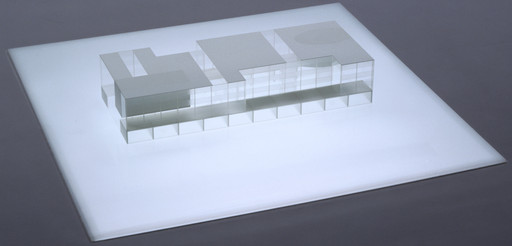
House in a Plum Grove is a three-story edifice on a corner plot in a Tokyo neighborhood and a prime example of Sejima’s residential architectural work. Known for her elegant use of simple forms and industrial materials like steel and glass, she achieves maximum impact by generating unexpected spaces that break from modern architecture’s characteristic focus on functionality. Unlike typical residential layouts, which feature large shared living areas, this house offers a range of spaces that may be adapted to changing daily routines. Rethinking traditional notions of privacy, the building includes interior walls punctuated with variously sized openings and composed of extremely thin, prefabricated steel plate. This increases the feeling of connectivity inside the home, as the apertures allow activities occurring in one room to be seen and overheard from another. With its unique combination of structural precision and flexible, experientially rich spaces, the house expresses the boundless potential of small-scale living.
The creation of study models in different scales and materials is essential to the conceptual and design development of Sejima’s projects, where it replaces the architectural sketch. The large size of this model—its physical presence and materiality—underscore Sejima’s interest in studies that allow for an empirical experience of the design.
MoMA Highlights: 375 Works from The Museum of Modern Art, New York (New York: The Museum of Modern Art, 2019)
Explore more

From MoMA Design Store


Installation views
We have identified this work in the following photos from our exhibition history.
Licensing
Artwork or archival images
If you would like to reproduce an image of a work of art in MoMA's collection, or an image of a MoMA publication or archival material (including installation views, checklists, and press releases), please contact Art Resource (publication in North America) or Scala Archives (publication in all other geographic locations).
Audio and film clips
MoMA licenses archival audio and select out of copyright film clips from our film collection. At this time, MoMA produced video cannot be licensed by MoMA/Scala. All requests to license archival audio or out of copyright film clips should be addressed to Scala Archives at [email protected]. Motion picture film stills cannot be licensed by MoMA/Scala. For access to motion picture film stills for research purposes, please contact the Film Study Center at [email protected]. For more information about film loans and our Circulating Film and Video Library, please visit Circulating Film and Video Library.
Text from a publication or the archives
If you would like to reproduce text from a MoMA publication, please email [email protected]. If you would like to publish text from MoMA's archival materials, please fill out this permission form and send to [email protected].
Feedback
This record is a work in progress. If you have additional information or spotted an error, please fill out this feedback form.