Not on view
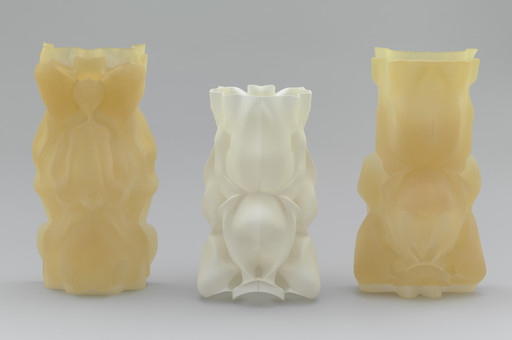
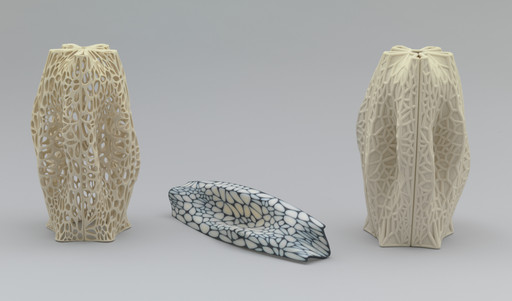
Oxman’s series takes its title from Jorge Luis Borges’s Book of Imaginary Beings (1957), a miscellany of over one hundred fantastical beasts from folklore and literature. Borges’s creatures exist on the cusp of the natural and the mythical. Oxman’s beings similarly augment, fuse, and adapt nature, exploring future possibilities for human biology and experience—an area of design practice that Oxman has termed “material ecology.”
The Imaginary Beings series explores the functions of the human body—skeletal, pulmonary, muscular— offering a conceptual proposition for how natural tissues and biological processes might be developed or replicated digitally in the future. In Oxman’s vision, biology enhanced by technology might allow humans to gain abilities possessed by Borges’s imaginary beings, such as flight or underwater breathing. Although this series deals with the human body, these works connect to Oxman’s wider practice, which seeks to strengthen the relationship between man-made and natural environments through digital design principles.
This Is for Everyone: Design Experiments for the Common Good, February 14, 2015–January 31, 2016.
Explore more

Neri Oxman
American, born Israel, 1976 28 works onlineSilkworms, ants, bacteria, or bees are hardly welcome in an architectural office next to drafting boards and paper models, but their presence is an essential part of the work done at Oxman, Neri Oxman’s nature-centric architectural practice.
Learn more →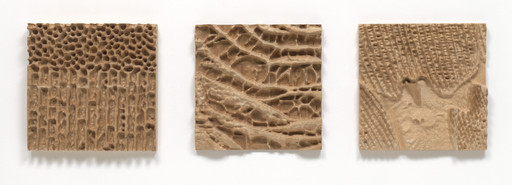







From MoMA Design Store


Installation views
We have identified this work in the following photos from our exhibition history.
Licensing
Artwork or archival images
If you would like to reproduce an image of a work of art in MoMA's collection, or an image of a MoMA publication or archival material (including installation views, checklists, and press releases), please contact Art Resource (publication in North America) or Scala Archives (publication in all other geographic locations).
Audio and film clips
MoMA licenses archival audio and select out of copyright film clips from our film collection. At this time, MoMA produced video cannot be licensed by MoMA/Scala. All requests to license archival audio or out of copyright film clips should be addressed to Scala Archives at [email protected]. Motion picture film stills cannot be licensed by MoMA/Scala. For access to motion picture film stills for research purposes, please contact the Film Study Center at [email protected]. For more information about film loans and our Circulating Film and Video Library, please visit Circulating Film and Video Library.
Text from a publication or the archives
If you would like to reproduce text from a MoMA publication, please email [email protected]. If you would like to publish text from MoMA's archival materials, please fill out this permission form and send to [email protected].
Feedback
This record is a work in progress. If you have additional information or spotted an error, please fill out this feedback form.