Neri Oxman, Massachusetts Institute of Technology, Cambridge, MA
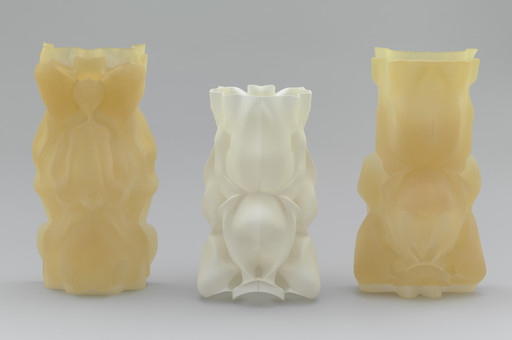
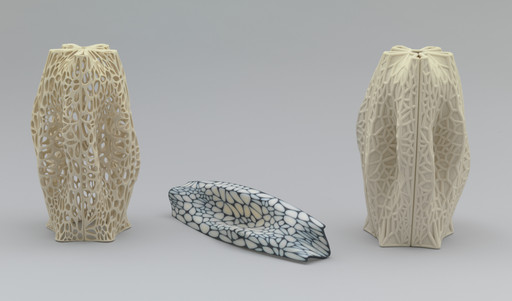
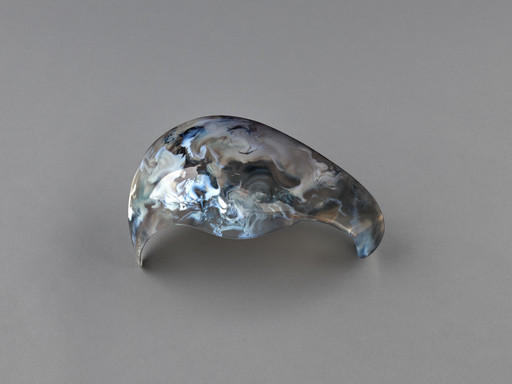
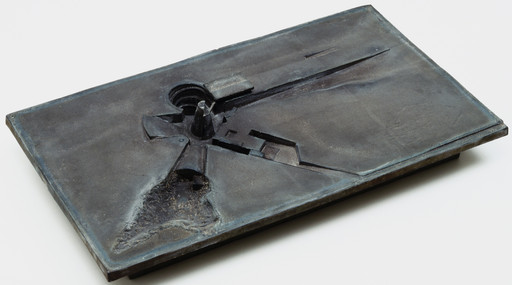
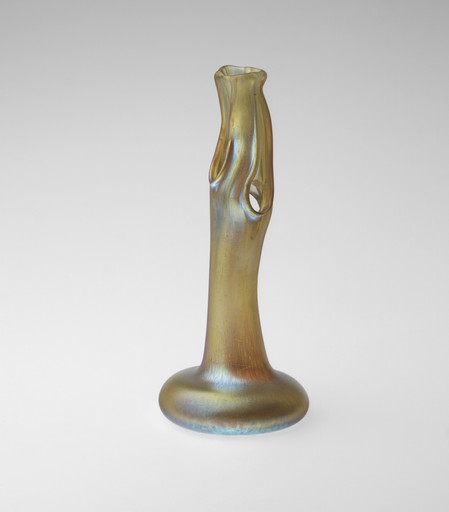
Cartesian Wax, from the Materialecology project
2007
Not on view
Over the past decades, architects have been studying the possibility of creating dynamic buildings that adapt to changing environmental conditions and levels of occupancy. With this task in mind, Oxman coined the term “material ecology” and advocates for products and buildings to be designed as living, interactive entities—environmentally informed, computationally grown, digitally manufactured, and biologically augmented.
The surface of Cartesian Wax is thickened locally when more structural support is needed, and modulates its transparency according to the light conditions of the environment. “The work is inspired by Descartes’s Cartesian Wax thesis,” explains Oxman, “which relates to the construction of self knowledge and the way it is informed by and reports on an individual’s experience of the physical world.”
Energy, 2019
Explore more

Neri Oxman
American, born Israel, 1976 28 works onlineSilkworms, ants, bacteria, or bees are hardly welcome in an architectural office next to drafting boards and paper models, but their presence is an essential part of the work done at Oxman, Neri Oxman’s nature-centric architectural practice.
Learn more →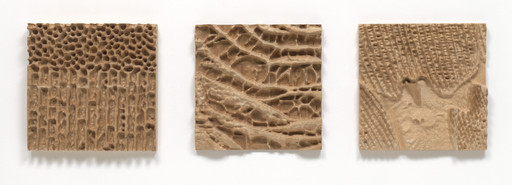




From MoMA Design Store


Installation views
We have identified this work in the following photos from our exhibition history.
Licensing
Artwork or archival images
If you would like to reproduce an image of a work of art in MoMA's collection, or an image of a MoMA publication or archival material (including installation views, checklists, and press releases), please contact Art Resource (publication in North America) or Scala Archives (publication in all other geographic locations).
Audio and film clips
MoMA licenses archival audio and select out of copyright film clips from our film collection. At this time, MoMA produced video cannot be licensed by MoMA/Scala. All requests to license archival audio or out of copyright film clips should be addressed to Scala Archives at [email protected]. Motion picture film stills cannot be licensed by MoMA/Scala. For access to motion picture film stills for research purposes, please contact the Film Study Center at [email protected]. For more information about film loans and our Circulating Film and Video Library, please visit Circulating Film and Video Library.
Text from a publication or the archives
If you would like to reproduce text from a MoMA publication, please email [email protected]. If you would like to publish text from MoMA's archival materials, please fill out this permission form and send to [email protected].
Feedback
This record is a work in progress. If you have additional information or spotted an error, please fill out this feedback form.