Video (color, sound)
Not on view
Artist and critic Hito Steyerl's video works explore how images are produced, circulated, and shared. The artist has referred to images as a "condensation of social forces," suggesting that through them we can trace the underlying systems of the contemporary world.
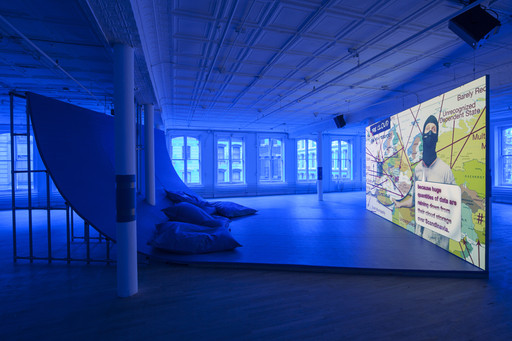
In this satirical take on instructional films, Steyerl demonstrates several tongue-in-cheek strategies for remaining "unseen" in a world subject to new, sophisticated means of surveillance—pointing to the ways in which our technologies encroach on physical experience. Much of the work was shot on a desert site riddled with photo calibration targets used by the military to hone the focus of airplane cameras. Acts of war are therefore mediated by digital tools; Steyerl drives this point home by superimposing a computer desktop onto the desert landscape, underscoring the links between economies of violence, communication, and entertainment. In her words, "How do people disappear in an age of total over-visibility? . . . Are people hidden by too many images? Do they go hide amongst other images? Do they become images?"
Cut to Swipe, October 11, 2014–March 22, 2015.
Publication excerpt from MoMA Highlights: 375 Works from The Museum of Modern Art, New York (New York: The Museum of Modern Art, 2019)
Both drawing from and subverting the conventions of documentary film, Steyerl’s essayistic videos explore how images are produced, circulated, and interpreted. In her writings, she has referred to images as a “condensation of social forces”: in a world so heavily reliant on the exchange of digital information, digital images—due to their widespread proliferation and vulnerability to manipulation—serve as artifacts of social and political systems and their biases.
For this work, whose basic premise is borrowed from a 1970 Monty Python sketch also titled “How Not to Be Seen,” the artist has satirically adopted the format of an instructional video to demonstrate strategies for remaining “unseen” in an age of “total over-visibility.” These tactics are narrated by a robotic voice and presented through real and virtual imagery that merge and interact. The work continually returns to the site of now-decommissioned US Air Force aerial-photography calibration targets in the California desert, for example, and to an animated rendering of a luxury residential housing complex.
The video reflects on the tension between the unprecedented capabilities of technology to surveil humans and encroach on physical experience, and the social and political invisibility of marginalized populations. In searing commentary, both poignant and absurd, the disembodied speaker enumerates strategies for becoming invisible, including “being female and over fifty,” “being a disappeared person as an enemy of the state,” “being a Wi-Fi signal moving through human bodies,” and “being spam caught by a filter.”
MoMA Highlights: 375 Works from The Museum of Modern Art, New York (New York: The Museum of Modern Art, 2019)
Explore more

Hito Steyerl
German, born 1966 5 works onlineArtist, theoretician, and educator Hito Steyerl has wondered, “Are people hidden by too many images?…Do they become images?” To make sense of global, digital, networked life, Steyerl integrates communications media into cinematic installations, blending documentary film techniques, speculative fiction, and first-person narrative.
Learn more →

Filmmaker
A person who directs or produces movies.
Learn more →








From MoMA Design Store


Installation views
We have identified this work in the following photos from our exhibition history.
Licensing
Artwork or archival images
If you would like to reproduce an image of a work of art in MoMA's collection, or an image of a MoMA publication or archival material (including installation views, checklists, and press releases), please contact Art Resource (publication in North America) or Scala Archives (publication in all other geographic locations).
Audio and film clips
MoMA licenses archival audio and select out of copyright film clips from our film collection. At this time, MoMA produced video cannot be licensed by MoMA/Scala. All requests to license archival audio or out of copyright film clips should be addressed to Scala Archives at [email protected]. Motion picture film stills cannot be licensed by MoMA/Scala. For access to motion picture film stills for research purposes, please contact the Film Study Center at [email protected]. For more information about film loans and our Circulating Film and Video Library, please visit Circulating Film and Video Library.
Text from a publication or the archives
If you would like to reproduce text from a MoMA publication, please email [email protected]. If you would like to publish text from MoMA's archival materials, please fill out this permission form and send to [email protected].
Feedback
This record is a work in progress. If you have additional information or spotted an error, please fill out this feedback form.