Wols (A. O. Wolfgang Schulze)
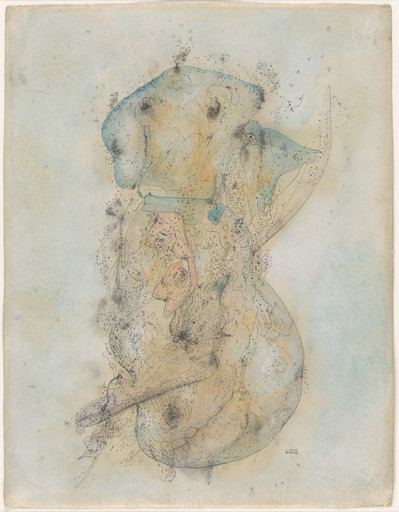
Plate 2 from the illustrated book Naturelles by René de Solier
published c. 1946
Drypoint
Not on view
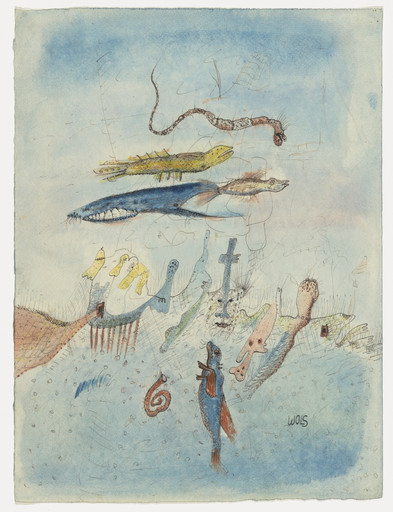
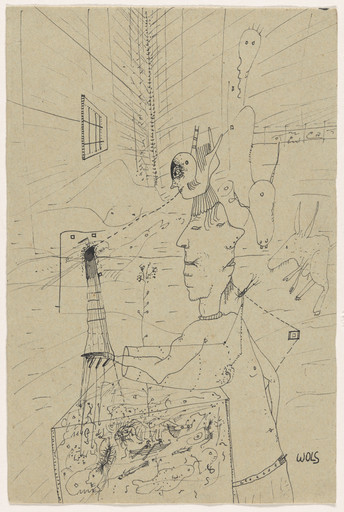
The German-born artist Wolfgang Schulze, who used the pseudonym Wols, moved to Paris in 1932 and initially took up photography, producing disturbing Surrealist images of human body parts, dead animals, and other subjects. As a German expatriate, he was imprisoned in the South of France for fourteen months after the outbreak of World War II in 1939. While in detention he made drawings and watercolors depicting fantastic landscapes and amorphous faces and figures that reflect the influence of children's art and the work of Paul Klee. After his release, Wols hid in Cassis, in unoccupied France. The artist never completely recovered from his war-related traumas, and the next decade, the last of his short life, was complicated by poverty, illness, and alcoholism.
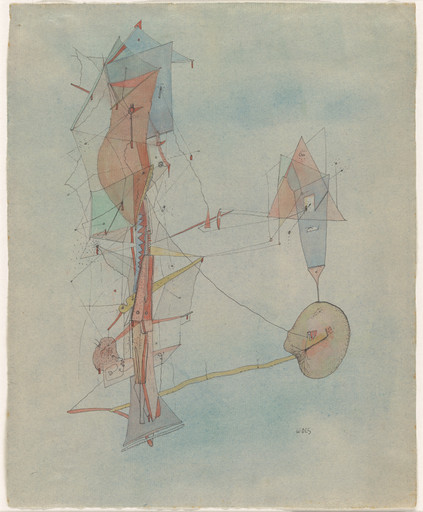
In 1945 Wols returned to Paris and began making small, abstract paintings using the automatic lines and drips of Surrealism in compositions typically based around a heavy central mass. The free-associative, hallucinatory quality of his work provides a link between that prewar movement and the gestural abstraction known generally as Art informel that took hold in the years after. Wols was immediately viewed as a pioneer of this latter style, and the agitated nature of his markings seemed to give visual form to the existential anxiety of the postwar era.
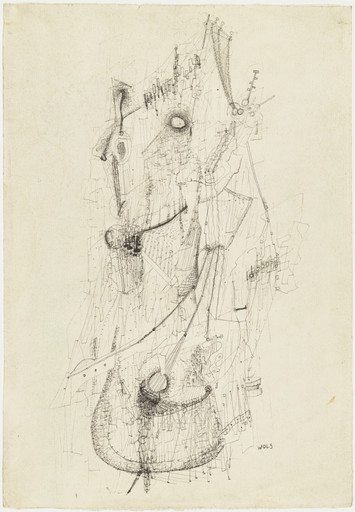
Wols's prints, a total of fifty-three drypoints created between 1945 and his death in 1951, comprise a distinct yet integral segment of his oeuvre. Nearly half were made as illustrations for books by Surrealist and Existential writers who befriended him, including Jean-Paul Sartre, Tristan Tzara, and René de Solier. The process of scratching directly on the plate with a drypoint needle was well-suited to Wols's compulsive style. The thin, scratchy lines with their characteristic burr capture all the microscopic details of his barbed, nestlike microcosms and the fuzzy tendrils of his insectlike forms.
an essay by Starr Figura, in Deborah Wye, Artists and Prints: Masterworks from The Museum of Modern Art, New York: The Museum of Modern Art, 2004, p. 139.
Explore more
Drypoint
An intaglio printmaking technique that creates sharp lines with fuzzy, velvety edges. A diamond-pointed needle is used to incise lines directly into a bare metal printing plate, displacing ridges of metal that adhere to the edges of the incised lines.
Learn more →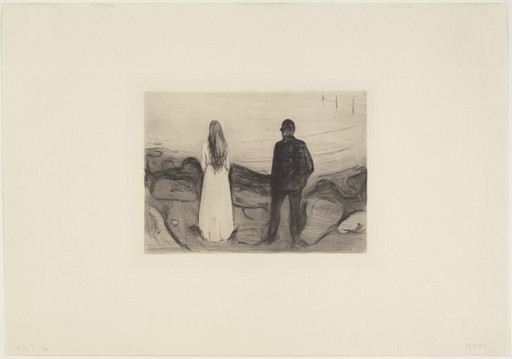

From MoMA Design Store


Installation views
We have identified this work in the following photos from our exhibition history.
Licensing
Artwork or archival images
If you would like to reproduce an image of a work of art in MoMA's collection, or an image of a MoMA publication or archival material (including installation views, checklists, and press releases), please contact Art Resource (publication in North America) or Scala Archives (publication in all other geographic locations).
Audio and film clips
MoMA licenses archival audio and select out of copyright film clips from our film collection. At this time, MoMA produced video cannot be licensed by MoMA/Scala. All requests to license archival audio or out of copyright film clips should be addressed to Scala Archives at [email protected]. Motion picture film stills cannot be licensed by MoMA/Scala. For access to motion picture film stills for research purposes, please contact the Film Study Center at [email protected]. For more information about film loans and our Circulating Film and Video Library, please visit Circulating Film and Video Library.
Text from a publication or the archives
If you would like to reproduce text from a MoMA publication, please email [email protected]. If you would like to publish text from MoMA's archival materials, please fill out this permission form and send to [email protected].
Feedback
This record is a work in progress. If you have additional information or spotted an error, please fill out this feedback form.