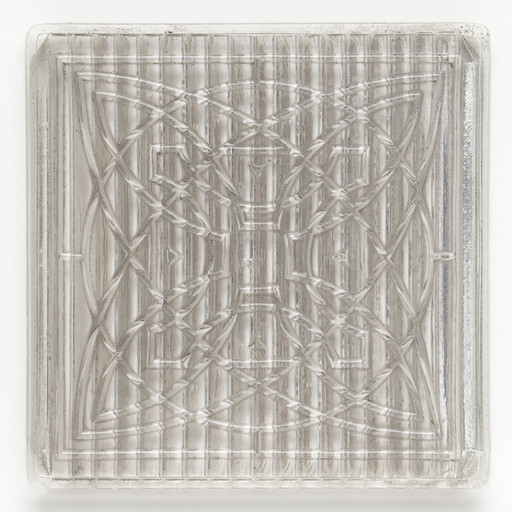
Clear and colored glass in zinc matrix
Not on view
Wright designed a playhouse encircled by a band of stained–glass windows as an addition to the suburban Chicago estate of the industrialist Avery Coonley. Composed of brightly colored geometric motifs, these windows suggest balloons, confetti, and flags. Wright described this prominent architectural element as a "kinder–symphony.” Mrs. Queene Ferry Coonley, like Wright’s mother and his first wife, Catherine, was drawn to the educational theories and “Gifts” of Friedrich Froebel, and she commissioned the playhouse as a kindergarten for her daughter and other neighborhood children.
Designing Modern Women 1890–1990, October 5, 2013–October 1, 2014.
Publication excerpt from The Museum of Modern Art, MoMA Highlights , New York: The Museum of Modern Art, revised 2004, originally published 1999, p. 83.
To enliven the interior of his Avery Coonley Playhouse, a kindergarten in the suburbs of Chicago for a private client, Frank Lloyd Wright designed stained-glass clerestory windows, which formed a continuous band around the top of the playroom. Each window in the series was composed of lively combinations of simple geometric motifs in bright colors. The windows were inspired by the sights of a parade, and their shapes abstracted from balloons, confetti, and even an American flag.
Wright designed the interior furnishings for almost all of his buildings, thereby creating an organic unity of the whole and its parts. Art glass was integral to the architectural fabric of many of his early works. The arranging of shapes into patterns in the Coonley Playhouse windows relates to the formal strategies Wright adopted in his architecture. His belief in the universality of fundamental geometric forms was as much a response to rational methods of modern machine production as an intuitive understanding that abstract forms carried shared spiritual values. Geometric forms had played a role in Wright's own childhood education through a German system of educational toys, the Froebel blocks, which he later credited as a major influence on his ideas about architecture.
The Museum of Modern Art, MoMA Highlights, New York: The Museum of Modern Art, revised 2004, originally published 1999, p. 83.
Explore more

Frank Lloyd Wright
American, 1867–1959 124 works onlineA pragmatist, technical innovator, and independent thinker, Frank Lloyd Wright designed cities and buildings and their interior furnishings across a prolific 72-year career, reflecting his vision of an ideal American society.
Learn more →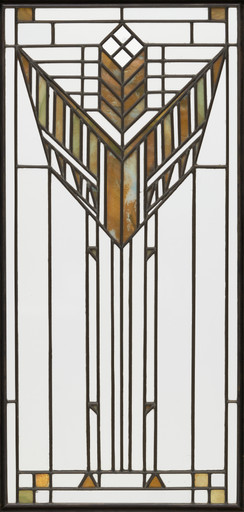

Furniture and interiors
An object or environment designed to accommodate human activities such as sitting, sleeping, or eating. Examples include chairs, tables, and kitchens.
Learn more →



From MoMA Design Store


Installation views
We have identified this work in the following photos from our exhibition history.
Licensing
Artwork or archival images
If you would like to reproduce an image of a work of art in MoMA's collection, or an image of a MoMA publication or archival material (including installation views, checklists, and press releases), please contact Art Resource (publication in North America) or Scala Archives (publication in all other geographic locations).
Audio and film clips
MoMA licenses archival audio and select out of copyright film clips from our film collection. At this time, MoMA produced video cannot be licensed by MoMA/Scala. All requests to license archival audio or out of copyright film clips should be addressed to Scala Archives at [email protected]. Motion picture film stills cannot be licensed by MoMA/Scala. For access to motion picture film stills for research purposes, please contact the Film Study Center at [email protected]. For more information about film loans and our Circulating Film and Video Library, please visit Circulating Film and Video Library.
Text from a publication or the archives
If you would like to reproduce text from a MoMA publication, please email [email protected]. If you would like to publish text from MoMA's archival materials, please fill out this permission form and send to [email protected].
Feedback
This record is a work in progress. If you have additional information or spotted an error, please fill out this feedback form.