Whitten made this work at the height of the Cold War. “The painting’s psychological underpinnings are dense and heavy,” he wrote, alluding to the Siberian mines as a site of political imprisonment and exile. The composition reveals the singular motion of the artist’s large Developer tool, fitted with a metal blade, and the unearthing of sediment-like layers of color beneath the dark surface. New conservation analysis shows that Whitten used unusual materials, including crystalline silica and lampblack to create the work’s light-reflecting and light-absorbing properties and aluminum bronzing powders to infuse it with iridescence.
MoMA conservators present new discoveries about the making of this work in the exhibition catalogue. To learn more, visit moma.org/Whitten.
Jack Whitten: The Messenger, March 23, 2025–August 02, 2025
Publication excerpt from MoMA Highlights: 375 Works from The Museum of Modern Art, New York (New York: The Museum of Modern Art, 2019)
Whitten had seen it all: born in Bessemer, Alabama, in 1939, the artist was raised in the segregated South, studied at the famous Tuskegee Institute, joined the civil rights movement, moved to New York in 1960 and met Jacob Lawrence and John Coltrane, and witnessed the September 11 attacks from his Tribeca studio. Yet his art does not depict these momentous events. In fact, he nearly rejected literal representation altogether. His work charts a different history, one no less searing, of a transformation of vision: of how we see rather than what we see, rendered not in realistic depictions but in abstract forms.
In the early 1970s, Whitten began experimenting with new technologies of Xerox and photographic reproduction. He also changed his painting process, pouring acrylic onto canvases and dragging various devices—afro combs, squeegees, and a twelve-foot-wide tool he called “the developer”—across the plasticine liquid. The effect is one of forms moving at terrific speed, the rush of blurred vision from a vehicle, or a radar scan. Whitten’s abstraction was a charged choice in 1974, when many artists were championing social realism and figuration as political tools. But his stunning pictures explore mediums rather than specific messages; they suggest the ways in which struggles for freedom and power were now being fought in the realm of new media: the mass-reproduced image, the television screen.
MoMA Highlights: 375 Works from The Museum of Modern Art, New York (New York: The Museum of Modern Art, 2019)
Explore more
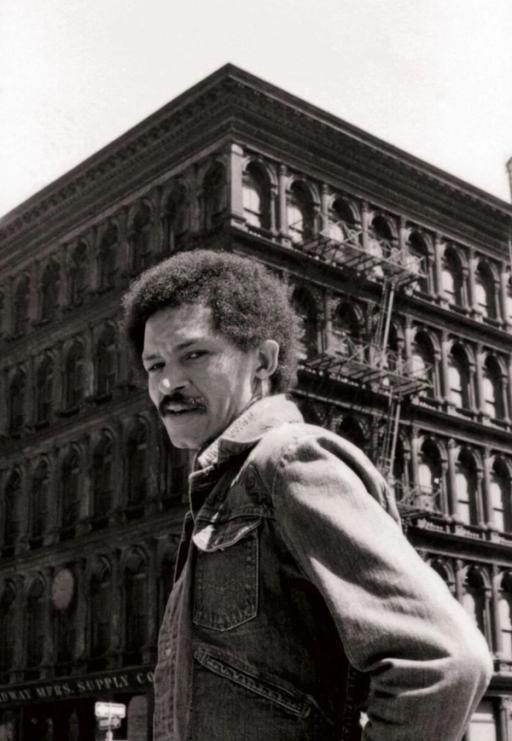
Jack Whitten
American, 1939–2018 9 works onlineThe artist Jack Whitten offered the world a new way to see. He worked throughout his prolific career to reimagine art and its relation to society. Their final objective is political in nature.
Learn more →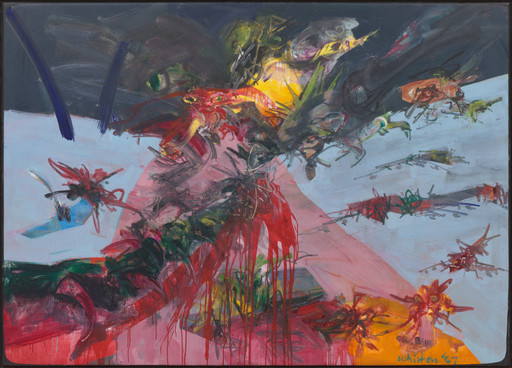

Articles and videos
From MoMA Design Store


Licensing
Artwork or archival images
If you would like to reproduce an image of a work of art in MoMA's collection, or an image of a MoMA publication or archival material (including installation views, checklists, and press releases), please contact Art Resource (publication in North America) or Scala Archives (publication in all other geographic locations).
Audio and film clips
MoMA licenses archival audio and select out of copyright film clips from our film collection. At this time, MoMA produced video cannot be licensed by MoMA/Scala. All requests to license archival audio or out of copyright film clips should be addressed to Scala Archives at [email protected]. Motion picture film stills cannot be licensed by MoMA/Scala. For access to motion picture film stills for research purposes, please contact the Film Study Center at [email protected]. For more information about film loans and our Circulating Film and Video Library, please visit Circulating Film and Video Library.
Text from a publication or the archives
If you would like to reproduce text from a MoMA publication, please email [email protected]. If you would like to publish text from MoMA's archival materials, please fill out this permission form and send to [email protected].
Feedback
This record is a work in progress. If you have additional information or spotted an error, please fill out this feedback form.