Begun in 1994 and completed in 2006, the Three Gorges Dam was built to curb flooding of China’s Yangtze River and provide hydroelectric power for a portion of the country’s population. But this massive public works project was also controversial, since it swamped more than 1,000 historical and archeological sites, inundated villages with water, and forced millions of people to relocate.
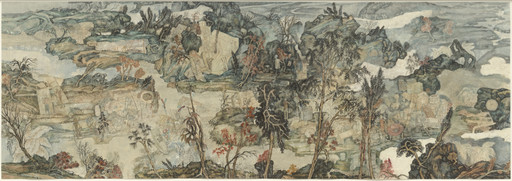
In Three Gorges Dam Migration, Chinese-born Yun-Fei Ji focuses on the people who were displaced by this epic construction project, who he calls “floating weeds,” using a term he adapted from an ancient Chinese phrase. He worked in the style of classical Chinese landscape painting and developed his narrative into a hand scroll measuring 10 feet long. But Ji subverted the traditional serenity of Chinese landscape painting with images chronicling the problems the dam brought with it. Among bamboo shoots and rocks, for example, he shows children impatiently pulling on their mothers’ shirts, a woman sleeping on the ground, and displaced families surrounded by bags filled with their belongings. He also incorporated fantastical imagery into his scenes, including a monstrous beast. At the ends of the scroll, Ji included calligraphy describing Chinese leaders’ longstanding wish to tame the Yangtze river.
Explore more
Migration and movement
People have always moved around the world. Early humans were nomadic, traveling in search of food, shelter, and safety. Today, people move for many different reasons, including economic, political, cultural, religious, and environmental.
Learn more →




From MoMA Design Store


Licensing
Artwork or archival images
If you would like to reproduce an image of a work of art in MoMA's collection, or an image of a MoMA publication or archival material (including installation views, checklists, and press releases), please contact Art Resource (publication in North America) or Scala Archives (publication in all other geographic locations).
Audio and film clips
MoMA licenses archival audio and select out of copyright film clips from our film collection. At this time, MoMA produced video cannot be licensed by MoMA/Scala. All requests to license archival audio or out of copyright film clips should be addressed to Scala Archives at [email protected]. Motion picture film stills cannot be licensed by MoMA/Scala. For access to motion picture film stills for research purposes, please contact the Film Study Center at [email protected]. For more information about film loans and our Circulating Film and Video Library, please visit Circulating Film and Video Library.
Text from a publication or the archives
If you would like to reproduce text from a MoMA publication, please email [email protected]. If you would like to publish text from MoMA's archival materials, please fill out this permission form and send to [email protected].
Feedback
This record is a work in progress. If you have additional information or spotted an error, please fill out this feedback form.