Not on view
Born in Aligarh, India, to a Muslim family, Zarina grew up aware of the political and religious struggles between her native country and neighboring Pakistan, a majority-Muslim state, which had gained its independence from the majority-Hindu India in 1947. She left Aligarh in her early twenties and lived in Bangkok, Delhi, Paris, Bonn, Tokyo, Los Angeles, and Santa Cruz before settling in New York in 1976. In Home Is a Foreign Place, she reflects upon her faraway childhood home. “This piece is my narrative of the house I was born in and left in my early twenties never to return,” she once explained.
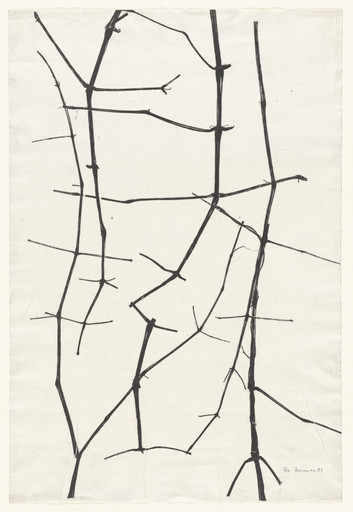
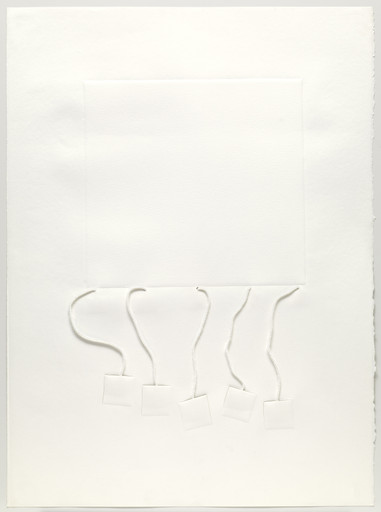
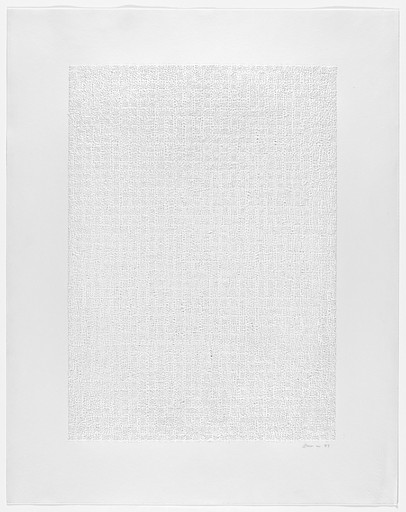
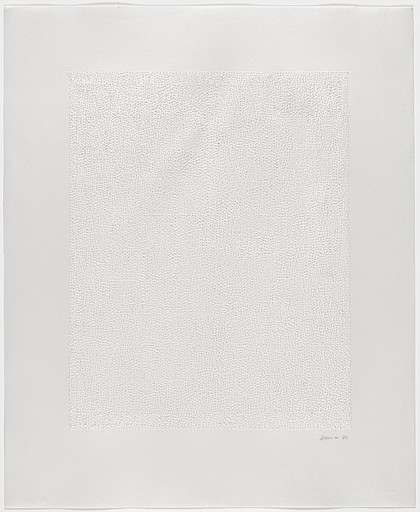
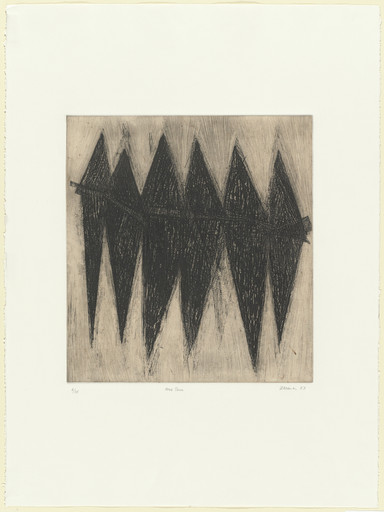
Home Is a Foreign Place consists of 36 woodblock prints, each of which features a geometric, monochromatic design. To make these images, Zarina wrote a list of words that she considered meaningful, such as “axis,” “distance,” “road,” and “wall.” She sent the list to a calligrapher in Pakistan, who wrote them in the traditional nastaliq script used for manuscripts in her native Urdu language. Back in her New York studio, Zarina developed what she has described as “idea-images, which flowed from these words.” The resulting images serve as a visual vocabulary expressing her feelings of home, memory, and loss. “I understood from a very early age that home is not necessarily a permanent place,” Zarina said. “It is an idea we carry with us wherever we go. We are our homes.”
Gallery label from Mind and Matter: Alternative Abstractions, 1940s to Now , May 5–August 16, 2010.
Zarina lived in Bangkok, Delhi, Paris, Bonn, Tokyo, Los Angeles, and Santa Cruz before settling in New York in 1976. Although she also works in sculpture and drawing, woodcuts have been of primary importance in her work over the last several decades. Each of the sheets in Home Is a Foreign Place bears an abstract image and a word printed in Urdu, the artist's mother tongue. The terms she chose, such as "threshold," "border," "country" and "door," paired with her minimal images, create a lexicon relating to the theme of home.
Mind and Matter: Alternative Abstractions, 1940s to Now, May 5–August 16, 2010.
Explore more
Migration and movement
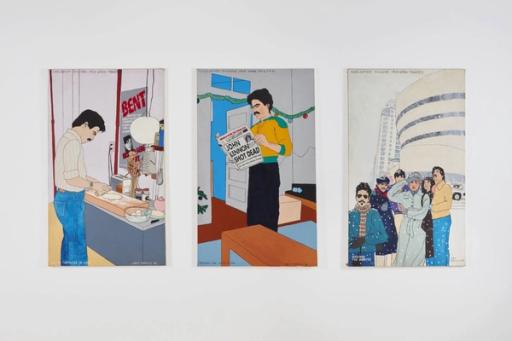
People have always moved around the world. Early humans were nomadic, traveling in search of food, shelter, and safety. Today, people move for many different reasons, including economic, political, cultural, religious, and environmental.
Learn more →

Audio
Audio from the playlist Kids
Audio from the playlist 1980–Today: Works from the Collection
Audio from the playlist Mind and Matter: Alternative Abstractions, 1940–Now
From MoMA Design Store


Installation views
We have identified this work in the following photos from our exhibition history.
Licensing
Artwork or archival images
If you would like to reproduce an image of a work of art in MoMA's collection, or an image of a MoMA publication or archival material (including installation views, checklists, and press releases), please contact Art Resource (publication in North America) or Scala Archives (publication in all other geographic locations).
Audio and film clips
MoMA licenses archival audio and select out of copyright film clips from our film collection. At this time, MoMA produced video cannot be licensed by MoMA/Scala. All requests to license archival audio or out of copyright film clips should be addressed to Scala Archives at [email protected]. Motion picture film stills cannot be licensed by MoMA/Scala. For access to motion picture film stills for research purposes, please contact the Film Study Center at [email protected]. For more information about film loans and our Circulating Film and Video Library, please visit Circulating Film and Video Library.
Text from a publication or the archives
If you would like to reproduce text from a MoMA publication, please email [email protected]. If you would like to publish text from MoMA's archival materials, please fill out this permission form and send to [email protected].
Feedback
This record is a work in progress. If you have additional information or spotted an error, please fill out this feedback form.