Grete Lihotzky
Frankfurt Kitchen from the Ginnheim-Höhenblick Housing Estate, Frankfurt am Main, Germany
1926-1927
Various materials
Not on view
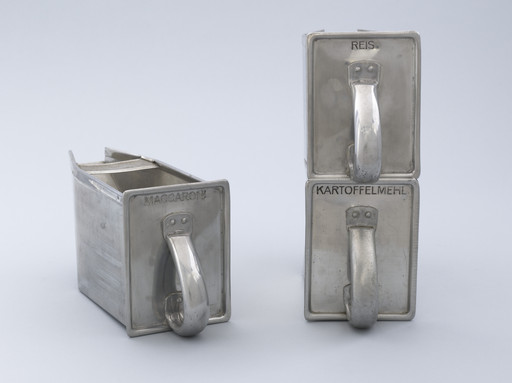
Many German cities faced a housing crisis in the 1920s, in the wake of World War I. Under the direction of chief city architect Ernst May, Frankfurt became a testing ground for modern architectural forms, new materials, and innovative construction methods. Lihotzky designed the Frankfurt Kitchen to ease domestic labor, applying scientific-management principles originally used in factories to promote efficiency, hygiene, and seamless workflow. It included a revolving stool, gas stove, built-in storage, and labeled aluminum bins for staples. Oak was used for flour containers to repel mealworms, and beech for cutting surfaces to resist stains. This iconic room, a hallmark within modern design history, introduced features that are considered standard in today’s kitchen.
Pirouette: Turning Points in Design, January 26, 2025–November 15, 2025
Publication excerpt from MoMA Highlights: 375 Works from The Museum of Modern Art, New York (New York: The Museum of Modern Art, 2019)
In the late 1920s, approximately ten thousand kitchens designed by Schütte-Lihotzky were at the core of a far-reaching program to modernize public housing and infrastructure in Frankfurt. Inflation and war had precipitated a housing crisis in all major German cities. Under the direction of chief city architect Ernst May, the so-called New Frankfurt became a testing ground for modern architectural forms, new materials, and innovative construction methods.
The Frankfurt Kitchen was designed like a laboratory or factory and in accordance with contemporary theories of efficiency, hygiene, and workflow. Schütte-Lihotzky’s primary goal was to reduce the burden of women’s labor in the home. In planning the design, she conducted detailed time-motion studies and interviews with housewives and women’s groups. Each kitchen came with a revolving stool, a gas stove, built-in storage, a foldaway ironing board, an adjustable ceiling light, and a removable garbage drawer. Labeled aluminum storage bins were provided for staples like sugar and rice, and they were designed with spouts for easy pouring. Careful thought was given to the choice of materials: oak was used for flour containers (to repel mealworms) and beech for cutting surfaces (to resist staining and knife marks). The result is one of modernism’s most famous cooking spaces.
MoMA Highlights: 375 Works from The Museum of Modern Art, New York (New York: The Museum of Modern Art, 2019)
Explore more






Audio
Audio from the playlist How Should We Live? Propositions for the Modern Interior
Articles and videos
From MoMA Design Store


Installation views
We have identified this work in the following photos from our exhibition history.
Licensing
Artwork or archival images
If you would like to reproduce an image of a work of art in MoMA's collection, or an image of a MoMA publication or archival material (including installation views, checklists, and press releases), please contact Art Resource (publication in North America) or Scala Archives (publication in all other geographic locations).
Audio and film clips
MoMA licenses archival audio and select out of copyright film clips from our film collection. At this time, MoMA produced video cannot be licensed by MoMA/Scala. All requests to license archival audio or out of copyright film clips should be addressed to Scala Archives at [email protected]. Motion picture film stills cannot be licensed by MoMA/Scala. For access to motion picture film stills for research purposes, please contact the Film Study Center at [email protected]. For more information about film loans and our Circulating Film and Video Library, please visit Circulating Film and Video Library.
Text from a publication or the archives
If you would like to reproduce text from a MoMA publication, please email [email protected]. If you would like to publish text from MoMA's archival materials, please fill out this permission form and send to [email protected].
Feedback
This record is a work in progress. If you have additional information or spotted an error, please fill out this feedback form.