Video (color, sound)
Not on view
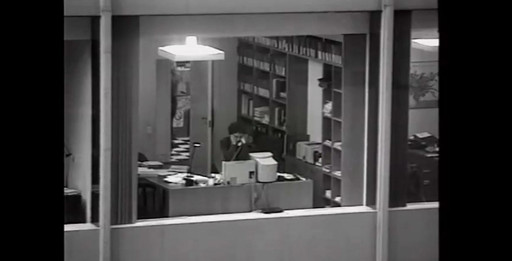
The MoMA Wall chronicles the removal of a wall fragment from one of the galleries at The Museum of Modern Art and its subsequent installation and "immolation" at the Whitney Museum of American Art, New York, on the occasion of a retrospective exhibition of the firm's work in 2003. The video follows the wall from its original setting in MoMA’s collection galleries, where it was once home to the enigmatic work 3 Standard Stoppages (1913–14) by Marcel Duchamp, an artist for whom Elizabeth Diller and Ricardo Scofidio have a long-held passion.
At the time of the wall’s extraction, while MoMA was undergoing renovation, the gallery was the home of the contractor’s office. The fragment—showing the original white color and the layers of paint built-up over the years—was grafted to a bigger network of white walls within the Whitney Museum in an installation called Mural, in which these walls were pierced randomly by a programmed drill running on track. When in front of the MoMA “aura,” the drill changed its logic and made its holes in the form of a regular, even grid, as can be seen in the fragment shown here. Bringing this video into MoMA’s collection adds a link to this chain of events and closes the circle.
Rough Cut: Design Takes a Sharp Edge, November 26, 2008–October 12, 2009.
Gallery label from 9 + 1 Ways of Being Political: 50 Years of Political Stances in Architecture and Urban Design , September 12, 2012–March 25, 2013.
This video chronicles the removal of a wall fragment from one of The Museum of Modern Art’s galleries and its subsequent installation and “immolation” on the fourth floor of The Whitney Museum of American Art in 2003, on the occasion of Scanning: The Aberrant Architectures of Diller + Scofidio, a retrospective exhibition of the firm’s work. The video follows the wall fragment from its original setting at MoMA, where it was home to the enigmatic work 3 Standard Stoppages (1913–14) by Marcel Duchamp, a perennial source of inspiration for Diller + Scofidio. The fragment itself was worthless, but its past interaction with a resonant work of art made it invaluable for the architects. Its appropriation and transformation—including the ritualistic perforation of its pristine surface—are the material of an installation that, in its incorporation of and inherent commentary on MoMA, is both related to the art practice of institutional critique and a provocative displacement of accepted architectural discourses and modes of expression.
9 + 1 Ways of Being Political: 50 Years of Political Stances in Architecture and Urban Design, September 12, 2012–March 25, 2013.
Explore more




From MoMA Design Store


Installation views
We have identified this work in the following photos from our exhibition history.
Licensing
Artwork or archival images
If you would like to reproduce an image of a work of art in MoMA's collection, or an image of a MoMA publication or archival material (including installation views, checklists, and press releases), please contact Art Resource (publication in North America) or Scala Archives (publication in all other geographic locations).
Audio and film clips
MoMA licenses archival audio and select out of copyright film clips from our film collection. At this time, MoMA produced video cannot be licensed by MoMA/Scala. All requests to license archival audio or out of copyright film clips should be addressed to Scala Archives at [email protected]. Motion picture film stills cannot be licensed by MoMA/Scala. For access to motion picture film stills for research purposes, please contact the Film Study Center at [email protected]. For more information about film loans and our Circulating Film and Video Library, please visit Circulating Film and Video Library.
Text from a publication or the archives
If you would like to reproduce text from a MoMA publication, please email [email protected]. If you would like to publish text from MoMA's archival materials, please fill out this permission form and send to [email protected].
Feedback
This record is a work in progress. If you have additional information or spotted an error, please fill out this feedback form.