Toyo Ito & Associates, Architects
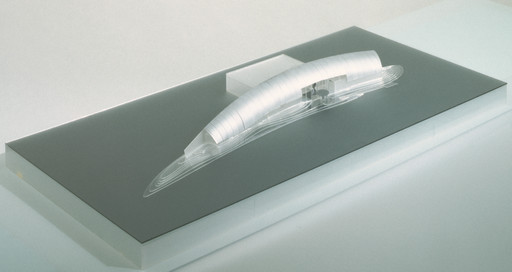
Mediatheque, Sendai, Miyagi Prefecture, Japan (Scale model 1:150)
1995–2001
Acrylic
Not on view
Ito's Sendai Mediatheque is a paradigmatic exploration of a new museum type. The Mediatheque gathers, preserves, exhibits, and presents media without being bound to a particular form. In his conception of the project, the architect imagined the viewer as an organism with two bodies: the tangible "primitive" body that seeks light and air and the "virtual" body that seeks information. This project marked a watershed in a growing discourse about architecture's relationship to the virtual.
The building consists of three elements: a series of weaving structural tubes, floor plates, and skin. It is conceived as a small piece cut out of an infinite structure, a gesture most evident in the lack of differentiation between the building’s cross section and its understated facade. This implies that the building is a visible part of an infinite fabric that oscillates between materiality and immateriality—between the primitive and the virtual. Inside, aluminum partitions fuzzily reflect the structural tubes, which also seem to extend infinitely. Media labs, interactive stations, digital displays, and countless other technological happenings are flexibly integrated into the space without disrupting the building’s versatility and its capability of adapting to new media and new ideas.
The Museum of Modern Art, MoMA Highlights since 1980, New York: The Museum of Modern Art, p. 197.
Explore more

From MoMA Design Store


Installation views
We have identified this work in the following photos from our exhibition history.
Licensing
Artwork or archival images
If you would like to reproduce an image of a work of art in MoMA's collection, or an image of a MoMA publication or archival material (including installation views, checklists, and press releases), please contact Art Resource (publication in North America) or Scala Archives (publication in all other geographic locations).
Audio and film clips
MoMA licenses archival audio and select out of copyright film clips from our film collection. At this time, MoMA produced video cannot be licensed by MoMA/Scala. All requests to license archival audio or out of copyright film clips should be addressed to Scala Archives at [email protected]. Motion picture film stills cannot be licensed by MoMA/Scala. For access to motion picture film stills for research purposes, please contact the Film Study Center at [email protected]. For more information about film loans and our Circulating Film and Video Library, please visit Circulating Film and Video Library.
Text from a publication or the archives
If you would like to reproduce text from a MoMA publication, please email [email protected]. If you would like to publish text from MoMA's archival materials, please fill out this permission form and send to [email protected].
Feedback
This record is a work in progress. If you have additional information or spotted an error, please fill out this feedback form.