Not on view
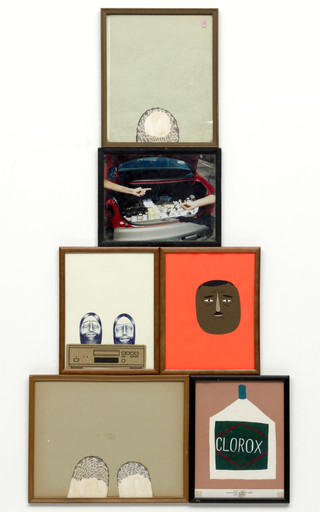
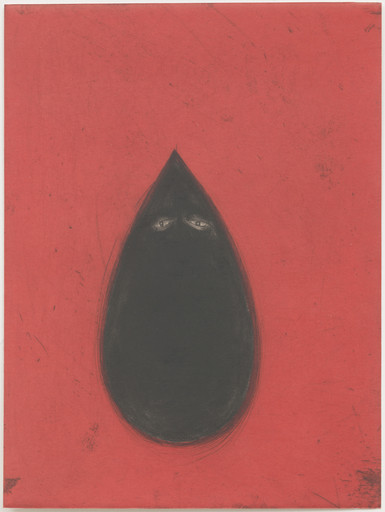
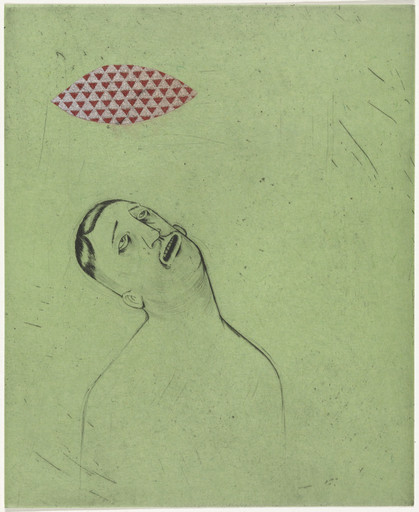
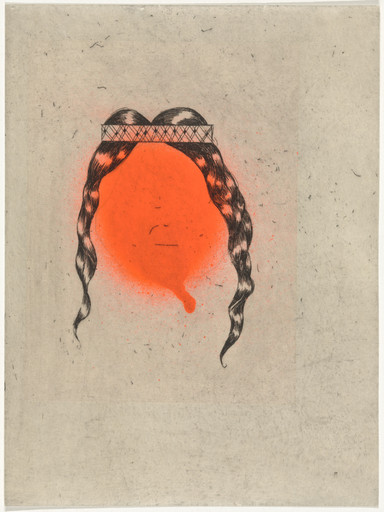
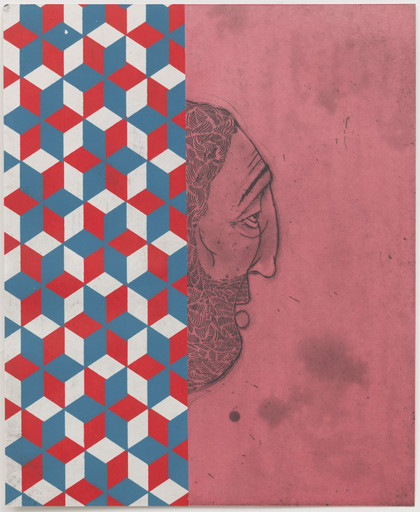
The ten prints in Drypoint on Acid are filled with the unusual characters, the sad sacks, and the down and out who are frequently the denizens of the world created by McGee. These figures evoke, among other things, the homeless or transient population of San Francisco, the city where McGee lives and works and where he got his start in the 1980s making graffiti under the moniker Twist. Since that time McGee has become a major figure in the bicoastal youth subculture that thrives on skateboarding, graffiti, surfing, punk rock, and other forms of street culture that exert increasing influence on the visual arts, music, fashion, and literature.
Contemporary urban culture provides the inspiration and the content for McGee's work. His installations often incorporate accumulations of found objects and detritus such as empty bottles, thrift-store picture frames, and discarded signs. He continues this practice in Drypoint on Acid by using collage elements from his vast collection of old industrial printed papers, which he embellishes with his own images of those who live on the margins of society. His prints combine a cartoon sensibility with an uncensored view of the harsh realities of urban life, resulting in sympathetic and evocative portraits of those left behind.
The Museum of Modern Art, MoMA Highlights since 1980, New York: The Museum of Modern Art, 2007 , p. 241 .
Explore more
Drypoint
An intaglio printmaking technique that creates sharp lines with fuzzy, velvety edges. A diamond-pointed needle is used to incise lines directly into a bare metal printing plate, displacing ridges of metal that adhere to the edges of the incised lines.
Learn more →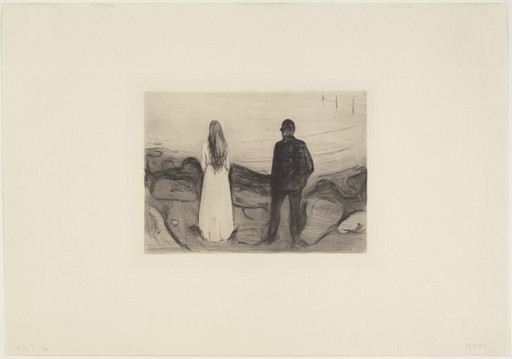
From MoMA Design Store


Licensing
Artwork or archival images
If you would like to reproduce an image of a work of art in MoMA's collection, or an image of a MoMA publication or archival material (including installation views, checklists, and press releases), please contact Art Resource (publication in North America) or Scala Archives (publication in all other geographic locations).
Audio and film clips
MoMA licenses archival audio and select out of copyright film clips from our film collection. At this time, MoMA produced video cannot be licensed by MoMA/Scala. All requests to license archival audio or out of copyright film clips should be addressed to Scala Archives at [email protected]. Motion picture film stills cannot be licensed by MoMA/Scala. For access to motion picture film stills for research purposes, please contact the Film Study Center at [email protected]. For more information about film loans and our Circulating Film and Video Library, please visit Circulating Film and Video Library.
Text from a publication or the archives
If you would like to reproduce text from a MoMA publication, please email [email protected]. If you would like to publish text from MoMA's archival materials, please fill out this permission form and send to [email protected].
Feedback
This record is a work in progress. If you have additional information or spotted an error, please fill out this feedback form.